There is a Romania that numbers cannot describe and that analyses, however rigorous, cannot fully capture. A Romania of ancient forests where light filters down through beech trees older than the modern states of Europe. A Romania of Carpathian ridges that rise in silence above the clouds, of villages where time has had the grace to slow down, of the Danube Delta — that labyrinth of waters, reeds and birds that resembles nothing else on the continent. A Romania where people invite you to their table before they ask who you are.
As of today, this Romania has its place in the pages of Atlas News Romania.
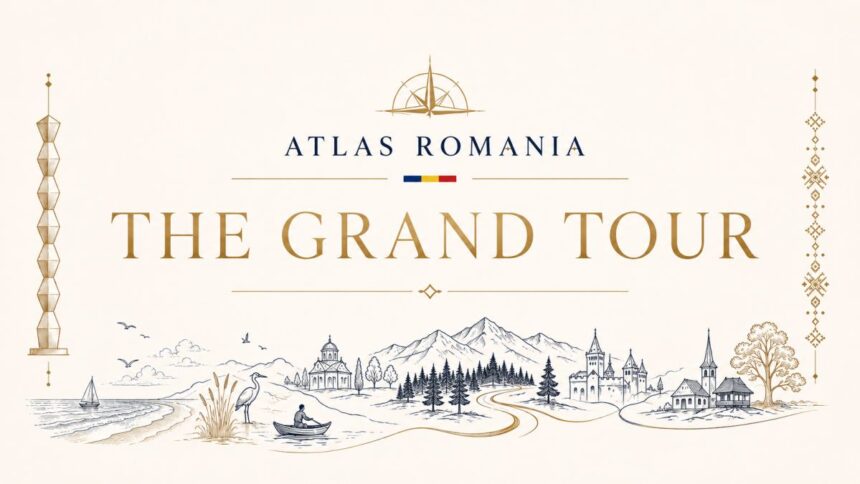
We are launching Atlas Romania The Grand Tour, a weekly editorial project with a simple aim — simple to state, yet demanding to fulfil: to show international audiences the very best of Romania. Not through a tourist catalogue, and not through hollow superlatives, but through authentic stories, real places and people of flesh and blood. Week after week, we will open a window onto a country that many know only from briefing files, strategic maps and news headlines — and that almost no one truly knows until they have seen it with their own eyes.
Why We Are Doing This
Atlas News Romania was founded with a mission embraced from its very first day: to promote Romania abroad, where our publication commands significant visibility. Our readers are ambassadors, diplomats, politicians, corporate executives and political analysts — people who know Romania through reports, statistics, briefings and negotiations. People who, more often than not, have seen Bucharest only in the corridor between the airport and a conference room, and for whom Romania remains a set of indicators: GDP, transport corridors, energy capacities, positioning on the eastern flank.

We owe them the other half of the story.
Because a country is not merely geopolitics. A country is also the scent of freshly cut hay on a July morning in Maramureș. It is the road that winds through the hills toward a Saxon citadel mentioned in no report. It is the old man who pulls his chair out to the gate in the evening, and who possesses something our world has lost — the time to sit and talk with a stranger. Our analyses will continue to explain strategic Romania. The Grand Tour will show the living Romania.
And there is one more reason, perhaps the most personal of all: we genuinely believe that Romania is extraordinary and deserves to be promoted at its true worth, everywhere in the world. Not out of ceremonial patriotism, but out of a conviction verified step by step, road by road, village by village. Those who have seen this country beyond the clichés know exactly what we mean. Those who have not yet seen it now have a guide.
Ancient Forests: Europe’s Green Cathedrals
We begin with what Romania perhaps holds most precious, and what is least known about it: its forests. Romania is home to some of Europe’s last virgin and ancient forests — ecosystems that have traversed the centuries untouched, in which nature operates according to its own laws, as it did long before mankind drew borders. The Carpathian beech forests, inscribed on the UNESCO World Heritage List, are green cathedrals where silence carries a particular weight. Here lives the largest population of brown bears in the European Union, alongside wolves, lynxes and deer — a wild Europe that the rest of the continent can now find only in documentaries.
For a reader from Brussels, London or Washington, accustomed to meticulously managed woodlands, an encounter with a virgin Romanian forest is an experience that is almost archaeological: this is what the entire continent once looked like. Romania has preserved what others have lost. And that is not nostalgia — it is a natural capital that very few countries still possess.
The Mountains: A Country’s Backbone
The Carpathians are not Europe’s tallest mountains, but they are among its most alive. They arc through the heart of the country like a backbone, and along their length unfold entire worlds: the Retezat, with its dozens of glacial lakes as clear as glass; the Făgăraș, with ridges that cut the sky and with the Transfăgărășan — the spectacular highway that climbs between cliffs and clouds, and which the international press has named, on more than one occasion, among the most beautiful roads in the world; the Rodna and Maramureș Mountains, austere and silent; the Western Carpathians, with their caves, gorges and villages scattered across the summits, where people still live today at altitudes where elsewhere you find only holiday chalets.
In the Carpathians you can walk an entire day without encountering a single soul. You can stand in silence on a peak for a full hour and hear nothing but the wind. In a world that has turned even nature into a queue, this luxury — space, stillness, chosen solitude — has become one of the rarest currencies in global tourism. Romania possesses it in abundance.
The Sea and Dobrogea: The Melancholy of a Different Kind of Coast
The Black Sea bears no resemblance to the Mediterranean, nor does it attempt to. It has a character all its own — northern, melancholic — with sunrises that emerge directly from the water, one of the few places in Europe where the sun rises from the sea. The Romanian coast knows how to be, simultaneously, wild and cosmopolitan — and it is precisely this dual nature that makes it extraordinary.
The most compelling testament to this renaissance is Mamaia Nord, the resort that has rewritten the standards of the Romanian Riviera in recent years. Built on the narrow strip of land between the sea and Lake Siutghiol, Mamaia Nord has become the destination where Romania reveals its modern face: new hotels and resorts meeting international standards, wide beaches with fine sand, elegant beach bars, terraces and restaurants that stand comparison with the finest European destinations. It is the place where one watches the sunrise with bare feet in the sand and coffee in hand, where the day is divided between sea and sunlounger, and where the evening extends naturally into music and life. For the international visitor accustomed to the Riviera or the Greek islands, Mamaia Nord is the Black Sea’s most welcome surprise: a young, dynamic resort in full ascent, demonstrating that the Romanian coast can compete, on its own terms, in the league of the continent’s premier holiday destinations.
A few kilometres to the north or south, the coastline shifts its register entirely — and therein lies its charm. The wild beaches of Vadu and Corbu, where untouched sand stretches for unbroken kilometres; Vama Veche, whose bohemian spirit has become the stuff of legend; fishing villages where time is measured in nets, not hours. Few European coastlines offer, within so short a distance, so many entirely different worlds.
And behind the coast opens Dobrogea — Romania’s oldest land, a steppe scattered with Greek and Roman citadels, with monasteries carved into chalk, with vineyards that have undergone a spectacular revival over the past decade. Histria, the oldest attested urban settlement on Romanian territory, reveals its stones a few steps from lagoons teeming with birds. Few regions in Europe concentrate so much history within so few square kilometres and remain, even so, so little known.
The Danube Delta: The Masterpiece
About the Danube Delta, perhaps the right thing is to write nothing at all — and simply say: go. The best-preserved of Europe’s great deltas, a biosphere reserve, a labyrinth of channels, lakes, sandbanks and floating forests in which more than 300 species of birds make their home. Pelicans rising in white flocks above the water, entire colonies of cormorants, egrets, swans and white-tailed eagles. Villages such as Letea, Mila 23 and Sfântu Gheorghe, reachable only by water, where fish is prepared as it was a century ago and where Lipovan hospitality is an institution in its own right.
The Delta is not a destination. It is a world. A world that moves to the rhythm of the water and imposes its own tempo upon the traveller — slower, more attentive, closer to what is essential. Those who have watched a sunrise on a Delta channel, in the silence broken only by birdsong, understand why this place is not narrated. It is lived.
Transylvania, Bukovina, Maramureș: Where the Stories Are True
There is then the cultural Romania — the one of overlapping worlds. Transylvania, with its Saxon fortresses and UNESCO-listed fortified churches, with Sighișoara — one of the few inhabited medieval citadels in Europe — with Brașov, Sibiu and Cluj, cities that weave history together with an urban energy increasingly visible on the continental map. And with the hills surrounding villages such as Viscri or Biertan, where even King Charles III of the United Kingdom has found, for many years now, a place close to his heart — and where the cultural landscape has remained, as rarely happens, whole and unbroken.
Bukovina, with its painted monasteries — Voroneț, Sucevița, Moldovița — whose exterior frescoes have withstood five centuries of rain, frost and history, preserving a blue that bears the name of the place itself: Voroneț blue. Maramureș, with its wooden churches whose slender spires seem to stitch the sky to the earth, with its carved gates, with the Merry Cemetery of Săpânța — perhaps the only place in the world where death is regarded with humour and serenity — and with people who wear traditional dress not for the tourists, but because that is how one dresses on a Sunday.
These are not stage sets. They are living worlds, in which local legends are interwoven with real biographies, and The Grand Tour will seek out both.
The People: Romania’s Strongest Argument
Every traveller who has journeyed through Romania ultimately says the same thing: the landscapes are extraordinary, but it is the people who stay with you. Romanian hospitality is not an agency slogan — it is a cultural reflex. Here, a guest is an honour, not a transaction. The host who will not let you leave without tasting something, the farmer who sets aside his work to point you in the right direction and ends up inviting you into his yard, the elderly woman who recounts the history of the village as though it happened yesterday — these encounters cannot be scheduled and cannot be purchased. They simply happen, with a naturalness that disarms those accustomed to standardised tourism.
The Grand Tour will write about these people. About the craftsmen who still know wood, about the shepherds who still drive their flocks to the mountain pastures, about the Delta fishermen, about the monastery monks, about the young entrepreneurs who chose to stay or to return home and build — guesthouses, wineries, workshops, businesses that keep the villages alive. They are, at the end of the day, the country’s most powerful argument. Because destinations are visited, but people are remembered.
Stillness and Safety: The Quiet Privilege
There is something else that is said too rarely about Romania, and that our readership — accustomed to assessing risk — will appreciate at its proper value: Romania is a quiet and safe country. Its cities can be walked at night without concern. Its villages sleep, quite literally, with their gates unlocked. In an increasingly tense Europe and an increasingly loud and unpredictable world, this is not a footnote. It is a privilege — a quiet one, noticed only when compared with what one has left behind.
Romanian stillness is not merely the absence of danger. It is also a quality of space: places where no one rushes you, where you do not queue to see a landscape, where you can still be alone with a mountain, a sea, a forest. The world of travel is only now rediscovering the value of this. Romania never lost it.
A Country That Deserves a Chance
We harbour no illusions, and we sell none. Romania is not perfect, nor does it need to be. It has roads that leave something to be desired, uneven tourism infrastructure, services that vary from place to place, things that need to be put right — and we will say so openly, because honesty is the only currency we accept, in analysis as in travel. But imperfection has never stripped this country of its beauty. On the contrary: precisely because it has not been standardised, Romania remains one of Europe’s last truly authentic destinations — one that has not been transformed into a backdrop for identical photographs. Here, authenticity is not a marketing concept. It is the natural state of things.
All we ask for Romania is a chance. The chance to be seen with one’s own eyes, not merely read about in reports. The chance to be chosen as a holiday destination by those who have already travelled the world and are searching for something they have never experienced. The chance to be judged by what it offers, not by what is said about it.
What Comes Next
From this point forward, Atlas Romania The Grand Tour will publish weekly features on dream destinations and storied places. Each episode will be an invitation: a place, its stories, its people, its legends and the reasons it is worth the journey. We will travel from the Delta to the Western Carpathians, from the monasteries of Bukovina to the wild beaches of Dobrogea, from the squares of Transylvanian cities to the hamlets at the end of mountain roads. No ready-made itineraries, no empty superlatives, no cardboard Romania. Only the real Romania — which is, we firmly believe, more beautiful than any advertisement.
And if, at the end of these weekly journeys, a single reader books a flight to Bucharest, climbs a mountain, spends a night in a Transylvanian village, or watches the sunrise over the Delta — and then tells their friends what they have discovered — then our mission will have achieved one of its objectives.
Atlas Romania The Grand Tour begins now. Romania is waiting for you. And, believe us, it knows how to wait beautifully — as only those places that are certain of their own worth know how to do.