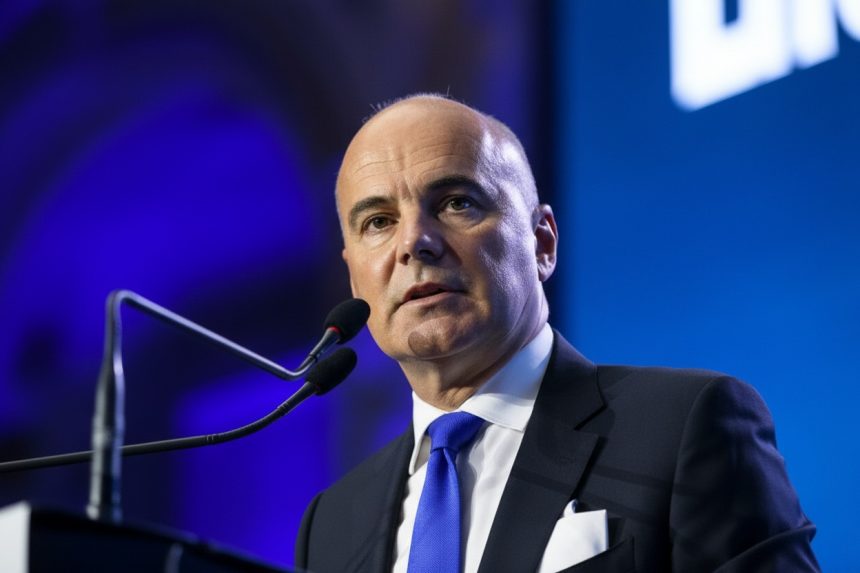
MEP Rareș Bogdan published an extensive post with strong geopolitical and economic overtones, warning that Romania risks missing, once again, a major strategic window at a time when the global economic order is being rapidly reshaped.
The message, published on Facebook, comes against the backdrop of a tactical rapprochement between the United States and China on several trade and security files, but also amid increasingly intense competition for resources, strategic infrastructure and influence across wider Europe. The tone is, at times, forceful and critical, but the central stake raised by the MEP is highly concrete: who will benefit from the new wave of capital, and who will remain, once again, a mere spectator.
Rareș Bogdan argues that Romania has “huge” potential on the European geopolitical and economic stage, but remains trapped by “petty, provincial, irrelevant stakes” and by the absence of a coherent strategic vision.
“The Black Sea is not a Russian lake, but an opportunity we must understand,” the MEP states, insisting that the country’s geographic position can become a major economic and strategic advantage if it is used intelligently.

Black Sea, energy and investments
At the heart of his message is the idea that Romania could become a first-tier regional actor in sectors such as energy, agriculture, mining, rare metals and the defence industry.
Rareș Bogdan speaks of an “avalanche of opportunities” generated by the new international geopolitical and economic configuration and stresses that investors, whether Romanian or foreign, seek one thing above all: predictability. Without it, he says, no speech about potential can be turned into contracts and jobs.
“China will enter Europe even more, the United States is preparing massive investments here and in Greece,” the MEP writes, suggesting that the Black Sea region and South-Eastern Europe will gain increasing weight in global economic competition.
At the same time, the MEP criticises what he describes as the inability of Romania’s political elites to turn the country’s strategic advantages into a coherent economic and geopolitical project.
“This planet has several major supply problems, and we hold two or three of the keys that we are unable to put into the lock,” he says. It is perhaps the sharpest image in the entire post: that of a country holding solutions in its hand, yet not knowing how to open the door.
Sharp criticism of the political class
The tone becomes significantly harsher in the section devoted to public administration and political decisions made over the past decades. The MEP speaks openly of “stupidity”, “servility” and “lack of courage”, invoking a series of missed historical opportunities and accusing Romania of perpetuating the logic of a “Balkan political boudoir”.
Bogdan also rejects the constant reflex of shifting responsibility onto external actors.
“The truth we refuse to acknowledge is that the fault is ours,” he writes, in a passage that dismantles simplistic explanations related to the influence of Brussels, Russia, China or other European capitals. In essence, it is a call for political maturity, rarely formulated so directly in Romania’s public space.
The message also includes an implicit criticism of the way Romania’s strategic resources and economic assets have been managed since 1990.
“When they did, nevertheless, show a little courage, decision-makers sold entire sectors at miserable prices for the country, but profitable ones for themselves,” the MEP states.
Romania between strategic potential and administrative deadlock
One of the central ideas of the post is that Romania finds itself in a rare moment of strategic opportunity, but risks failing to capitalise on it.
Rareș Bogdan says that, following his visits to New York, Washington, Toronto, Paris, London, Rome, Abu Dhabi and Riyadh, he has seen that Romania is perceived abroad as a country with considerable potential, both as an investment destination and as a security provider.
“I have seen how Romania is on the list of countries with huge potential,” he argues. The gap between how Romania is viewed from the outside and how it views itself from within becomes, in the MEP’s text, one of the most pressing themes.
In his view, the main problem is not the lack of resources, but the inability to build a long-term vision.
“We stand at the door instead of building a door ourselves,” Rareș Bogdan writes, in one of the most memorable formulations of the post.
A message with political and economic stakes
The post can also be read as a political message, at a time when Romania is intensely debating its economic direction, strategic investments, regional positioning and the future of governance.
The emphasis placed on predictability, investment, strategic infrastructure, the Black Sea and the defence industry confirms an increasingly visible trend: geopolitical and economic files are overlapping in domestic political discourse, while the lines between foreign policy and economic policy are becoming increasingly blurred.
At the same time, the MEP’s message points to an attempt to reposition the public debate toward issues of economic strategy and regional role, in an international context in which NATO’s Eastern Flank, energy corridors and European economic security are gaining growing importance. It remains to be seen to what extent this call for strategic vision will also produce concrete political effects.
The full text of the post:
“Courage and vision, or lamentation and ignorance? Romania can be huge in the regional geopolitical game and on the European, even global, economic stage. But it must move beyond petty, provincial, irrelevant stakes. The Black Sea is not a Russian lake, but an opportunity we must understand. If we do that, we will bring a great deal of money here, to our home.
The global economic stage is constantly changing. The US-China meeting is an important step, even though, beyond the new trade agreements announced but not detailed, and the news about a three-year vision, we do not yet have certain data. China will enter Europe even more, the United States is preparing massive investments here and in Greece. What, however, is Romania doing? Romanian and foreign investors need only one thing: PREDICTABILITY. What are we doing amid this avalanche of opportunities generated by our geostrategic position and by the resources given to us by God at the creation of the world? Will we choose a prime minister who understands the economy and, above all, the role of investment and international economic relations in Romania’s immediate and long-term future? Or will we remain captive to petty games of Balkan political boudoir, in which ‘I’ll take my toys and leave’ becomes a registered trademark and shows a lack of understanding of the world in which we are navigating?
This year I have been to New York, Washington, Toronto, Paris, London, Rome, Abu Dhabi, Riyadh, and I am more often in Europe’s capital, Brussels, than in Bucharest. I have seen how Romania is on the list of countries with huge potential, but which risks once again missing the chance to position itself both as an investment El Dorado and as a security provider and major-calibre player in areas such as energy, agriculture, rare metals, mining and strategic weapons production. This planet has several major supply problems, and we hold two or three of the keys that we are unable to put into the lock. We stand dazed in front of the gate and wonder.
I ask myself whether this is stupidity, ignorance or hidden interests. It is almost incomprehensible to me how, for 35 years, we have managed only to contemplate windows of opportunity instead of exploiting them. Certainly, the fault is ours. However much we lament that it is the fault of ‘foreigners’, of ‘Brussels’, of the Russians, the Chinese, the Hungarians, or the French and Germans together, the truth we refuse to acknowledge is that the fault belongs to us, or to those who led governments and ministries and who missed, one after another, chance after chance. Out of convenience, fear, servility, lack of courage or simply STUPIDITY. And when they did, nevertheless, show a little courage, decision-makers sold entire sectors at miserable prices for the country, but profitable ones for themselves.
We prefer to behave like provincials who do not understand that our Romania can once again be GREAT in the European geopolitical and economic game, and beyond. We stand at the door instead of building a door ourselves. We have carpenters, we have the material, but we have too many site supervisors who do not know which of them is more in charge.
Vision means, in major politics and in economic policy, having discernment. Thinking big. Not looking at Romania as a basin with two hysterical ducks rowing inside it. Or as a henhouse from which, periodically, you make a good soup for the whole street to eat. Because there will be streets tomorrow as well. Children will grow up and, in turn, have children of their own. And you will remain with the same five hens for which you receive a subsidy.
Vision is not the micromanagement with which Romania is content. Vision means thinking big in order to make something big. Otherwise, you limit yourself to administering your poverty, on which you place two sequins and say they are sapphires. The sapphires, in our case, are in the ground, on the ground, at the sea, in the mountains; they are everywhere. They are, above all, the people who are only waiting to show what they can do. But does anyone ask them as well, or do they periodically fall victim to the algorithm?”
Read also
MEP Rareș Bogdan on Europe Day: “The Lioness Europe Has Awakened”