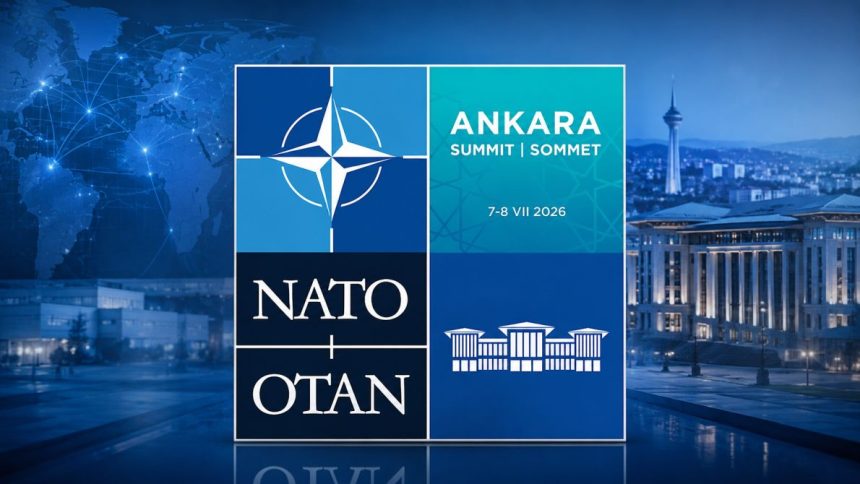
The NATO Summit in Ankara, scheduled for 7–8 July 2026 at the Beștepe Presidential Compound (NATO), risks being reduced in the public debate to a single figure: the allies’ commitment to allocate 5% of GDP to defence. This reduction is a strategic misreading. The real stake of the summit is not budgetary, but geographical. Ankara forces the Alliance to look at its own map from an angle it has treated as secondary for two decades: routes, straits, ports, critical infrastructure, the Black Sea, the southern flank, the Caucasus, the Eastern Mediterranean and the Middle East. After years in which NATO summits have been read mainly through the language of political unity and budgetary commitments, Ankara forces the Alliance to see its real geography more clearly.
Ankara changes the angle from which NATO reads its own map
Turkey’s selection as host can be read, from a strategic perspective, as more than a protocol detail. A summit in Madrid, Vilnius or The Hague speaks of political cohesion and transatlantic solidarity. A summit in Ankara speaks of geography. Turkey is the state that physically connects four strategic theatres at the same time: the Black Sea to the north, the Eastern Mediterranean to the south, the Caucasus to the east and the Middle East to the south-east. Few allies occupy a comparable position of articulation.
This position transforms Turkey from a presumed southern periphery of the Alliance into a technical room of Euro-Atlantic security, but one that operates according to the logic of its own strategic autonomy. The decisions taken in Ankara — or not taken — have direct consequences for the way NATO can project force, control naval access and support the eastern flank. To treat Turkey as a margin of the map is to misread the map. The NATO Summit in Ankara forces precisely this reconfiguration of perspective: from an alliance defined by procedures and declarations towards an alliance defined by routes, infrastructure and access control.
Turkey, the ally without which the Black Sea remains incomplete
No serious discussion about Black Sea security can avoid a fundamental legal and geographical fact: naval access between the Black Sea and the Mediterranean passes through the Bosphorus and the Dardanelles, two straits under Turkish sovereignty. This control is not informal. It is enshrined in the Montreux Convention, which gives Ankara a special legal and strategic role over naval transit in times of peace and conflict (The Washington Institute).

After the invasion of Ukraine, Turkey applied the framework of the Montreux Convention to restrict the passage of military vessels belonging to belligerent states, with the exceptions provided by the convention, thereby limiting Russia’s ability to reinforce its naval presence in the Black Sea from outside. This move showed that Ankara possesses a strategic instrument that no other member of the Alliance can replicate. Turkey’s policy in the region combines this legal leverage with a strategic autonomy that Ankara deliberately cultivates, maintaining a calculated balance between allied commitment and its own national interests (SWP Berlin).
This autonomy makes Turkey an uncomfortable, but indispensable, ally. Recently, Ankara issued a direct warning to Moscow to avoid actions that threaten regional security and Turkish interests in the Black Sea (Reuters). From this perspective, without Turkey, the naval dimension of Black Sea security remains incomplete, regardless of how many declarations of solidarity the Alliance adopts. The Black Sea cannot be defended through communiqués. It can only be defended through access control, real capabilities, infrastructure, air defence and allied coordination.
Budgets are not enough unless they become infrastructure, ammunition and mobility
At the summit in The Hague, the allies established an unprecedented commitment: 5% of GDP for defence and security by 2035, structured into two components — 3.5% for core defence expenditure and 1.5% for security, infrastructure, resilience and defence industrial capacity (NATO). This commitment is linked to annual plans and NATO Capability Targets, designed to translate figures into concrete capabilities (NATO).
Here lies a distinction that the Ankara summit makes unavoidable. Percentages of GDP defend nothing by themselves. They do not guard ports, protect air bases, secure pipelines, defend submarine cables or hold borders. A defence budget becomes real deterrence only when it is transformed into stored ammunition, military mobility infrastructure, industrial production capacity and resilience of critical networks.
The strategic reading is the following: NATO can no longer function exclusively as an alliance of values and procedures. It must function as an alliance of routes, straits, ports, infrastructure and defence industry. And the 1.5% component dedicated to infrastructure and resilience is not an annex to the 3.5%, but the very bridge that connects money to geography. Without it, percentages remain accounting abstractions.
America asks Europe for responsibility, but NATO remains dependent on American capabilities
The summit’s context is marked by increasingly explicit American pressure on European allies. The United States has announced a six-month review of the American military presence in Europe, accompanied by criticism of some allies deemed insufficiently committed (Reuters). The underlying message is a demand for responsibility: Europe must assume a larger share of the burden of its own defence.
This pressure should not, however, be read as an American withdrawal from Europe or as a signal that the United States is abandoning the continent. For Atlas News Romania, the stake is different: the review functions as a test of European strategic maturity. Europe is being called upon to demonstrate that it can transform budgetary commitments into real capabilities, without assuming that the American umbrella is permanent and unconditional.
Yet the paradox remains visible. The Atlantic Council warned, in a recent analysis, that NATO deterrence in the air domain remains heavily dependent on American enabling capabilities. The demand for European autonomy and the real dependence on the United States coexist, and the summit in Ankara will not resolve this tension. It will expose it.
Ankara will also test the internal discipline of the allies
The NATO Summit in Ankara will test not only the Alliance’s strategic geography and military capacity, but also the internal political discipline of member states. Here, the Czech case becomes an instructive example — secondary in weight, but revealing in significance.
The Czech government decided not to include President Petr Pavel in the country’s delegation to the NATO Summit in Ankara (Atlas News România). The decision is sensitive precisely because Pavel is not an ordinary president when it comes to security: he is a former general and former chair of the NATO Military Committee (Reuters). Following his exclusion, Pavel appealed to the Constitutional Court (Reuters).
The strategic reading is the following: Ankara will test not only NATO’s military capacity, but also the internal political discipline of the allies. The Czech case shows that some states arrive at the summit not only with budgetary shortfalls, but also with institutional disputes over who speaks in the name of national security. A state that cannot harmonise its position between president and government arrives at the Alliance table with a political vulnerability before it even begins discussing military vulnerabilities. Percentages of GDP do not become credible deterrence if the state itself cannot formulate a unified strategic line. For flank states, including Romania, the lesson is evident: the national position at a NATO summit cannot be improvised between institutions locked in political competition.
Romania must read Ankara through the Black Sea, not through diplomatic protocol
For Romania, the summit in Ankara has direct relevance that cannot be exhausted by protocol readings. The Alliance’s eastern flank cannot be understood without the naval dimension of the Black Sea, and this dimension cannot be conceived without Turkey’s role. Romania and Turkey are, geographically, two pillars of the same maritime basin, regardless of differences in political positioning.
Romania’s strategic interest is for NATO to treat the Black Sea as a strategic theatre in its own right, not as a mere annex to the war in Ukraine. As long as Black Sea security is discussed exclusively through the lens of Ukraine, it remains dependent on the evolution of a single conflict. Treated instead as an autonomous theatre, the Black Sea acquires its own defence logic — ports, trade routes, energy infrastructure, submarine cables, freedom of navigation. Here, the correct reading of Ankara is not a diplomatic option, but a national security necessity.
Romania therefore has every interest in the Ankara summit enshrining the Black Sea as a distinct strategic space, while integrating Turkey’s role into the defence architecture of the eastern flank. To view Ankara through diplomatic protocol means missing exactly what matters. To view it through the Black Sea means understanding the real stake.
Anyone who wants security in the Black Sea must understand Ankara. Not as an uncomfortable ally, but as a strategic reality.
Read also