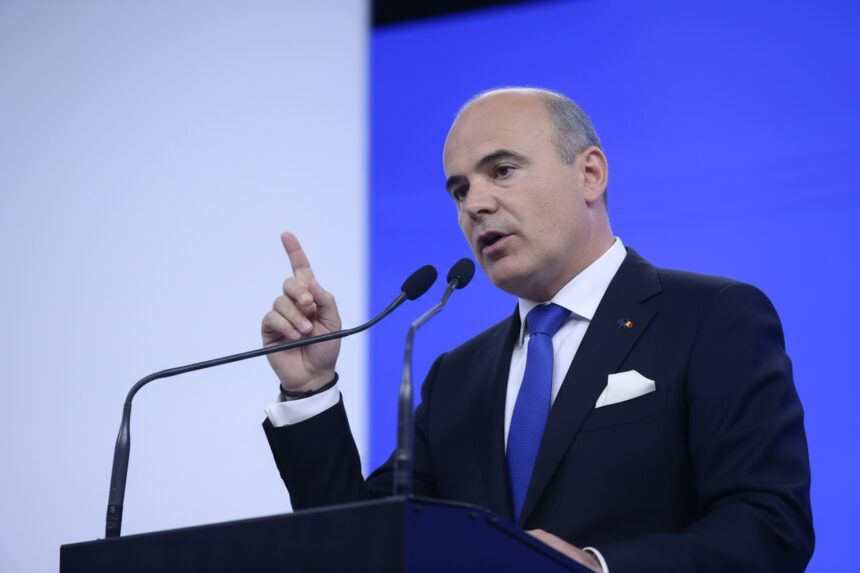
Member of the European Parliament Rareș Bogdan warns that economic pressures, public debt servicing costs and social discontent risk triggering a political and institutional crisis in the European Union. In a post criticising European leaders’ decisions, he calls for the protection of strategic industries, stronger relations with the United States and a renewed focus on citizens’ prosperity in European policymaking.
“Disaster is coming! The EU must reset itself. Or it will disappear,” Bogdan writes, describing the European project in terms of reconciliation between peoples that had fought one another for centuries and the opportunities it has created for younger generations.
His warning concerns the prospect of a prolonged economic deterioration, with consequences for public confidence in institutions and established political parties.
“We are on the brink of a tsunami, but I do not have a banking crash in mind. Rather, a profound decline in material prosperity, with a political price to pay.”
Deficits and Debt Servicing Costs at the Heart of the Warning
Bogdan builds his argument around European governments’ borrowing costs. In his assessment, more expensive financing is putting pressure on budgets already strained by the pandemic, the energy crisis, the green transition and rising defence expenditure.
“The more indebted or politically unstable a country is (does that sound familiar?), the higher the interest rates investors demand to buy its bonds,” the MEP explains.
He argues that reducing deficits becomes increasingly difficult politically when the measures adopted affect household incomes, pensions or public services. In Romania’s case, he criticises the management of fiscal imbalances and warns of the country’s vulnerability as financing becomes more expensive.
The scenario he describes is one of gradual erosion of prosperity, rather than a sudden financial collapse, with the potential to reshape voting behaviour profoundly.
“Not a collapse like the one in 2008, but a quagmire, a slow deterioration. With a political price to pay,” Bogdan writes.
At the same time, the MEP acknowledges the European Central Bank’s capacity to intervene in a crisis, while warning of the costs: “Let us be clear: the ECB has the tools to prevent the collapse of the euro area. But the price will be colossal.”
Protecting Industry and Strengthening Relations with the United States
A substantial part of the post addresses Europe’s strategic choices. Bogdan criticises European leaders over dependence on Russian energy, insufficient protection of industrial production and their handling of transatlantic relations.
In his view, the partnership with Washington must be strengthened regardless of who holds the US presidency. The MEP argues that weakening this relationship serves Russian and Chinese interests.
“I anticipated this and called for a stronger EU–US partnership, regardless of who the American president might be, rather than for its undermining! Because that is precisely what Russia and China are seeking.”
On economic policy, Bogdan advocates more decisive action in support of strategic sectors and a reassessment of how Europe protects its producers against external competition.
“At this eleventh hour, we must defend our strategic industries, as the Americans are already doing through the IRA or tariffs on Chinese cars,” he argues.
For Romania, the MEP identifies natural gas resources and the Neptun Deep project as opportunities to strengthen the country’s regional energy position.
Social Discontent and the Break with Established Parties
The post also criticises migration policies and the costs of the green transition. Bogdan argues that concerns about integration, jobs and living standards have too often been dismissed through political labelling.
“The gravest mistake was the refusal to listen. Anyone who raised a legitimate question about the impact of migration, the costs of the green transition and job losses was automatically branded an extremist,” the MEP states.
In his assessment, deteriorating material conditions can turn dissatisfaction with governments into a challenge to the European project itself. The rise of anti-establishment parties would therefore also reflect declining confidence in the promise of prosperity.
“The tsunami will not be financial or banking-related, but political and institutional. Yet the fuse is the economy. When the middle class feels that its future is being stolen, it reacts.”
Bogdan warns that this electoral shift could directly undermine the Union’s ability to build agreement among its member states.
“With political forces hostile to the European system, consensus on the budget, defence and foreign policy will disappear. The decision-making process will grind to a halt. The EU will become a powerless bureaucratic shell,” he argues.
Despite its alarmed tone, the message concludes with an appeal to preserve and reform the European Union. The MEP believes the project can be saved by correcting the decisions he criticises and restoring the link between European integration and citizens’ prosperity.
“Can it still be saved? Yes. Is it worth saving? YES! It is our home!”
Read also