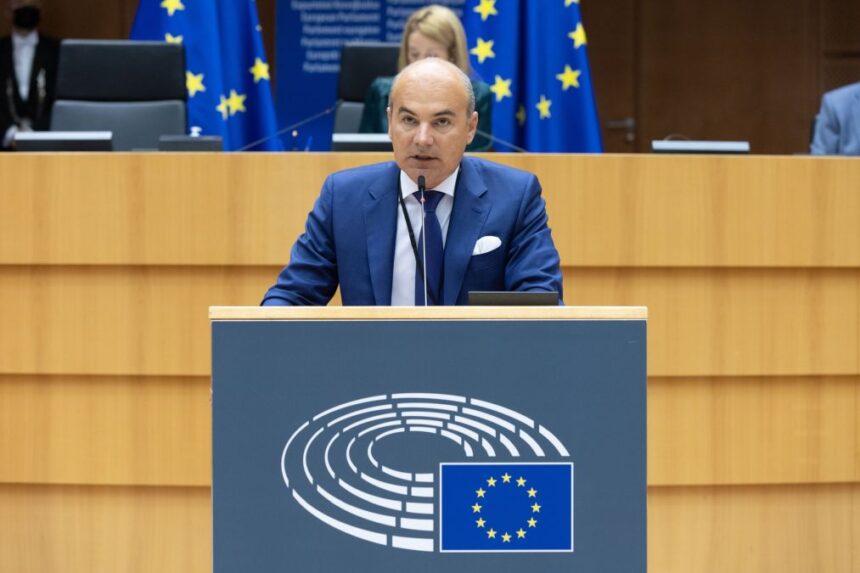
Romanian MEP Rareș Bogdan, a member of the National Liberal Party (PNL), has issued a stark warning about the future of Europe’s traditional political parties, accusing them of losing touch with voters and becoming increasingly incapable of responding to economic and social change. In an extensive political assessment, he examines the decline of established parties in Germany, France, Greece, Italy, the Netherlands and Austria, arguing that political complacency, the mishandling of successive crises and an unwillingness to acknowledge past mistakes have contributed to the rise of anti-establishment forces.
“Traditional parties, the established parties, the mainstream parties, are collapsing across Europe. They have become completely disconnected from the people, turned their backs on citizens and no longer represent their communities,” Rareș Bogdan states.
The Romanian MEP continues his criticism in unusually uncompromising terms, directing his remarks at political organisations that have long dominated European politics.
“They have become deaf to the people, when they are not treating them with contempt. They pursue politics for their own benefit. They no longer understand social and economic realities.”

To illustrate the growing divide between political parties and society, Bogdan offers a striking analogy: “European politics is a showroom of household appliances.”
He develops the comparison through the image of a robotic vacuum cleaner following a predetermined route through an empty room, repeatedly colliding with the same obstacles. In his view, traditional political parties have come to operate in much the same way, continuing along established paths without responding to voters’ concerns.
“They thought they would last forever. Complacency. Arrogance. They believed that their historical prestige, party machinery and local organisational networks were guarantees of survival,” the MEP argues.
While acknowledging the importance of local party structures in electoral competition, Bogdan warns that organisational strength cannot compensate for a loss of credibility.
“Local party networks are the lifeblood of elections, but you cannot convince people that concrete is poured from the bottom up. People can see reality for themselves.”
Germany: The Rise of the AfD and the Decline of the Established Parties
Rareș Bogdan devotes considerable attention to Germany, where the Christian Democratic Union and its Bavarian sister party, the Christian Social Union (CDU/CSU), together with the Social Democratic Party (SPD), have dominated federal politics for decades.
In his assessment, successive coalition governments have blurred the distinctions perceived by voters between these two major political forces, creating political space for the rise of Alternative for Germany (AfD).
“Voters could no longer distinguish a genuine alternative between the two,” the MEP argues, referring to the CDU/CSU and SPD.
He identifies three major strategic mistakes: the ideological convergence of Christian Democrats and Social Democrats during Angela Merkel’s chancellorship, the management of the 2015 migration crisis, and an energy policy that combined the phase-out of nuclear power with continued dependence on Russian natural gas.
Bogdan is particularly critical of the German authorities’ response to the pressures experienced by local communities following the migration crisis.
“The refusal to publicly acknowledge the logistical, financial and security pressures — on schools, housing and local budgets — severed Berlin’s connection with municipalities and citizens.”
His assessment of Germany’s energy policy is equally forceful.
“Phasing out nuclear power while simultaneously relying on cheap Russian gas struck directly at the foundations of the German economic model: heavy industry, small and medium-sized enterprises, and household purchasing power.”
Electoral results confirm a substantial shift in the balance of political power in Germany, although they do not, in themselves, establish the causes of that transformation.
According to the official results of Germany’s February 2025 federal election, the CDU/CSU secured 28.5% of the vote, the SPD fell to 16.4%, and the AfD became the country’s second-largest political force, with 20.8%. The Free Democratic Party (FDP), which had participated in several coalition governments, received just 4.3% and failed to re-enter the Bundestag.
The trend continued in 2026, particularly in eastern Germany. In the Saxony-Anhalt state election, the AfD secured 43.8%, compared with 17.2% for the CDU. In Mecklenburg-Western Pomerania, the AfD won 38.2%, the SPD received 35.5%, and the CDU failed to enter the state parliament after securing just 4.9%.
In November 2026, several national opinion polls placed the AfD at approximately 27–28% of voting intentions, ahead of the CDU/CSU. These surveys reflect respondents’ preferences at the time they were conducted and should not be treated as election results.
Rareș Bogdan also criticises the strategy of excluding the AfD from political cooperation arrangements. In his view, erecting a firewall around the party without addressing public concerns over migration, economic competitiveness and the costs of the energy transition risks widening the distance between voters and the governing parties.
France, Greece and Italy: When the Parties That Built the Political System Lose Their Electorates
Another prominent example in Bogdan’s analysis is Greece, where PASOK, the social-democratic party that dominated the country’s political life for decades, suffered a dramatic electoral collapse following the sovereign debt crisis.
The party secured 43.9% of the vote in the 2009 parliamentary election but fell to approximately 4.7% in January 2015, after accepting austerity programmes negotiated with international creditors.
The decline was so pronounced that it gave rise to the term Pasokification in political scholarship, describing the rapid erosion of electoral support for traditional social-democratic parties.
PASOK subsequently recovered some of its electoral strength, securing 12.79% in the 2024 European Parliament election, although it remains far removed from its former position of dominance.
In France, the Romanian MEP points to the decline of the two major political traditions that shaped the Fifth Republic: the Socialists and the Gaullist centre-right.
In the 2022 French presidential election, Anne Hidalgo, the Socialist Party candidate, received just 1.75% of the vote, while Valérie Pécresse, representing Les Républicains, secured 4.78%.
These results highlighted the difficulties faced by both parties in competing with the centrist political movement associated with Emmanuel Macron, the left represented by La France Insoumise, and the National Rally (Rassemblement National).
Bogdan also recalls the Italian precedent of the 1990s, when Christian Democracy (Democrazia Cristiana) and the Italian Socialist Party disappeared in their historical forms amid corruption scandals and a profound transformation of the country’s political system.
In his interpretation, these examples demonstrate that even parties instrumental in building Europe’s post-war democratic institutions are not immune to a collapse in public confidence.
Austria and the Netherlands: Political Fragmentation and the Possibility of Recovery
Bogdan’s assessment extends to Austria, where the Austrian People’s Party (ÖVP) and the Social Democratic Party (SPÖ) dominated government for decades.
In the 2024 Austrian parliamentary election, the Freedom Party (FPÖ) finished first with 28.8%, followed by the ÖVP with 26.3% and the SPÖ with 21.1%.
The Romanian MEP attributes this shift in electoral support to public dissatisfaction over migration, inflation and the functioning of public institutions.
The Netherlands, however, provides an important qualification to the broader picture.
The Christian Democratic Appeal (CDA), which had fallen to just five parliamentary seats in 2023, achieved a significant recovery in the October 2025 election, winning 18 seats.
The Labour Party (PvdA), likewise affected by participation in government and electoral losses, opted for electoral cooperation with the Greens. The joint GroenLinks–PvdA list secured 20 seats in 2025.
These developments demonstrate that the decline of established political parties is not necessarily irreversible and that political reorganisation can enable them to regain part of their former electoral support.
For Rareș Bogdan, however, the fundamental problem remains the inability of some historically dominant parties to examine their own decisions critically and acknowledge the grievances of the societies they seek to represent.
The MEP warns that traditional parties refuse to confront their strategic mistakes, “while disillusioned citizens lend their support to forces seeking to undermine the European project.”
His criticism therefore extends beyond the electoral setbacks experienced by established political parties to the wider consequences of their growing detachment from citizens. At the heart of his analysis is the argument that experience in government, political recognition and extensive local party organisations can no longer guarantee the survival of a party that has lost its ability to represent voters’ concerns.
ORIGINAL POST BY RAREȘ BOGDAN
Full English translation of the original Romanian text supplied for this article. The text below preserves the author’s arguments, figures, emphases and rhetorical style.
Traditional parties, the established parties, the mainstream parties, are collapsing across Europe. They have become completely disconnected from the people, turned their backs on citizens and no longer represent their communities. They have become deaf to the people, when they are not treating them with contempt. They pursue politics for their own benefit. They no longer understand social and economic realities. And questions of identity? Absolutely!
European politics is a showroom of household appliances. A robotic vacuum cleaner: it moves around an empty room on its own, repeatedly collides with the same obstacles and continues along its programmed route, without needing anyone to guide it.
Let me give you a few examples of parties that have been pushed to the margins or virtually destroyed because they failed to respond to successive crises: austerity, migration and deindustrialisation.
But above all, because they thought they would last forever. Complacency. Arrogance. They believed that their historical prestige, party machinery and local organisational networks were guarantees of survival.
Local party networks are the lifeblood of elections, but you cannot convince people that concrete is poured from the bottom up. People can see reality for themselves.
Moreover, traditional parties refuse to engage in a critical examination of their strategic mistakes, while disillusioned citizens lend their support to forces seeking to undermine the European project.
Germany: AfD versus CDU and SPD
I will begin with Germany.
The attempt to preserve the established parties by erecting a firewall against the AfD, without addressing the underlying causes of public disillusionment — namely border security, economic competitiveness, EU bureaucracy and the costs of the green transition — has made those parties prisoners of their own taboos.
And this comes after decades during which the CDU/CSU and SPD together secured more than 80–90% of the vote in federal elections.
Germany was once the ultimate model of political stability. Those days are gone!
SPD: The party has fallen from more than 40% in the Schröder era — 40.9% in 1998 — to historically low levels, around 13–15% in recent opinion polls and regional elections.
CDU/CSU: Although it has remained the principal centre-right political force, it has declined from its former dominance of 35–41% during the Merkel era to below 30% in the 2025 federal election. It has subsequently fallen to around 20% in recent opinion polls and faces a near-complete erosion of its electoral position in certain eastern German states.
AfD: Initially founded in 2013 as an academically driven Eurosceptic party, it rapidly evolved into a right-wing populist, anti-immigration movement following the 2015 refugee crisis.
It became Germany’s second-largest political force in the 2025 federal election, rose to first place in national opinion polls in 2026, and became the leading political force in several eastern German states — Thuringia, Saxony and Brandenburg — breaking the historical dominance of the established parties.
September 2026: The AfD secured 43.8% in Saxony-Anhalt, doubling its result from five years earlier, while the CDU collapsed to 17.2%.
In Mecklenburg-Western Pomerania, the AfD obtained 38.3%, followed by the SPD with 35.4% and the CDU with just 4.9%.
November: Surveys conducted by Germany’s seven major polling institutes placed the AfD in first position, with between 26% and 29% of voting intentions.
If elections were held in Germany today, the current governing coalition of the CDU/CSU and SPD would no longer command a parliamentary majority.
Three Strategic Mistakes of the Grand Coalition
1. The ideological convergence of the CDU and SPD
Through successive coalition governments under Angela Merkel — 2005–2009, 2013–2017 and 2018–2021 — the CDU moved towards the political centre and centre-left on social and environmental issues, while the SPD administered a system of economic and labour-market reforms contested by its own traditional supporters.
The result was an enormous political vacuum on both the conservative right and within the traditional working-class electorate.
Voters could no longer identify a genuine alternative between the two parties, increasingly perceiving them as different expressions of the same political establishment.
2. The 2015 migration crisis
Angela Merkel’s decision to keep Germany’s borders open, supported by the SPD and challenged only formally by the Bavarian CSU, provided the decisive impetus for the AfD’s rise.
The refusal to publicly acknowledge the logistical, financial and security pressures — on schools, housing and local budgets — severed Berlin’s connection with municipalities and citizens.
3. Energy policy!!
Phasing out nuclear power while simultaneously relying on cheap Russian gas struck directly at the foundations of the German economic model: heavy industry, small and medium-sized enterprises, and household purchasing power.
Almost Complete Political Collapses: Disappearance or Irrelevance
PASOK — Greece, centre-left PASOK was the dominant force in Greek politics for three decades, frequently securing more than 40–44% of the vote, including 43.9% in 2009.
What happened?
By accepting the austerity memoranda imposed by the Troika — the International Monetary Fund, the European Commission and the European Central Bank — without adequately protecting the middle class, PASOK suffered a collapse to 4.7% in 2015.
Although the party subsequently recovered to around 12–13%, its decline gave its name to the phenomenon of systemic collapse within European social democracy.
Parti Socialiste (PS) — France, centre-left
The party of François Mitterrand and François Hollande held the presidency and an absolute majority in the National Assembly until 2017.
In the 2022 presidential election, the Socialist Party candidate, Anne Hidalgo, received just 1.75% of the vote.
Its electorate was absorbed either by Emmanuel Macron’s centrist movement or by the radical left, represented by La France Insoumise.
Today, the party maintains its parliamentary relevance largely through broad electoral alliances.
Les Républicains / UMP — France, centre-right
The direct heirs of Gaullism, associated with Jacques Chirac and Nicolas Sarkozy, represented the other great historical pillar of France’s Fifth Republic.
In 2022, their presidential candidate, Valérie Pécresse, received just 4.78% of the vote, falling below the threshold required for full reimbursement of presidential campaign expenditure.
A substantial share of the party’s electorate and political figures shifted either towards the National Rally (Rassemblement National), associated with Marine Le Pen and Jordan Bardella, or towards the Macron-aligned political camp.
The party was left internally divided and without a clear political direction.
Democrazia Cristiana and PSI — Italy, centre-right and centre-left
This is the defining historical precedent.
The parties that founded and governed post-war Italy were swept from the political stage in the early 1990s, amid the Mani Pulite corruption investigations and their inability to reform the state.
Their more recent successors in Italy’s traditional party system — Forza Italia and the Democratic Party (Partito Democratico) — have, in turn, faced a prolonged erosion of electoral appeal in the face of sovereigntist and anti-establishment political forces, including Brothers of Italy (Fratelli d’Italia), the League and the Five Star Movement.
The Second Category: Severe Electoral Erosion and the Risk of Political Irrelevance
CDA — Christen-Democratisch Appèl, the Netherlands, centre-right / Christian Democrats
The CDA was the backbone of virtually every Dutch governing coalition from the 1980s until 2010, providing prime ministers such as Ruud Lubbers and Jan Peter Balkenende.
What happened?
Its failure to respond to rural grievances, the nitrogen emissions crisis and the housing crisis drove large sections of its electorate towards newer political movements, including the Farmer–Citizen Movement (BBB), Pieter Omtzigt’s New Social Contract (NSC), and Geert Wilders’ Party for Freedom (PVV).
More recently, its electoral support fell to a historical low of below 4–5%.
PvdA — Partij van de Arbeid, the Netherlands, centre-left
Following its participation in a coalition with Mark Rutte’s liberals, during which it accepted stringent austerity measures, the Labour Party fell from 24.8% in 2012 to 5.7% in 2017.
It was effectively compelled to form a joint electoral list with the Greens (GroenLinks) in order to remain relevant on the parliamentary stage.
ÖVP and SPÖ — Austria, centre-right and centre-left
Where did they begin?
For decades, Austria’s political system was defined by a division of power almost exclusively between the Social Democrats and the Austrian People’s Party, each regularly securing between 35% and 45% of the vote.
Their inability to manage migration, inflation and declining public confidence in Vienna’s institutions propelled the Freedom Party (FPÖ) to the top of the electoral rankings.
The two major historical parties were pushed down to approximately 20–25%, forcing them to explore fragile three-party coalitions in an effort to prevent the hard right from entering government.
FDP — Freie Demokratische Partei, Germany, classical liberals
Traditionally the kingmaker of West German politics, the FDP was the indispensable junior coalition partner for either the CDU/CSU or the SPD.
In 2013, it was excluded from the Bundestag altogether.
It failed to return to parliament in 2025, securing just 4.3% of the vote, and remains below the 5% electoral threshold.
Its decline reflects the political costs of participation in governing coalitions that have failed to deliver on the expectations of its own electorate.