Dr Andrei Stoiciu | Influence Architects | 13 noiembrie 2026
Anticipating a dark scenario is part of the strategic planning intelligence analysts are preparing already now.
A FICTIONAL OPENING
The year is 2028. The wars in Ukraine and Iran have become part of the same confrontation. A year earlier, after Washington pressed Azerbaijan to restrict Russian–Iranian trade, Moscow and Tehran occupied the country and replaced its government. They now hold a key link in the Caspian trade corridor. In Ukraine
By 2028, Russia has taken Odesa, the remaining coastline and Ukraine’s last outlets on the lower Danube. The territory still under Ukrainian administration is landlocked. Its much reduced exports move through neighbours at higher cost and a central economic argument for EU accession falls away. Kiev ceases to function as the seat of government after further advances, repeated infrastructure damage and a fiscal crisis. An international recognised leadership operates elsewhere with weak control on the ground. Some regional administrations keep services going while the centre struggles to pay them or enforce decisions. The first question for donors is who can receive funds, administer aid and act on an agreement.

European governments tightened sanctions on Iran, and the United States used bases in Europe for a new round of strikes. Tehran retaliated against the American military presence and American military basis from Romania to Germany. After a U.S. interception brought down an Iranian flight bound for Yemen that Washington said was carrying military cargo, the Houthis joined the confrontation. Attacks on civilian aviation and airports brought traffic across much of Western Europe to a standstill. In London, Paris and Berlin, departure boards are still full of cancellations. US intelligence alleges that the Russians, and the Chinese behind them, are supplying components for long-range missiles to Iran since 2026 as well as intelligence for targeting. This is a low cost, low risk leverage China and Russia use to disrupt the American strategy. Russia considers it as an useful tool to punish Europe for its support for Ukraine and publicly states it will continue to do until European states and the US stop military intelligence and weapons delivery to Ukraine
Tehran has two terms for ending the confrontation. Lift the sanctions a nd end the use of European territory for American strikes on Iran. Europe still needs American protection at the very moment that hosting American forces has drawn it into another war. The choices that could produce that dilemma are already visible in the diplomacy of November 2026. Anticipating a dark scenario is part of the strategic work any intelligence analyst is compelled to prepare already now.
1. Where the negotiations stand
Russia and Ukraine resumed direct U.S.-mediated talks in Abu Dhabi on 10–11 November after a nine-month gap. On 12 November, Jared Kushner and Steve Witkoff went to Moscow to see Vladimir Putin, then to Dublin to meet Zelenskyy. The envoys said European representatives would join the next round and that work was underway on what could be the war’s largest prisoner exchange. A general ceasefire, a territorial settlement and enforceable security guarantees remain a very far prospect but US asked Russia to submit a new proposal for security architecture
Russian hospitality usually begins with something on the table. So,when Steve Witkoff and Jared Kushner sat down across from Vladimir Putin at the Kremlin on 12 November, one detail caught my eye. There were papers and microphones. There was no water, tea or coffee in sight. My reading was that the Kremlin wanted this to look like a working meeting from the first minute.
The stronger signal was what the Kremlin chose to make public. The footage went beyond the customary handshakes. With the cameras still running, Putin challenged Europe’s approach to the continent’s security and warned that sending European troops into Ukraine after a peace deal would restart the fighting. He was speaking to two American envoys, but European governments were clearly part of his audience.
2. The incentives driving the talks in 2026
Understanding current incentives does not mean you endorse them. It means that without asking the right questions about incentives structure and assessing the capabilities behind the incentives you are not supporting any useful analysis.
Russia wants its position on the battlefield to translate into binding limits on Western military involvement. A general ceasefire would give Ukraine time to replenish its forces and its partners time to organize a military presence which Moscow consider an absolute threat. A limited humanitarian deal can serve Russian interests without giving up that leverage.
Europe’s leading governments want a ceasefire that preserves a viable Ukraine, plus a guarantee with enough substance to deter renewed fighting.
Who, exactly, was in a position to answer on Europe’s behalf? After the Abu Dhabi talks, Kushner quipped that getting Europe to agree on a single representative might be harder than persuading Russia to let Europeans join. Zelenskyy pressed European leaders to settle the question by the end of November. He wanted a negotiator with a mandate that could bring together EU members and allies such as Britain and Norway. In Dublin, leaders were still debating whether to send one person or a team, and who would lead it.
Zelensky’s government has the most immediate stake in a pause. It would ease pressure on the power grid and exhausted units.
Washington wants a result it can show quickly and a bigger European share of the cost of defence while USA is pacing down its presence on the continent. Kushner and Witkoff have asked Moscow to update its security proposals and spell out what it would do in return to reassure Europe.But Washington still has every reason to preserve the leverage it gets from NATO, military access and its role in allied command. A reduction in troops can serve that purpose if Europeans shoulder more of the cost. A Russian say over where the alliance can operate would cut directly into that leverage.
3. The gap between European promises and military capacity
The European Defence Agency projects €454 billion in EU defence spending for 2026, up from €418 billion in 2025. The money is substantial. The gap is between the money committed and the forces that can be deployed, protected and resupplied. The Kiel Institute found that even as Europe led on military aid to Ukraine in the first half of 2026, its donors relied heavily on U.S. weapons and stocks for systems such as Patriot. In Ukraine, the strain is already visible and air-defence shortages leave Ukraine vulnerable to repeated blackouts.
The interceptor arithmetic makes the timing problem tangible. A U.S. congressional report cited an estimate that Iran can produce 50 ballistic missiles a month equivalent to 600 a year at that pace. Recent engagements during the war showed a defender uses two or more interceptors per incoming missile, matching that annual volume would take 1,200 interceptors. Even if a U.S. production line tripled its production and delivered 780 a year, it would fall 420 short in the number required to cover Iranian production, before allocating any output elsewhere. Lockheed Martin reported delivering 620 PAC-3 MSE interceptors in 2025. The example shows how quickly expenditure can outrun replenishment when several theatres draw on the same stocks. The current US production cannot cover the current Iranian missile threat but has to consider also the drone threat and the immense Chinese and Russian military missile production. There is little left to support Ukraine or the depleted European stocks.
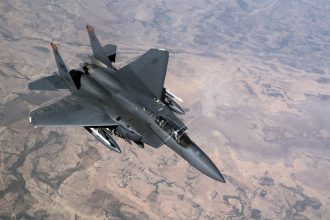
Iran’s strikes on U.S. facilities in the Middle East exposed a second gap. Even the most advanced aircraft depend on bases that can keep them flying under pressure. The era of assuming that Western air power can operate from nearby bases with impunity is over. Ranking Iran by its overall military strength tells you very little about its ability to disrupt American air operations. A European security guarantee for Ukraine therefore comes with two questions. Who supplies the interceptors, crews and replacements if the commitment overlaps with another war? And which governments will authorize their troops to fight if the guarantee is tested?
4. Why Moscow is reopening the 2021 security demands
In December 2021, Russia published two draft agreements. Its draft sought a halt to further enlargement, including Ukrainian membership, restrictions on deployments beyond those in place on 27 May 1997 and an end to NATO military activity in Ukraine and several neighbouring regions. NATO replied in January 2022 that countries retained the right to choose their security arrangements. In Abu Dhabi, Russian negotiator Vladimir Medinsky made a new European security framework a central subject. After the Moscow meeting, the Kremlin said it would update the 2021 proposals and left the scope of the revision open. Moscow is teasing Europe with proposal for bilateral agreements. There is no doubt that Russia has all the incentives change the current security map in Europe and uses the war in Ukraine to increase its leverage.
The demands now reach directly into the terms of a Ukrainian settlement. Moscow claims all four Ukrainian regions it declared annexed in 2022. It also categorically rejects Ukraine joining Nato. Putin dismissed a demarcation through contested areas and presented Russia’s claimed border as the only clear line. Medinsky has also spoken of expanding a Russian-held buffer in northern Ukraine quoting Putin “ Wherever the Russian flag has been raised, it must not be lowered.
Putin’s position on European troops in Ukraine is equally categorical. He warned in 2025 that Western forces arriving during hostilities would be liable to attack. On 12 November he explicitly extended that warning to a post-ceasefire deployment, saying Russia would treat the troops as targets and fighting would resume. London and Paris see the multinational force they are planning as a way to reinforce Ukraine after a ceasefire. Moscow sees it as a lasting Western military presence entering through the terms of the deal. So which European leader would be ready to send its troops to Ukraine and test if Putin is bluffing risking a wider war ?
European governments have structural reasons to be concerned about Moscow’s terms. For Poland, Romania and the Baltic states, the 1997 benchmark would put allied reinforcements on the negotiating table. At Dublin, European Council President Costa explicitly defended the existing European security architecture. My reading is that Moscow will insist the outlines of a new order before accepting a durable halt. Washington and Europe want enough of a halt to make wider diplomacy possible. Each side wants the other to take the risk first.
5 Most analysts mistake conviction for capacity
At a three-day conference at the University of Bucharest focusing on the war, I heard Romanian and international professors return to the same imperatives. Condemn Russia, stand with Ukraine until victory, punish Iran, claim allegiance to the Transatlantic alliance counter China and make the population more resilient to Russian propaganda. Russia appeared in the same discussions simultaneously as a state on the verge of collapse and an immediate threat. A serious analyst has to explain which one governs the next winter, which economic constraint would curtail Russian output and when. SIPRI puts Moscow’s military spending at 7.5 per cent of GDP in 2025. Wishing that those constraints would end the war is a poor substitute for estimating how long Russia can keep fighting.
When a commentator treats a pledge as a delivery schedule, political advocacy passes for a forecast. That lets budgets and production plans go unchallenged until a shipment fails to arrive or a government is called on to honour a guarantee.
5. The most likely outcome is prolonged attrition
Expect more talks, some humanitarian bargains, continued fighting and periodic escalation. A comprehensive security settlement would require agreement among governments that disagree about the threat, the map and who can deploy forces where. That takes years under better conditions. A frontline map says little about how many trained troops remain available to rotate in, how often civilian power goes down or how many interceptors are left.
Even if the front eventually hardens into an armistice line, I believe serious strategic planners are already incorporating the assessment of a hostile relationship to persist and expand through 2028 including escalation to multiple fronts. A settlement would require either a change in what Moscow believes it can gain by fighting or a guarantee Kiev trusts and European governments are prepared to enforce. The diplomacy has yet to produce either condition.
Ukraine is running down people and revenue as well as matériel. SIPRI puts 2025 military spending at 40 per cent of GDP. The World Bank and its partners estimated nearly $588 billion in ten-year recovery needs based on damage through 2025. EU officials put the separate financing gap for 2027 at €70 billion. The state has to pay soldiers, civil servants and repair crews in the next budget with a workforce and tax base that continued fighting will further erode. Europe has to cover those costs while trying to replace its own depleted equipment. For example the UK has given all its self-propelled guns to Ukraine and Germany has no more Patriots to spare.
The numbers are already on the table. A senior Ukrainian source told AFP that Kiev wants at least ten years of Western funding for an army of 800,000 after the war. The population in Ukraine regions controlled by Kiev in fall 2026 as estimated by a British official is at roughly 20 million, Taking 20 million as the low starting assumption, losing another millions residents to Russian advances and two to three million to emigration would leave about 15–16 million under Ukraine’s administration. An army of 800,000 would then equal roughly 5 per cent of all residents. Europe would face both a long-term defence bill and greater demand for services in the countries receiving new arrivals.
6. How the Iran and Ukraine wars could converge
The 2028 dark scenario opening prepared by some intelligence agencies anticipates worsening developments.
The conflicts can become entangled well before any of those extremes. Moscow benefits when a second war competes for Western weapons and attention. Tehran has an incentive to raise the political cost to European governments of hosting U.S. operations and applying sanctions. Some European allies, like Romania have already supported U.S. operations linked to the Iran war. Houthi attacks have disrupted commercial shipping in the Red Sea, showing how a regional conflict can impose costs far from the battlefield. American military access gives Washington reach and gives Europe protection. It also means a decision taken in Washington over Iran can expose European governments to consequences they had little say in from energy prices to trade disruptions.
A credible peace will depend on whether the governments making the guarantees have the forces, the supplies and the political consent and legitimacy to honour them if the fighting starts again. American shifts in policies show that priorities change more rapidly than pledges.
One can condemn Russia’s invasion and Iran’s attacks while assessing their incentives and capacities. When moral certainty passes for military evidence, virtue signaling belongs to politicians while experts need to move away from strategic delusion. Ukraine can lose the institutions that Europe promises to defend. Romania’s survival depends on knowing what we can finance, field and sustain before both crises arrive. The war has brought some of the Black Sea’s main trade routes to a standstill. In October 2026, the number of ships entering the Black Sea through the Bosphorus fell by 41% compared with the same month a year earlier. Regular grain exports through the deep-water ports around Odesa have been virtually halted since the summer, and the alternative route via the Danube ports and the Sulina Canal can handle only part of that volume. Attacks on cargo ships off the Romanian and Bulgarian coasts have pushed up war-risk insurance premiums and prompted some shipowners to try to avoid calling even at ports in those two countries. For Constanța, the economic impact is already tangible. War risk is reflected in freight rates, and some ships stop calling at the port altogether.
Our shared convictions tell us what kind of peace we consider just, while strategic analysis assesses the prospects for an agreement based on each side’s interests and its actual capacity to keep fighting or sustain peace.