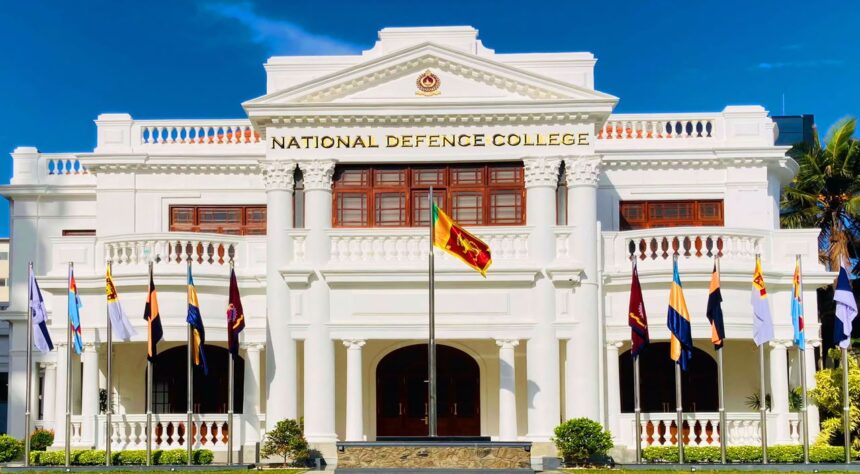
 Ahram online editor Amr Yehia, specializing in diplomacy and international affairs, is scheduled to deliver a comprehensive strategic lecture for the Course Participants of National Defence College – Sri Lanka on July 24, 2026. The high-level briefing will be conducted virtually via video conference.
Sri Lanka’s National Defence College and Its Strategic Audience
The presentation follows an official invitation extended to the Egyptian writer by the Commandant of the NDC, Major General Chamila Munasinghe WWV RWP RSP USP ndc psc IG MSc(NS & SS). The lecture will be delivered as part of the core curriculum module on ‘Geopolitics & Geostrategy’ to National Security and Strategic Studies (NS&SS) Course Number 05. The current cohort comprises senior command officers from the Sri Lankan Army, Navy, and Air Force—primarily at the rank of Brigadier or equivalent—alongside senior executive officials from the national police and civil administration. Reflecting the institution’s international standing as a regional center of military excellence, the audience includes senior international officers representing six partner nations: Australia, India, Bangladesh, Indonesia, Saudi Arabia, and the Sultanate of Oman.


The National Defence College of Sri Lanka serves as the state’s premier apex institution for senior military, police, and civil service leadership. Operating under a mandate to foster high-level statecraft, diplomacy, and defense economics, the college forms the intellectual foundation for senior officers preparing for supreme command and policy-formulation roles.
The “Egypt First” Doctrine and the Pursuit of Strategic Autonomy
Yehia’s participation represents an important opportunity for the ongoing exchange of expertise between Mediterranean and Indian Ocean littoral states regarding global issues, maritime security, defense autonomy, and regional stability. The core of the lecture will analyze the underlying strategic drivers of modern Egyptian foreign policy, Egypt’s active role in regional security, and the definitive ways its history and identity shape modern statecraft.
In particular, Yehia will highlight the „Egypt First” Doctrine enacted under the administration of President Abdel Fattah El-Sisi. This framework serves as a practical, non-ideological model designed to protect national sovereignty and secure maximum strategic independence within an increasingly multipolar global order.
Spanning two hours of interactive dialogue with the military leadership and international participants, the lecture will detail how Egypt balances its deep-rooted diplomatic ties with Western capitals while systematically expanding its economic and political partnerships worldwide. Key indicators of this strategy include Egypt’s formal integration into major economic blocs, such as the BRICS alliance to advance the developmental priorities of the Global South, alongside large-scale bilateral infrastructure partnerships like the construction of the El-Dabaa Nuclear Power Plant in cooperation with Russia.
Yehia will also articulate Egypt’s balanced posture toward shifting global dynamics—a strategic position reinforced by the state’s recent inauguration of its new State Strategic Command Headquarters, „The Octagon,” which institutionalizes advanced crisis management to insulate national security from external shocks.
Egypt’s Approach to Regional Crises and Security Challenges
A significant portion of the briefing will be dedicated to evaluating live global and regional crisis and their broader impact on international stability. This includes an assessment of Egypt’s crucial stabilization efforts regarding the Libyan crisis. Yehia will also present Cairo’s diplomatic and humanitarian mechanisms in the Gaza crisis, detailing Egypt’s firm opposition to the forced displacement of populations, alongside ongoing efforts to support stable post-war governance under the Palestinian Authority.
On the Sudanese file, Yehia will highlight the Egyptian position remains firmly anchored in the absolute preservation of Sudan’s state institutions, national unity, and territorial integrity, while rejecting any external interference that seeks to prolong the conflict or partition the country. The lecture will underscore that as a direct neighbor bearing the immense humanitarian weight of the displacement crisis, Cairo views the stability of Khartoum not merely as a foreign policy file, but as an inseparable extension of Egypt’s own national security and strategic depth.
Additionally, the analysis will address the Grand Ethiopian Dam (GERD), reaffirming that Nile water security represents an existential national interest governed by international legal frameworks. Yehia will outline Cairo’s absolute rejection of unilateral attempts to alter the territorial integrity of Somalia and the subsequent implications for Red Sea security. Turning to the Levant corridor, he will focus on external interventions violating Lebanese sovereignty and detail Egypt’s ongoing logistical and institutional backing of the Lebanese government to restore stability.
National Development as the Foundation of Strategic Independence
The lecture will conclude by establishing the causal link between Egypt’s domestic infrastructure expansion and its foreign policy flexibility. Yehia will argue that mega national projects—such as the New Administrative Capital, the modernization of the Suez Canal Economic Zone, and other giant developmental initiatives—are not merely economic programs. Instead, they serve as the structural foundation necessary to sustain Egypt’s strategic autonomy, ensuring that the state remains an indispensable and unyielding anchor for peace and stability across the region.