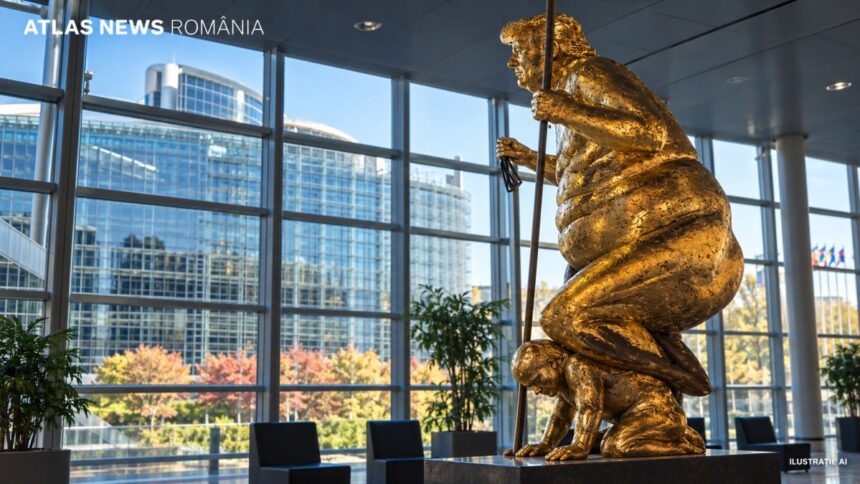
Displaying a sculpture depicting the President of the United States naked on the premises of the European Parliament in Strasbourg represents a serious error of political judgement. The portrayal conveys an insulting message about Donald Trump, while its location lends it institutional weight. Such a gesture introduces an unnecessary source of antagonism into relations between Europe and the United States.
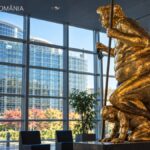
The sculpture by Danish artist Jens Galschiøt, entitled “Orange Plague” and also known as “King of Injustice”, depicts the American president naked, seated on the shoulders of a much smaller man. Unveiled on Tuesday, 6 October, the work stands approximately 2.5 metres tall and, according to the artist, is covered in 23-carat gold. It is scheduled to remain on display at the European Parliament until Thursday, 8 October.
The initiative came from Danish MEP Per Clausen, a member of The Left group, who invited the artist to exhibit the sculpture. This establishes political responsibility for organising the exhibition. It does not, however, resolve the issue of using the premises of a European institution to ridicule the American president.
A personal attack amplified by its institutional setting
The policies of the US administration are open to robust criticism, including within the European Parliament. Disagreements over trade, diplomacy or climate policy should be debated openly, with arguments, evidence and proposals. Respect for the presidency does not require agreement with the decisions of its incumbent.

The sculpture, however, uses a personal attack as a vehicle for political expression. Its degrading portrayal of Donald Trump demonstrates nothing about the consequences of any decision taken by his administration. It conveys hostility and seeks to ridicule. However legitimate it may be to challenge a policy, humiliating its proponent is no substitute for an argument.
The location changes the significance of the gesture. In a private gallery, the work would express the artist’s position and the curator’s choice. In the European Parliament, it benefits from the visibility, prestige and symbolic authority of the host institution. Photographs circulate alongside the Parliament’s name, and the public cannot be expected to know the administrative procedures governing the organisation of an exhibition.
Moreover, this visibility was explicitly sought. In a statement published by his party, Enhedslisten, Per Clausen argues that the European Parliament is an appropriate venue for the sculpture because its message can reach other MEPs and European Commissioners. The institutional setting is therefore part of the organiser’s political purpose.
Hosting the exhibition does not, in procedural terms, amount to the adoption of an official position by Parliament as a whole. Nor would it be fair to attribute Clausen’s choice to every MEP. Yet the absence of a resolution does not negate the message conveyed by the display or the responsibility associated with the use of institutional premises.
How would a similar gesture at the White House be interpreted?
An exercise in reciprocity illustrates the problem. How would the display at the White House of a painting depicting Ursula von der Leyen silencing the press be interpreted? Would invoking the artist’s freedom of expression be sufficient for the US administration to dispel the political significance of the setting?
Such a painting would symbolically convey an accusation of censorship, without the portrayal itself constituting evidence. Its display at the White House would nonetheless lend the message unmistakable institutional weight. There would be legitimate grounds to criticise the gesture for what it conveyed about the US administration’s attitude towards the leadership of the European Commission.
The White House and the European Parliament have different structures and responsibilities. An individual parliamentarian does not speak for the entire institution, and a parliamentary exhibition is not equivalent to a presidential communication. The comparison nevertheless remains relevant to the central question: can an institution make its premises available for an offensive message and then maintain that the location has no significance?
Reciprocity is a test of consistency. Europe has grounds to expect respect for its institutions and representatives. The same standard must apply to the treatment of partners on official European premises.
Artistic freedom does not remove diplomatic responsibility
Freedom of expression protects satire even when it is uncomfortable, provocative or in poor taste. It does not, however, oblige a public institution to make its premises available for every such expression. Choosing to host an exhibition also entails assessing its appropriateness, its message and its possible consequences.
Criticising that choice does not amount to calling for the sculpture to be banned. It means expecting sound judgement from an institution that represents citizens with differing political views and plays a role in the Union’s external relations.
The information verified for this article does not clearly establish who granted administrative approval for the installation or under what conditions. Parliament’s leadership should clarify these responsibilities. An invitation from an MEP explains how the initiative originated, but it does not answer every question about the use of shared premises.
Nor is a response from Washington necessary to assess the ill-judged nature of the gesture. Any actual deterioration in relations would need to be demonstrated, rather than assumed. The risk of antagonism is nevertheless sufficiently evident to warrant caution on the part of a European institution.
The European Parliament can defend European interests through debate, democratic scrutiny and decision-making. Hosting a humiliating portrayal of the President of the United States strengthens none of these instruments. It places the institution’s prestige at the service of a personal attack and conveys an insulting message to a partner with whom Europe must be able to engage even when disagreements are profound. Such an error cannot be excused simply by invoking satire.