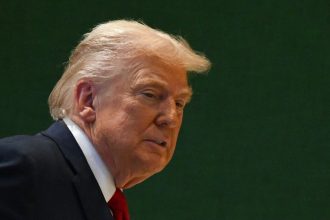
In less than a week, Xi Jinping received two of the world’s most powerful leaders in Beijing, in the same Great Hall of the People. On May 14 and 15, 2026, Donald Trump paid a state visit to the Chinese capital. On May 19 and 20, 2026, Vladimir Putin stepped onto the same red carpet, in the same palace, after the same state ceremonies. Two visits. Five days apart. The same host.
The international press discussed almost exclusively the immediate outcomes of the two bilateral meetings: the fragile trade truce between Washington and Beijing, statements on Taiwan, Chinese purchases of American soybeans, the more than 40 agreements signed with Moscow, the anti-Western rhetoric of the Xi–Putin joint statement, criticism of the American “Golden Dome” project, and the war in Iran that loomed over both meetings.
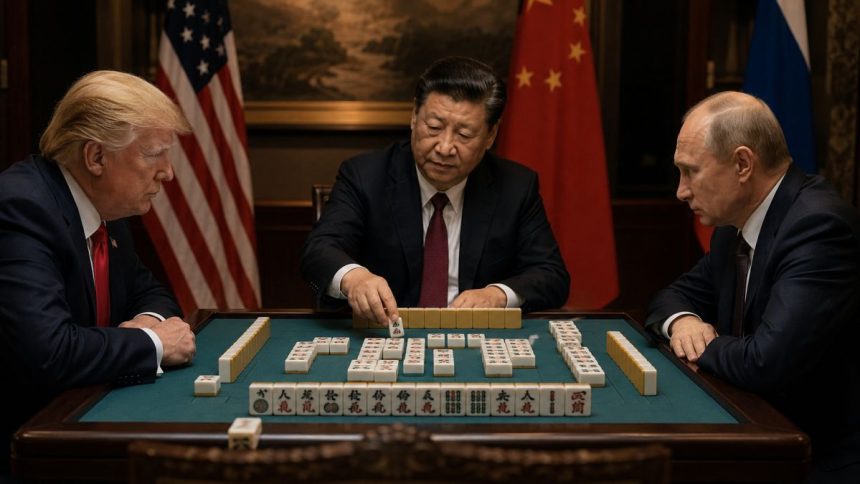
In reality, these meetings were not about America. Nor were they about Russia. They were about China. More precisely, they were about the way Beijing is reorganizing its position in the international system without yet triggering the frontal rupture that the West almost reflexively anticipates. While Washington and Moscow continue to think about geopolitics through the logic of direct pressure, blocs and explicit confrontation, China is playing an entirely different game. Not chess. Mahjong.
The difference between chess and geopolitical Mahjong
In chess, the objective is clear: the rapid neutralization of the opponent, control of the center, direct attack on the king, tactical sacrifice for strategic advantage. Two players. Complete information. A decisive ending. It is a game of visible confrontation and definitive victory.

In Mahjong, the logic is radically different. Four players, not two. Hidden information behind the wall of tiles, not complete information on the board. Combinations built quietly, through accumulation. You do not win through permanent frontal attack, but through patience, concealment, positioning and the slow construction of a hand that the other players notice too late. It is not a game of shock. It is a game of inevitability. When a player calls “mahjong,” the game is already over, without the others having understood exactly when they lost it.
This is the key to contemporary Chinese strategy.
Beijing is not, at this stage, trying to destroy the international order built after 1945. It is attempting something far more sophisticated: to become so indispensable to the functioning of that order that the shift in the center of gravity occurs almost naturally, through accumulated dependency, not through military conquest. This is the fundamental difference that many Western capitals still underestimate.
Washington still measures power in aircraft carriers, alliances and sanctions regimes. Moscow measures it in occupied territories, nuclear capabilities and historical spheres of influence. Beijing is beginning to measure it in degrees of dependency.
Xi did not organize two meetings. He built a choreography of power
The Xi–Trump and Xi–Putin sequence must be read not through the immediate content of the talks, but through the symbolic architecture Beijing built around them.
On May 14, 2026, Donald Trump was received at the Great Hall of the People with the full state ceremony: guard of honor, anthems, state banquet, and a visit to the Temple of Heaven — a space historically reserved for China’s emperors. According to CNBC, Trump was accompanied in Beijing by an impressive delegation of American corporate leaders: Apple’s Tim Cook, Tesla’s Elon Musk, Nvidia’s Jensen Huang, Boeing’s Kelly Ortberg, plus more than a dozen other chief executives who met Premier Li Qiang.
At the state banquet, according to Al Jazeera, the American president called Xi “my friend” and invited him to Washington on September 24. For his part, Xi told him, according to the official statement of China’s Ministry of Foreign Affairs, that “the transformation unseen in a century is accelerating globally” and proposed that the two countries overcome the “Thucydides Trap” together, making 2026 “a historic and landmark year” for bilateral relations.
The discussions included tariffs, soybeans, semiconductors, Taiwan, Iran and fentanyl. The visit ended without substantial agreements announced publicly, but with a consolidation of the fragile trade truce between the two countries. According to CNN, Trump later said in a Fox interview that Taiwan had been the “most important” issue for Xi during the negotiations, and that he had told him he preferred the island’s situation “to remain as it is.”
Five days later, on May 19, 2026, Vladimir Putin stepped onto the same red carpet, in front of the same palace, with the same type of state ceremony. On May 20, after talks, Xi and Putin oversaw the signing of more than 40 cooperation agreements in areas such as trade, technology, energy and media exchanges. According to NPR, Xi announced that bilateral relations had reached “the highest level in history,” while Putin invited Xi to Moscow in 2027.
The Xi–Putin joint statement criticized the American “Golden Dome” system — a missile-defense project worth $175 billion — and lamented the expiration of the last U.S.–Russia arms-control treaty, according to Al Jazeera. The two leaders warned against a global return to the “law of the jungle.”
Two visits. Two identical ceremonies. Two completely different diplomatic registers. The same stage. The same host.
The sequence was not a logistical coincidence. It was a calibrated demonstration.
Beijing sent four messages at once: that it can receive, at home, within the space of a week, both the leader of its main strategic rival and the leader of its main tactical partner, without the two visits contradicting each other; that Washington and Moscow come to Beijing, not the other way around, and both accept Chinese protocol; that the great international crises — from the war in Iran, to Ukraine, Taiwan and the global nuclear architecture — inevitably pass through the Chinese capital; and that in an increasingly polarized world, China is the only great power that can publicly afford two simultaneous registers.
This is the real stake. Not the specific outcome of a meeting. But the transformation of Beijing, for one week visible to the entire world, into the functional diplomatic capital of the planet.
Beijing has studied the fall of empires
The history of great powers is a history of overstretch. The British Empire expanded to the point where it could no longer militarily sustain its dominions, and its post-1945 collapse was gradual but irreversible. The Soviet Union tried to sustain a total military, ideological, technological and economic competition with the West, and its domestic economy gave way before its army did. The United States has repeatedly entered cycles of strategic consumption in the Middle East, from Vietnam to Iraq, Afghanistan and, now, Iran, each cycle eroding its diplomatic capital and projection capacity. Contemporary Russia chose to accelerate history through frontal war in Ukraine, paying a price it will continue to pay for decades.
China’s leadership appears to have studied all these errors systematically. Official Chinese Communist Party documents, Xi Jinping’s speeches at the 20th Party Congress and the series of “historical studies” imposed on party cadres in recent years obsessively return to the same theme: the danger of overly rapid ascents and premature confrontations.
Beijing’s strategy does not stem only from ambition. It also stems from historical fear. The Century of Humiliation, the collapse of the imperial order, foreign occupations, civil war, the trauma of internal chaos and the Soviet lesson have produced a political culture obsessed with controlling the pace of history. China does not play slowly merely because it has patience. It plays slowly because its leaders believe that any premature acceleration can destroy everything they have built.
Beijing avoids two major traps: premature direct war and global strategic overstretch.
This is why China does not become directly militarily involved in Ukraine, although it supports Moscow economically. This is why Beijing refuses to be absorbed into a U.S.–Iran confrontation, even as it maintains close ties with Tehran. CSIS observed, in its commentary dedicated to Trump’s visit, that Beijing had already positioned itself as an interlocutor with Tehran for the reopening of the Strait of Hormuz, following Iranian Foreign Minister Abbas Araghchi’s visit to Beijing — a strategic detail far more important than it may appear. China does not intervene. It mediates. And mediation is not neutral: it directly serves Beijing’s strategic interests — access to Iranian energy at preferential prices, the weakening of American influence in the Gulf, and the consolidation of China’s image as an indispensable power in the global energy architecture.
This is why the rhetoric on Taiwan methodically alternates between public firmness and operational ambiguity. At the state banquet on May 14, Xi told Trump that mishandling the Taiwan issue would throw the bilateral relationship into “great danger.” It was a firm warning, but phrased in the classic diplomatic register, not in the language of an ultimatum. China does not avoid confrontation because it is weak. It postpones it because it is still accumulating.
Russia consumes power. China stores power
One of the most persistent geopolitical illusions of recent years is the idea that Moscow and Beijing are equal partners in a coherent anti-Western bloc. In reality, the war in Ukraine has accelerated an asymmetry that has existed within the Sino-Russian relationship for at least a decade.
Russia consumes: material resources, ammunition, diplomatic capital, access to Western markets, strategic freedom and skilled human capital. China accumulates: influence over an increasingly dependent Russia, commercial dependencies among third countries, access to Russian energy sold at a substantial discount, diplomatic positioning as a potential mediator, and technological autonomy through industrial substitution.
The May 20 meeting confirmed this asymmetry. According to NPR, the 40 agreements signed focused predominantly on energy and raw materials exported from Russia in exchange for Chinese technology, machinery and industrial products. The two states emphasized in particular the growth of trade in oil and natural gas. Putin came to Beijing to reaffirm his indispensability to China, but left after confirming Russia’s dependence on China.
Even the announcement that the United States had recently allowed three Chinese tankers loaded with Iranian oil to transit the Strait of Hormuz — information confirmed by Trump himself at the end of his visit to Beijing, according to CNN — shows how deep Russian and Iranian dependence on China’s positioning within global energy chains has become.
Beijing’s official position on Ukraine remains framed in terms of “peace,” “negotiations” and “stability.” China’s Ministry of Foreign Affairs constantly maintains that Beijing does not seek an escalation of the conflict and supports political solutions. It is precisely this ambiguity that gives China maximum strategic advantage. China does not need to “save” Russia. It only needs to make sure that Russia can no longer fully exit Beijing’s orbit. And every month of war deepens this dependence.
In the logic of Mahjong, Russia is a valuable tile for Beijing precisely because it is vulnerable. A strong partner would be a rival. A weakened partner is an asset.
Russia is trying to change the world order through shock. China is trying to make it inevitable.
Washington is beginning to understand China’s game
The United States still largely treats China through the traditional logic of great-power competition: sanctions, military alliances, conventional and nuclear deterrence, technological control through export restrictions. This approach is not wrong, but it is partial.
The fact that Donald Trump chose to travel personally to Beijing on May 14, 2026, accompanied by America’s corporate elite, rather than convene the summit in a third capital or wait for Xi to visit the United States, is itself a sign of recalibration in the relationship. Regardless of the concrete details of the agreements announced at the end of the visit, the symbolic message is clear: Washington accepted, at least partially, to play under conditions chosen by Beijing. And Beijing offered enough for Trump to be able to turn the visit into a domestic success, without conceding any of its structural red lines.
The CSIS analysis published around the visit observed precisely this point: although China “seems sufficiently confident to push back against Trump on many key issues,” Beijing’s very willingness to host the summit “signals that it is far less confident than many observers believe.” This ambivalence — the simultaneous projection of confidence and need — is itself a tile in the Mahjong game. Beijing wants to appear neither too strong, so as not to trigger the West’s defensive coalition-building, nor too weak, so as not to lose its gravitational effect on the Global South.
Beijing is not pursuing only classic military superiority. It is pursuing control over systemic dependencies.
The U.S. Department of Defense’s annual report on China’s military and security developments describes a Beijing that is simultaneously developing its naval capabilities, military-industrial infrastructure, hypersonic missile technology, space systems, artificial intelligence with military applications, information-warfare capabilities and mechanisms of economic strategic resilience. The document explicitly describes a China seeking to alter the regional and global balance of power without yet entering into total military confrontation with the United States.
What the American report captures less fully is the complementary dimension: the network of port infrastructure controlled by Chinese companies in more than 90 ports around the world, dominance in rare-earth value chains, control over the processing of more than 80% of critical minerals for the energy transition, a dominant position in the global production of solar panels, batteries and electric vehicles, plus the expansion of the CIPS payment system as a gradual alternative to SWIFT.
This is the point that many Western analyses still fail to fully integrate. China does not need to defeat America militarily in order to change the world order. It only needs to make the world dependent on China’s functioning.
Beijing is not pursuing classical domination. It is pursuing the reduction of others’ options
This is probably the most important idea of the current geopolitical moment, and the hardest for Western strategic thinking, formed in the logic of the Cold War, to internalize.
The West continues to analyze China through a 20th-century lens: territorial conquest, formal military alliances, ideological blocs, direct confrontation. But Chinese strategy appears to be built differently. Beijing does not need to occupy Europe. It does not need to conquer the Middle East. It does not need to politically control Africa. It does not even need to immediately destroy the Western financial system.
It only needs the states of the world to gradually reach a situation in which they can no longer produce without China, build without China, carry out the energy transition without China, export without the Chinese market, manage industrial chains without Chinese infrastructure, or resolve major crises without Beijing’s participation.
This is the contemporary form of systemic power. Not total control. The gradual limitation of others’ strategic freedom.
In this sense, the Belt and Road Initiative, strategic partnerships with more than 140 states, the expansion of BRICS+, the network of Confucius Institutes, investments in the digital infrastructure of the Global South and public-health diplomacy are not separate instruments. They are different tiles in the same Mahjong hand, built in parallel, many of them apparently neutral or purely commercial, but gradually combining into a strategic configuration.
The limits of the Chinese game
This analysis should not be confused with a prediction of the inevitability of Chinese success. Beijing’s strategy has serious structural vulnerabilities.
China’s demography has entered a phase of accelerated decline, with a shrinking working-age population and a rapid aging process that will exert growing pressure on the economic model. The domestic debt accumulated by local administrations and the real-estate sector represents a systemic risk that the authorities are trying to manage through successive restructurings, without a complete resolution. Tensions with neighbors — Japan, South Korea, the Philippines, India, Vietnam — limit Beijing’s ability to consolidate a coherent regional sphere. The centralized political system, dependent on the figure of a single leader, reduces strategic flexibility in the face of errors.
To these must be added a dimension that strategic analysis cannot ignore: the same logic of accumulated dependencies that builds China’s systemic strength also functions, in practice, as an instrument of coercion. The unofficial economic sanctions imposed on Australia in 2020 after its call for an international inquiry into the origins of the pandemic, the trade pressure on Lithuania in 2021 after the opening of a Taiwanese representative office in Vilnius, the increasingly assertive behavior in the South China Sea, the situation in Xinjiang and the curtailment of Hong Kong’s autonomy all show that Beijing does not limit itself to quiet accumulation. When it considers it necessary, it transforms the dependencies it has built into levers of direct pressure. And this precedent constitutes, paradoxically, one of the vulnerabilities of the strategy: each coercive use of dependencies makes the opposing side more aware of the game and more motivated to seek alternatives.
Above all, the Mahjong model has an intrinsic vulnerability: it depends on the other players’ failure to understand it. Once the strategy becomes visible, counterreactions can be coordinated. And the recent reconfiguration of American alliances in the Indo-Pacific, European restrictions on Chinese investment in critical sectors, technological “de-risking” and the diversification of supply chains suggest that this visibility has already begun.
The real question is whether Beijing will succeed before the other players understand the configuration of its hand.
The question is not whether China will attack. It is whether the world will notice in time what it is building
The Western debate is dominated by a single obsessive question: will China attack Taiwan? It is a legitimate and operationally important question. But perhaps it is not yet the essential question.
The deeper question is whether the world understands that Beijing is building something structurally more complex than a mere offensive military capability. China is trying to build an order in which direct confrontation becomes unnecessary because global dependence on Beijing will already be too great to allow real alternatives.
The week of May 14–20, 2026 was, in this sense, a visible demonstration. Trump came. Putin came. To the same palace. Five days apart. With the same ceremonies. The world watched. European capitals reacted reactively. Commentators discussed each bilateral meeting separately. Almost no one commented on their combined configuration — which was precisely what truly mattered.
This is the logic of China’s geopolitical Mahjong. Not spectacular victory. Not frontal attack. Not shock. But the slow, quiet, systematic construction of a position from which the other players discover, too late, that the game can no longer continue without them. And that it ended before they had even noticed it had truly begun.
For Romania and NATO’s Eastern Flank, the implication is direct: strategic thinking formed exclusively in the logic of the Russo-Western confrontation risks missing the deeper transformation of the international system. Bucharest cannot ignore Russia. But nor can it fail to understand China. Because the world order on which Romania has built its foreign policy over the past three decades will not be changed only by tanks to the east. It will also be changed by a game of Mahjong being played in parallel, quietly, at the other end of the continent.
Perhaps this is the great strategic risk of the next decade: not that the world does not see China’s rise, but that it still interprets it through the geopolitical reflexes of the last century.
Great powers are trained to observe the mobilization of an adversary’s army.
They find it much harder to notice the moment when that adversary begins to reorganize the very logic of the system within which all other powers already operate.
Read also
Putin in Beijing After Trump: Russia Seeks Relevance in an Order It No Longer Controls