

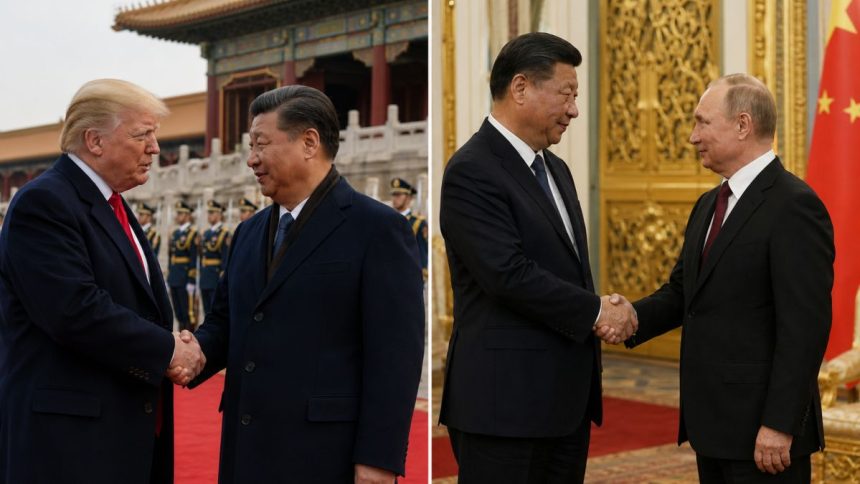
Putin’s visit to Beijing is not merely a bilateral Russian-Chinese meeting, nor is it only a discussion about the Power of Siberia 2 gas pipeline. The timing gives the meeting with Xi Jinping a broader strategic significance: the Russian leader arrives in China only days after Donald Trump’s visit, at a moment when Beijing is seeking to project the image of a power capable of engaging simultaneously with Washington and Moscow, without subordinating itself to either relationship.
Officially, the Kremlin rejects any connection between the two visits. Presidential aide Yuri Ushakov stated that Putin’s trip had been agreed as early as February and that there was no direct link with the Trump–Xi summit. Politically, however, the sequence matters. In less than a week, Xi Jinping receives in Beijing the leaders of the other two major powers of the international system. For China, this is a demonstration of diplomatic centrality. For Russia, it is an attempt to show that it remains present at the table where the new global order is being discussed. The Guardian
What Trump Left Behind in Beijing
The Trump–Xi meeting of May 14–15 did not produce a fundamental reset in Sino-American relations, but it did create a framework for stabilization. According to public reporting on the Trump–Xi summit, Beijing presented the meeting as a stage in stabilizing relations with Washington, with an emphasis on maintaining channels of communication, managing differences and coordinating on international and regional issues.
For Washington, the summit was an attempt to reduce the risk of direct confrontation with Beijing, without abandoning the structural competition with China. For Beijing, it was an opportunity to present itself as a mature, indispensable power, capable of dealing with the United States on equal terms. Associated Press described Putin’s visit as a moment of reaffirmation of the Russian-Chinese relationship, in a context in which Xi Jinping is simultaneously trying to maintain a stable relationship with the United States after his summit with Donald Trump.



For Moscow, the relevant signal is not the existence of a major agreement between Trump and Xi. That is not the point. The real signal is that the Chinese-American relationship can be managed, even amid deep rivalry. And a manageable relationship between Washington and Beijing automatically reduces Russia’s exclusive value to China.
In recent years, Russia has bet on the idea that the rupture between the West and China would make the Russian-Chinese partnership inevitable and increasingly deep. But if Beijing can simultaneously maintain a pragmatic relationship with Washington and a strategic relationship with Moscow, then Russia is no longer the alternative centre of an anti-Western world. It becomes one element in China’s strategic portfolio.
Putin’s Visit: Symbolism, State Apparatus and Political Message
Vladimir Putin’s visit carries an obvious symbolic weight. It comes in the context of the 25th anniversary of the Treaty of Good-Neighborliness and Friendly Cooperation between Russia and China, signed in 2001. The Kremlin announced that Putin and Xi are expected to adopt a declaration on the formation of a multipolar world and a new type of international relations. According to the briefing given by Yuri Ushakov and reported by Anadolu Agency, the document is 47 pages long and aims to define the common vision of the bilateral relationship and of the main issues on the international agenda.
The message is clear: Moscow and Beijing want to show that they are not merely discussing economic projects, but an alternative architecture of power. In the diplomatic language of the two capitals, the “multipolar world” is the formula through which the Western-dominated order is challenged. But this is where the first important difference appears. For Russia, multipolarity is a way of preserving its great-power status. For China, multipolarity is a framework in which Beijing can become the indispensable pole of the system.
This difference is not stated publicly, because both sides have an interest in maintaining the appearance of strategic convergence. But it is essential. Russia wants to be treated as a strategic equal. China wants to maximize its freedom of action.
Russia Is Not Negotiating Only Gas, But Relevance
The Power of Siberia 2 project is the visible component of the meeting. The pipeline is expected to transport Russian gas to China through Mongolia and is presented by Moscow as a major element of its energy pivot toward Asia. For Russia, the stakes are enormous: after losing a significant part of the European market, the Kremlin needs an alternative market that is large, stable and capable of absorbing substantial volumes.
The problem is that Russia needs this project more than China does. Beijing can negotiate the price, timeline, volumes and delivery conditions from a position of advantage. Reuters noted that although Russia and China had previously agreed on the construction of Power of Siberia 2, the two sides had not yet reached an agreement on price. This difference is not a technical detail, but an indicator of the real balance of power between a pressured seller and a buyer with options.
This is the central tension of the visit. Russia is trying to maintain its great-power status through a relationship that, economically, may push it into an increasingly pronounced dependence on China. Moscow can present Power of Siberia 2 as a strategic victory, as proof that the pivot to Asia is working. But if the project advances on Beijing’s terms, the reality will be more ambiguous: Russia will not have replaced dependence on Europe with autonomy, but with a more concentrated dependence on China.
This vulnerability has a clear factual basis. After 2022, Russian pipeline gas exports to Europe contracted dramatically, and Moscow was forced to accelerate its energy pivot toward Asia. At the same time, China purchased Russian energy on advantageous terms, benefiting from its position as a strategic buyer.
This does not mean that Russia is becoming irrelevant. On the contrary, it remains a major military power, a nuclear actor, a decisive presence in Eurasia and a pressure factor against NATO. But its autonomous economic instruments have narrowed. And when a great power needs another great power’s market, technology, financial infrastructure and diplomatic cover, the relationship can no longer be described simply as a partnership between equals.
China Between Washington and Moscow
For Beijing, the Trump–Putin sequence is a diplomatic opportunity. China can signal to the United States that it is a responsible actor in global stability, willing to discuss economics, trade, security and international dossiers. At the same time, it can signal to Russia that the strategic partnership remains solid and that Moscow is not being abandoned.
This dual positioning is Xi Jinping’s real advantage. China does not have to choose between Trump and Putin. More importantly, it can use each relationship to strengthen its position in the other. The relationship with Russia gives it strategic depth, access to resources, military cooperation and a counterweight to Western pressure. The relationship with the United States gives it access to the world’s most important economy, to the stability of global markets and to the management of technological competition.
Associated Press cited a relevant formulation by Wang Zichen, a representative of the Center for China & Globalization: Trump’s visit was about stabilizing the most important bilateral relationship in the world, while Putin’s visit is about reassuring a long-standing strategic partner. This distinction captures Beijing’s position very well: China treats Washington and Moscow differently, but seeks to extract strategic value from both directions.
An energy-related detail from Trump’s visit reinforces this logic. According to reporting based on the White House position and information from Reuters, American officials raised the prospect of additional Chinese purchases of U.S. energy, including oil and LNG. At this stage, there is no firm public agreement in this regard, and Chinese communications have not explicitly confirmed an energy package. But the mere opening of the discussion shows a strategic constant in Beijing’s approach: supply diversification remains a priority, regardless of the rhetoric of partnership with Russia.
For Moscow, this is an uncomfortable signal. Russia wants to be China’s indispensable energy supplier. China, by contrast, wants multiple suppliers, multiple routes and the ability to negotiate each relationship on its own terms. In this equation, Power of Siberia 2 is not merely an infrastructure project, but a test of Russia’s ability to secure relevance without accepting excessive dependence.
Iran as a Test Case for China’s Centrality
The Iranian file perhaps best illustrates the arbitral position Beijing is trying to occupy. For Washington, China is a necessary interlocutor because Beijing has economic leverage over Tehran, including through energy imports. For Moscow, China is important because it can provide diplomatic cover to a strategic partner under Western pressure.
During and after the Trump–Xi visit, American officials indicated that they had discussed energy with Beijing, including sanctions applied to Chinese companies purchasing Iranian oil. Trump indicated that he had discussed with Xi the possibility of lifting certain sanctions on Chinese companies that buy oil from Iran and that he would make a decision later. Reuters
For Russia, this discussion matters. Iran is a strategic partner of Moscow, and the way Beijing manages American pressure on Tehran indirectly affects Russia’s position as well. If Beijing discusses Iranian energy with Washington and then receives Putin to talk about multipolarity and strategic cooperation, China is showing that it can play on several levels at once, without being captive to a single camp.
This is precisely the kind of centrality that Russia can no longer claim. Moscow can influence crises, amplify tensions and block security arrangements. Beijing can speak with all relevant parties and turn ambiguity into diplomatic advantage.
Not Rigid Blocs, But Negotiated Dependencies
The classic image of a world divided into blocs — the West versus the Russia–China axis — is too simplistic for the current reality. What is emerging instead is an order of negotiated dependencies.
The United States wants to limit China’s rise, but cannot fully sever its economic and strategic relationship with Beijing. China wants to reduce American pressure, but does not want to give up Russia as a strategic partner. Russia wants to remain a great power, but needs China to compensate for the loss of access to Europe.
In this geometry, Beijing has the greatest room for manoeuvre. Washington remains the dominant power of the Western system, but must manage a long-term competition with China. Moscow remains dangerous, but increasingly dependent on the terms set by its non-Western partners. China, by contrast, can alternate cooperation, competition and strategic ambiguity.
That is why Putin’s visit after Trump should not be read as proof of a perfectly consolidated axis. On the contrary, it reveals the fragility of a Russia trying to remain indispensable in a system whose centre of gravity is shifting ever more visibly toward Beijing.
The Stakes for NATO’s Eastern Flank and Romania
For Romania and NATO’s Eastern Flank, this realignment is not abstract. A Russia that loses some of its autonomous economic instruments but remains militarized and dependent on power projection may become more unpredictable, not less dangerous.
The Black Sea remains one of the areas where Russia can project strategic relevance. If Moscow can no longer compete economically with the West and no longer controls access to the major European energy markets, military pressure, hybrid operations and the use of frozen conflicts become even more important instruments for maintaining its great-power status.
At the same time, Romania must closely monitor how China positions itself toward the Euro-Atlantic architecture. Beijing is not a direct actor in Black Sea security, but its influence over Russia, its relationship with Washington and its ability to negotiate with both capitals can indirectly affect the European strategic environment.
For Bucharest, the lesson is straightforward: the new global order is not being decided only in Washington, Brussels or Moscow. More and more lines of force pass through Beijing.
Russia Remains in the Game, But No Longer Writes the Rules Alone
Putin is not going to Beijing merely to discuss a gas pipeline. He is going in order to show that Russia remains present in the major negotiations of the international system. But this very need to demonstrate relevance points to a vulnerability.
Russia is not excluded from the global game. It still possesses military force, destabilizing capacity, energy resources and diplomatic weight. But it is increasingly playing on other actors’ terrain. In the case of this visit, that terrain is Beijing.
For Xi Jinping, the Trump–Putin week confirms a position of advantage: China can discuss strategic stability with Washington and multipolarity with Moscow, without fully accepting the logic of either partner. For Putin, the visit is an opportunity to project continuity and strength. But it is also a test of the real limits of Russian power.
The central question is no longer whether Russia remains part of the great-power game. It does. The question is under what conditions.
Read also
The Beijing Summit: Not a New G2, but a Selective Co-Management of U.S.–China Rivalry







Unde este Europa în această nouă configurație mondială?