When BlackRock — the asset manager overseeing $13.89 trillion at the end of the first quarter of 2026, according to the quarterly report published by CNBC — changes its tactical market positioning, investors take notice. Even more so when that repositioning comes against the backdrop of a conflict that has brought energy back to the center of the global economic hierarchy and has shown, within the span of a few months, that dependence on imports is no longer an administrative vulnerability, but a measurable form of strategic weakness.
That is the true reading of the crisis in the Middle East — not the price of oil, not capital outflows, not ECB rates. It is the fact that a regional conflict has acted as an accelerator of trends that had previously been unfolding over decades.
Three Months That Changed a Hierarchy
The military escalation in the first months of 2026 — with the disruption of traffic through the Strait of Hormuz and strikes on regional energy infrastructure — has reopened the risk of a major energy shock at a moment when the IMF warns that the war has already weakened global growth momentum. The International Monetary Fund’s blog, “War Darkens Global Economic Outlook,” documents how the closure of the strait and the destruction of infrastructure in the region raise the prospect of a major energy crisis if hostilities continue, with a baseline scenario that assumes a 19% increase in energy prices and a reduction in global growth to 3.1% in 2026. Brent crude rose by more than 50% from the outbreak of the conflict, temporarily climbing above $119 a barrel in March. In its note of March 2, the BlackRock Investment Institute assessed the conflict primarily as a volatility shock, identifying as decisive variables the duration of hostilities, the degree of disruption to energy transit, and the final political configuration.
The market’s response was immediate and revealing. In the first phase of the crisis, global investors withdrew a net $56 billion from US equities. The well-known “TINA” trade — “There Is No Alternative” to American equities — seemed to give way to a “TIARA” moment — “There Is A Real Alternative” — with capital flowing toward European and Asian markets, taking advantage of a weaker dollar and lower valuations.

The truce announced at the beginning of April reversed the picture. Reuters reported that, in less than two weeks after the announcement, global investors injected a net $28 billion into US equities, while the S&P 500 crossed the 7,000-point threshold with a recovery of more than 10% in 11 trading sessions — a faster pace than after the “Liberation Day” tariff announcement in April 2025. Europe immediately lost ground: European equities recorded net outflows of $4.7 billion in the week ending April 15, the largest outflow since November 2024, according to EPFR data cited by Bank of America.
The move was not capricious. It was rational. And it is precisely that rationality that raises the fundamental question.
Europe’s Structural Handicap
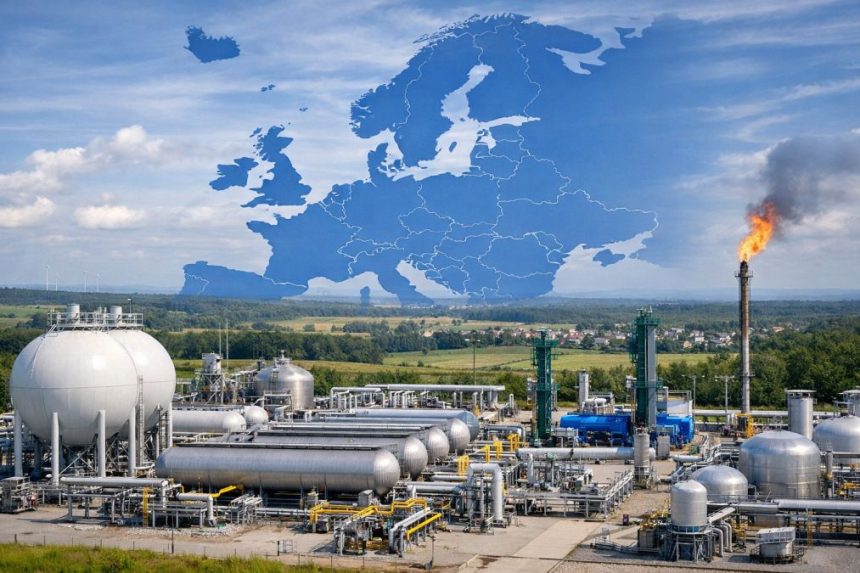
IMF studies, as reported by Reuters, show that the euro area will grow by only 1.1% in 2026, down from the previously forecast 1.4% — and compared with 2.3% projected for the United States. The gap is not explained by superior fiscal management in Washington or by a more inspired monetary policy. It is explained by a single structural factor: energy dependence. Eurostat data indicate that the EU’s total energy import dependency stood at 57% in 2024, with an import dependency rate for natural gas of 85.6% and an almost total dependency for oil and petroleum products. The United States is a net energy exporter. The same external shock therefore produces radically different effects depending on the structural position of the economy. Reuters documented this asymmetry: even in a scenario where disruptions ease by mid-year, the euro area remains exposed simultaneously to higher inflation and weaker growth.
Under the IMF’s baseline scenario, inflation in the euro area would rise to 2.6% in 2026, while the ECB could be pushed toward additional tightening of up to 50 basis points. Yet some central bank officials argue that the current energy shock remains closer to the baseline scenario than to a severe one and should not, for the time being, significantly alter the inflation and growth outlook — a tension that remains unresolved.
The IMF, again as reported by Reuters, has also issued a specific warning to European governments: broad-based energy subsidies — the natural political reflex in the face of a price shock — distort market signals and may become fiscally unsustainable. Reuters noted that the institution is explicitly urging Brussels not to overcompensate for rising energy prices, because the political temptation comes with a medium-term cost: the accumulation of debt and the erosion of the capacity to respond to future shocks.
The Transatlantic Asymmetry: More Than Energy
First-quarter corporate earnings illustrate the divergence more precisely than any macroeconomic model: companies in the S&P 500 are expected to report earnings growth of nearly 14%, compared with 4.2% for European companies — and even that 4.2% is largely supported by the oil sector, which directly benefits from higher energy prices. Reuters showed that investors are returning to US equities partly because American corporate earnings, especially in technology, remain robust despite the geopolitical shock.
This is the real asymmetry: the same energy shock that compresses margins in European industry — chemicals, manufacturing, transport — strengthens the profitability of the American energy sector and fuels a technological revolution whose geography remains predominantly North American. Artificial intelligence, the leading investment narrative of the moment, functions as an additional multiplier of the American advantage: data centers consume energy in massive volumes, and the United States produces it in excess. The BlackRock Investment Institute notes that the US technology sector is now expected to record earnings growth of 43% in 2026, compared with 26% in the previous year, and that these expectations directly informed the decision to return to an “overweight” position in US equities on April 14.
Michael Browne, strategist at the Franklin Templeton Institute, succinctly summed up the logic behind the renewed flow of capital into the American market, as quoted by Reuters: “Am avut al patrulea șoc exogen în șase ani și, dat fiind natura acestui șoc, nu e surprinzător că ne întoarcem la economia care a performat cel mai bine pe termen foarte lung, care investește cel mai mult pe termen scurt și care produce cele mai bune rezultate”.
Energy as a Form of Systemic Power
The strategic reading of this crisis goes beyond financial analysis. What the months since the escalation in the Middle East have shown is that energy dependence is no longer merely an economic vulnerability, but a measurable form of geopolitical weakness — translated directly into the cost of capital, industrial competitiveness, and international influence.
Reuters () reported that Larry Fink, BlackRock’s chief executive, had already warned in March that oil at $150 a barrel could trigger a global recession. The IMF constructed three scenarios — baseline, adverse, and severe — with average prices ranging from $82 to $125 a barrel, each associated with progressively worsening growth and inflation rates. The severe scenario implies global growth of only 2%, the conventional threshold of a global economic recession. The IMF warns that the principal concern is the de-anchoring of inflation expectations: the shock of 2022 has already made consumers hypersensitive to any price increase, and a second major episode could amplify wage-price spirals in economies with fragile nominal anchoring.
The Strait of Hormuz — through which approximately one-fifth of global oil and liquefied natural gas flows transit — has functioned in this crisis as a geopolitical force multiplier. Whoever controls or threatens this artery holds an instrument of systemic pressure, not merely a regional one. The BlackRock Investment Institute underlines that geopolitical fragmentation will continue to support the defense and energy security sectors, and that companies will invest increasingly in the resilience of supply chains, regardless of the outcome of this specific conflict.
What Remains After the Truce
The truce changed the direction of capital flows, but it did not resolve the vulnerabilities that were exposed. Europe emerges from this crisis with the same model of energy dependence, with narrower fiscal space, with an industry that has absorbed additional costs, and with a rearmament agenda that will compete for the same budgetary resources.
The relevant question for European decision-makers is not how to manage energy prices in the short term. It is whether there is the political will to turn this repeatable crisis — the third major energy shock in four years, after 2022 and the signals of 2023 — into a catalyst for genuine energy autonomy. Otherwise, any truce in the Middle East will, for Europe, amount to little more than a pause before the next bill arrives.