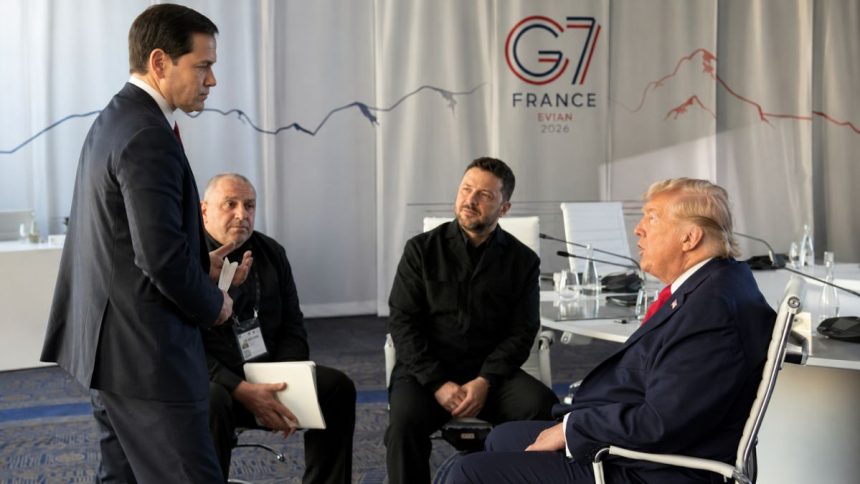
The G7 summit at Évian-les-Bains looked yesterday less like an orderly gathering of the major Western economies and more like an X-ray of the new global diplomacy: fast-moving, overlapping, competitive and far less dependent on the classical rituals of final communiqués. What was on display on the shore of Lake Geneva was not chaos, but a change of tempo in international politics. Leaders no longer come to such gatherings merely to confirm positions already negotiated. They come to seize the right moment, to push an agenda, to secure a meeting, to shift the day’s centre of gravity.
This is, in all likelihood, the most important conclusion of the summit. The G7 has not become irrelevant. On the contrary, it remains a stage of considerable value. But precisely because it is a stage of considerable value, each actor seeks to use it quickly, precisely and efficiently. Diplomacy has moved from slow round tables, dominated by predictable formulas, to focused bilaterals, to clear agendas and to successive attempts to capture political attention.
Yesterday was the perfect expression of this transformation. Donald Trump arrived with the Iran dossier and with the advantage of a fresh diplomatic victory. Volodymyr Zelensky sought to prevent the marginalisation of Ukraine at a moment when global attention was shifting towards the Middle East. Emmanuel Macron sought to use the summit to reposition France as the organiser of a conversation broader than the old Western format. European leaders sought to obtain guarantees regarding Russia. And the remaining participants used their presence at Évian for their own strategic calculations.
A day in which the agenda moved faster than the format
In the classical mould, a G7 summit has a fixed agenda, official themes, working sessions and a carefully prepared diplomatic choreography. At Évian, this architecture remained standing, but political reality overtook it. The formal agenda was pushed into the background by the speed of events.

Iran abruptly shifted the centre of gravity. The preliminary agreement announced by Washington entered the summit as a major political fact, and Trump exploited the moment at once. Around this dossier gathered questions about Gulf security, the Strait of Hormuz, the stability of energy markets and the risk of a new regional architecture negotiated first and foremost by the United States.
This produced an important shift. Ukraine, which in recent years had almost automatically been the dominant theme of Western gatherings, was forced to compete for attention. It did not disappear from the agenda, but it could no longer monopolise the agenda. And this says a great deal about the present international moment: the West no longer operates within a single central crisis, but within a succession of simultaneous crises.
For Zelensky, yesterday was a struggle for political space. The Ukrainian president came to Évian not only for military support or declarations of solidarity, but to ensure that the war with Russia was not pushed into the background by the Iran dossier. Here one of the summit’s real tensions came into view: Ukraine remains vital for Europe, but for Washington the global agenda is broader, more transactional and more fluid.
Trump sensed this fluidity and entered the summit with a clear advantage: he had a new dossier, a result to present and an opportunity to dominate the conversation. However the agreement with Iran evolves, its political effect at Évian was immediate. The American president did not come to explain, but to set the pace. He did not come to be absorbed into the European agenda, but to compel it to react to his own.
From consensus to the competition for attention
The G7 at Évian showed that major summits are no longer only about consensus. They are about attention. Whoever manages to impose the theme of the day gains diplomatic ground. Whoever loses the moment risks seeing their dossier pushed into the background, even if that dossier remains strategic.
This is the fundamental difference from the slower diplomacy of past decades. In the old format, leaders came to summits after months of preparation, and the purpose was to produce an image of unity. Today, the summit becomes a space of controlled competition. Each leader arrives with their own urgency, their own domestic pressure and their own window of opportunity.
This is not necessarily a bad thing. On the contrary, it may be the sign of a more realistic diplomacy. The world no longer has the patience for slow rituals, and crises no longer wait for the completion of perfect formulas. Leaders are obliged to work with short windows, with parallel negotiations and with partial results. In this context, bilaterals that are fast, clear and goal-oriented become more important than plenary sessions.
Here lay the essence of yesterday. Évian was not a disorderly summit, but an accelerated one. A summit in which leaders raced after the right moment to advance their agenda. Trump seized the Iran moment. Zelensky sought to recover the Ukraine moment. Macron sought to turn the summit’s moment into France’s moment.
Macron and the attempt to control an uncontrollable summit
For Emmanuel Macron, the Évian summit was a difficult diplomatic operation. The French president sought to manage several levels at once: the unity of the G7, the relationship with Trump, the Ukraine dossier, the tensions in the Middle East and the presence of certain leaders invited from outside the Western core.
This is a large diplomatic ambition, but also a risky one. The wider the table, the harder control of the agenda becomes. Yet the alternative would have been weaker: a G7 enclosed within its own formula, discussing a world it can no longer organise on its own.
Macron wagered on a sound idea: the relevance of the G7 no longer derives solely from the economic weight of its members, but from the format’s capacity to connect Western power with regional actors, with emerging states and with the real dossiers of the moment. For this reason, the summit should not be read merely as a gathering of the seven, but as an attempt at the diplomatic extension of Western influence.
But it was precisely this extension that turned Évian into a space difficult to discipline. Each leader came with something to obtain. Each bilateral had its own calculation. Each dossier competed with the others. In place of a single agenda, the summit produced several agendas that overlapped and collided.
Bilaterals, the new infrastructure of power
The most important scene of the day was not the plenary. It was the margins of the summit. The bilateral meetings, the brief exchanges, the restricted consultations and the direct conversations set the real tone of the gathering.
This is not a mere observation of protocol. It is a change in diplomatic infrastructure. In a world where the major dossiers shift rapidly, leaders no longer wait for institutions to produce a consensus slowly. They seek the right meeting, at the right moment, with the right interlocutor.
The bilateral thus becomes the central instrument of accelerated diplomacy. It allows clarity, speed and direct negotiation. It does not always produce spectacular results, but it allows positions to be tested without the burden of a broad format. At Évian this was plainly visible: the official summit provided the framework, but the bilaterals produced the political substance.
In this sense, the G7 functioned as a high-level diplomatic marketplace. Not in the vulgar sense, but in the strategic one: a space in which each actor seeks to exchange something, to obtain something, to block something or to put something on the table. The difference is that the principal currency was not economic power alone, but time. Whoever made the best use of the summit’s limited time succeeded in pushing their agenda higher.
Ukraine, Iran and the competition among crises
Yesterday also revealed a more uncomfortable reality for Europe: Ukraine is no longer the only dossier capable of organising the Western agenda. The war remains fundamental to European security, but it no longer occupies the centre of the global stage on its own.
Iran demonstrated this. The moment the nuclear dossier, Gulf security and the Strait of Hormuz entered the discussion, the agenda automatically reordered itself. Energy, maritime transport, the stability of the Middle East and the risk of regional escalation became themes with an immediate impact on all.
This competition among crises does not mean that Ukraine has become less important. It means that the world has become more strategically crowded. For Kyiv, this is dangerous. For Europe, it is a challenge. For Trump, it may be an opportunity: in a world with multiple crises, the leader who produces movement in one dossier immediately acquires political capital.
Hence the subtle tension of the day. The Europeans sought to bring the discussion back towards Russia and towards the need for pressure on Moscow. Trump arrived with the Iranian impulse. Zelensky sought to prevent Ukraine from being treated as a dossier of continuity, while Iran was becoming the dossier of the moment.
This competition for centrality is the new reality of Western diplomacy.
Not chaos, but adaptation
It would be wrong to describe Évian as a chaotic summit. It is more accurate to describe it as a summit adapted to a chaotic world. The difference matters.
Chaos would mean an absence of direction. At Évian, direction was not lacking. There were too many directions at once. Each leader came with their own map, and the summit became the place where these maps were laid one over another.
This is the new condition of major international gatherings. They can no longer deliver the clean image of a stable order, because order itself is unstable. They can, however, deliver something perhaps more useful: direct contact, rapid adjustment, targeted negotiation and the immediate testing of positions.
From this perspective, the G7 at Évian was relevant precisely because it was not linear. It showed how diplomacy works when the world moves faster than institutional mechanisms. It showed how leaders try to turn recent events into political advantage. It showed how the classical summit is being gradually replaced by the summit-as-operation.
The strategic lesson of yesterday
Yesterday at the G7 confirmed a profound shift: international diplomacy has entered a phase of acceleration. Major summits are no longer merely places of deliberation, but moments of opportunity. What matters is no longer only what is discussed officially, but who manages to impose the pace, who places their dossier at the centre of the conversation and who makes the most efficient use of the short window of direct meetings.
Trump understood this and arrived with the Iran dossier exactly when it offered him diplomatic capital. Zelensky understood the danger and sought to prevent the loss of Ukraine’s centrality. Macron understood the change of format and sought to turn France into the host of a broader, faster diplomacy more closely connected to the real crises.
The G7 at Évian was not the summit of Western consensus. It was the summit of tempo. A summit in which the speed of events forced each leader to play their card quickly, clearly and without the luxury of waiting.
This is not necessarily bad news. Slow, rigid and excessively ceremonial diplomacy can no longer keep pace with a world in which wars, energy, markets, technology and regional security move simultaneously. Fast bilaterals, concise agendas and direct negotiation may become not a departure from diplomacy, but its new form of efficiency.
At Évian, the G7 did not look like a tedious round table. It looked like a system in motion. And in a world where the moment matters more and more, those who fail to seize the moment risk no longer seizing the agenda.
Read also
Trump Dominates G7 Agenda With Iran Deal. Macron Seeks to Reclaim Diplomatic Ground