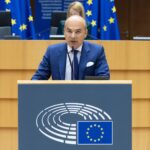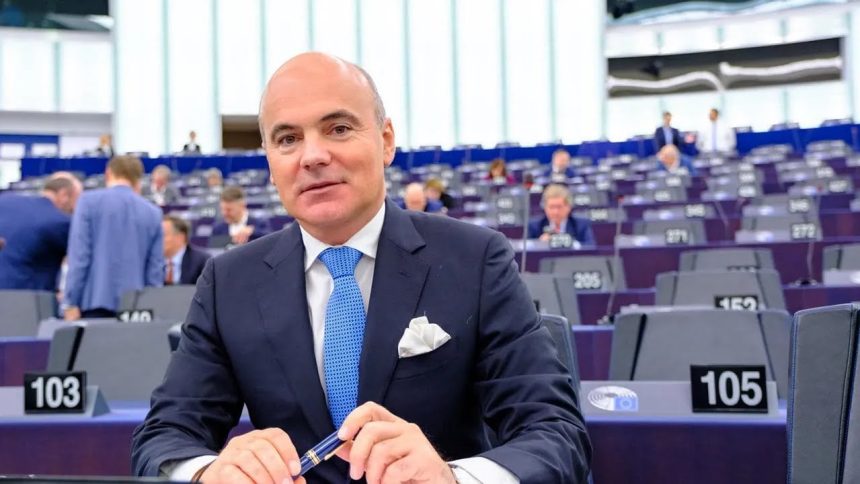
The Republic of Moldova is entering a decisive stage in its accession negotiations with the European Union, with the moment expected to be formalized on 15 June in Luxembourg, during the intergovernmental conference dedicated to the opening of Cluster 1 – Fundamentals. Romanian MEP Rareș Bogdan announced, in a Facebook post, that Chișinău’s file had been unblocked in Brussels following a major shift in dynamics at ambassadorial level among the EU member states.
“Here it is happening! The Republic of Moldova is beginning accession negotiations,” Rareș Bogdan stated, presenting the moment as one of the most important recent developments in Chișinău’s European path.
According to the MEP, the opening of negotiations is expected to be formalized “most likely, on 15 June,” when the intergovernmental conference will take place in Luxembourg, marking the launch of negotiations on Cluster 1 – Fundamentals. Rareș Bogdan noted that the Cypriot Presidency of the European Union “announced last night that preparations are beginning.”
The MEP explained that this stage involves setting the negotiating principles, finalizing the legal texts and defining the specific conditions that the European Union will require the Republic of Moldova to meet in order to subsequently close this cluster. In the language of the accession process, these conditions are known as benchmarks.

“What does this mean: the negotiating principles are being established, namely the finalization of the legal texts and the definition of the specific conditions that the EU imposes on the Republic of Moldova in order to be able, subsequently, to close this cluster. The so-called benchmarks,” Rareș Bogdan explained.
Rareș Bogdan: The Breakthrough Took Place at EU Ambassadorial Level
Rareș Bogdan stated that the decisive moment took place in Brussels, at the level of the member states’ ambassadors, within Coreper. According to the MEP, the shift in dynamics was generated by the unblocking of Hungary’s position, after Hungary’s new prime minister, Péter Magyar, announced an agreement with Kyiv on expanding the rights of the Hungarian minority in Transcarpathia.
“The major shift in dynamics took place yesterday in Brussels, at ambassadorial level (Coreper),” Rareș Bogdan said.
According to him, the agreement obtained by Budapest concerns sensitive areas for the Hungarian minority in Ukraine, including education, language and representation. The lifting of Hungary’s blockage on the Ukrainian file had a direct effect on the Republic of Moldova as well, because the two candidacies are treated informally within a political package logic at Council level.
“Hungary’s new prime minister, Péter Magyar, announced the unblocking of the file after obtaining an agreement with Kyiv on expanding the rights of the Hungarian minority in Transcarpathia (education, language, representation),” Rareș Bogdan wrote.
The MEP explained that the candidacies of the Republic of Moldova and Ukraine are “informally politically coupled in Council decisions,” and that the lifting of the Hungarian veto automatically cleared Chișinău’s path as well.
“As the candidacies of the Republic of Moldova and Ukraine are treated ‘as a package’ (informally politically coupled in Council decisions), the lifting of this 17-month veto initially imposed by the Orbán regime automatically freed Chișinău’s path as well,” Rareș Bogdan emphasized.
At the same time, the MEP warned that Budapest is maintaining its reservations regarding the pace of the process. According to his post, Hungary will not accept any accelerated procedure along the way and will request a national referendum at the end of the process.
“Budapest made a point of specifying, however, that it will not accept any accelerated procedure along the way and that it will request a national referendum in Hungary at the end of the process,” Rareș Bogdan stated.
The MEP’s announcement comes in the same political context in which the European Commissioner for Enlargement, Marta Kos, confirmed that the Republic of Moldova is preparing to begin accession negotiations with the European Union. Atlas News Romania previously reported the statements made by the European Commissioner, who indicated that the opening of negotiations on the first cluster represents a major step, but one conditioned on the continuation of reforms.
Cluster 1, the Toughest Test for the Republic of Moldova
Rareș Bogdan insisted on the importance of Cluster 1, noting that it is not a mere procedural step, but the hard core of the accession negotiations. Cluster 1 – Fundamentals includes the most sensitive files for Brussels: judicial reform, the fight against corruption, public procurement, financial control and the functioning of democratic institutions.
“Cluster 1 is the ‘Fundamentals’ axis and includes the toughest files: judicial reform, the fight against corruption, public procurement, financial control and the functioning of democratic institutions,” Rareș Bogdan stated.
The MEP explained that, under the new enlargement methodology, the European Union applies the “Fundamentals First” principle. This means that the first cluster is opened first and closed last, while progress on the other chapters depends directly on the results achieved in the fundamental areas.
“One more point: the ‘Fundamentals First’ principle applies. Under the new enlargement methodology, this cluster is opened first and closed last,” Rareș Bogdan noted.
For the Republic of Moldova, this stage marks the transition from general political commitments to concrete institutional assessments. Once Cluster 1 is opened, Chișinău will have to demonstrate measurable progress in the areas that define a state’s capacity to function within the European Union: an independent judiciary, an effective administration, credible financial control, transparent public procurement and stable democratic institutions.
“The pace of progress on the other economic or sectoral chapters will depend directly on the results achieved here,” Rareș Bogdan emphasized.
The MEP also linked this development to the activity of the European Parliament, stating that the European legislature was the first institution of the European ecosystem to acknowledge the progress made by the Republic of Moldova. Rareș Bogdan noted that, in the Committee on Foreign Affairs, the process was given the green light, and that his amendments on increasing funding for reforms and trade liberalization are included in the adopted report.
“Yesterday afternoon, we gave the green light to the process in the Committee on Foreign Affairs. In fact, the European Parliament was the first institution of the European ecosystem to acknowledge the progress made by the Republic of Moldova,” Rareș Bogdan stated.
According to him, his amendments aimed to strengthen financial support for the Republic of Moldova through reform mechanisms and precise financing instruments, alongside an increase in trade liberalization.
“My amendments regarding the increase of funds for reform mechanisms and precise financing instruments, together with the increase in trade liberalization, are included in the adopted report,” the MEP stated.
The Political Stakes for Romania and the Republic of Moldova
Rareș Bogdan’s message carries a political significance that goes beyond the simple description of a European calendar. For the Republic of Moldova, the opening of negotiations on Cluster 1 would mean entering the most serious stage so far in its European path. For Romania, Chișinău’s progress towards the European Union is a direct strategic stake, linked to regional stability, the security of the eastern flank and the consolidation of the democratic space at the EU’s eastern border.
The announcement comes at a time when the Republic of Moldova is facing constant political, economic and geopolitical pressures, while the European integration process is becoming not only a diplomatic option, but also an instrument of internal consolidation. The opening of negotiations does not mean rapid accession, but it does mark the transition to a stage in which reforms will be assessed directly, technically and politically against European Union standards.
If the moment in Luxembourg is confirmed on 15 June, the Republic of Moldova will enter a negotiating phase in which every step of progress will matter. Rareș Bogdan presents this step as a major breakthrough, but also as the beginning of a difficult stage in which Chișinău will have to prove that it can turn European political support into real, measurable and irreversible reforms.
Read also
Romania’s OIF Candidate Dacian Cioloș Sees Cairo as a Bridge for a Modern, Pragmatic Francophonie