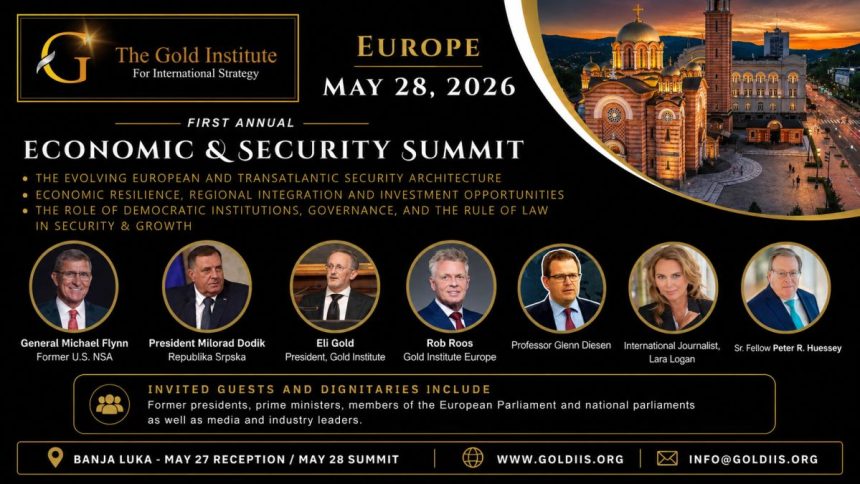
Banja Luka will become, at the end of May 2026, the host of the first European edition of a transatlantic strategic forum. The Gold Institute for International Strategy is organizing the First Annual Economic & Security Summit Europe on May 27–28, 2026, an event built around three major pillars: the European and transatlantic security architecture, economic resilience and regional investment opportunities, and the role of democratic institutions, governance, and the rule of law in security and economic growth.
For the Western Balkans, the summit carries significance that goes beyond protocol. The event is part of a broader series of strategic formats that are shifting the debate on Southeastern Europe directly into the region, rather than limiting it to major Western capitals. The official program includes a reception on the evening of May 27, followed by the forum itself on May 28, from 10:00 a.m. to 5:00 p.m. According to the organizers, the guest list includes former presidents, former prime ministers, members of the European Parliament, national legislators, as well as leaders from the media and business sectors.
A Strategic Agenda Built Around Three Core Themes
The first thematic pillar of the summit focuses on the European and transatlantic security architecture at a time when the war in Ukraine, NATO’s redefinition, the recalibration of U.S.–EU relations, and competition with Russia and China require a reassessment of the foundations of this system. The discussions will address how Western alliances are adapting to an international order marked by great-power competition and growing pressure on the security of NATO’s eastern flank.
The second pillar emphasizes economic resilience, regional integration, and investment opportunities in a European space where supply chains, energy dependencies, critical infrastructure, and regional markets have become direct elements of geopolitical competition. For the Western Balkans, this component is essential: the region is at once an energy transit space, an emerging market, and an area where economic influence often translates into political influence.

The third pillar addresses the role of democratic institutions, governance, and the rule of law in security and economic growth. It is a central issue for a region where the European Union’s enlargement processes, institutional reforms, and the consolidation of the rule of law remain essential conditions for full integration into the Euro-Atlantic architecture.
According to The Gold Institute for International Strategy, the summit will devote special attention to the role of the Republic of Srpska within Bosnia and Herzegovina, as well as to its relations with regional and international actors.
Banja Luka, a Host City with Regional Weight
The choice of Banja Luka as the host of the summit’s first European edition is not accidental. The capital of the Republic of Srpska, one of the two constituent entities of Bosnia and Herzegovina, alongside the Federation of Bosnia and Herzegovina, is one of the key nodes of the Western Balkans, a region where the post-Dayton architecture, Bosnia and Herzegovina’s complex relationship with the European Union, and the diplomatic and economic presence of external actors such as the United States, Russia, China, and Turkey intersect.
On March 21, 2024, Bosnia and Herzegovina received the green light from the European Council to open accession negotiations with the European Union, based on the European Commission’s recommendation of March 12, 2024. The process, however, remains conditional on complex domestic reforms. At the same time, the region is one of Europe’s most active arenas of competition for influence, where Chinese infrastructure investments, Russian energy projects, Turkey’s economic presence, and American and European stabilization policies intersect in a space with a relatively small population but disproportionate strategic importance.
In this context, the organization of a transatlantic summit in Banja Luka is itself a political signal. The Western Balkans can no longer be viewed solely through the lens of institutional crises or EU enlargement files, but also as a space of connectivity, investment, energy, security, and influence.
American, European, and Regional Speakers
The list of speakers announced by The Gold Institute for International Strategy brings together voices from the military, political, academic, and media communities, reflecting the organizers’ ambition to build a broad dialogue that goes beyond strictly academic or strictly political boundaries.
Eli M. Gold is the president and founder of the Gold Institute, the organization hosting the summit. Under his leadership, the institute has positioned itself as a transatlantic platform for strategic dialogue, with an agenda centered on security, foreign policy, and international alliances.
Lieutenant General Michael T. Flynn(Ret.), chairman of the Gold Institute, is a former National Security Advisor of the United States in the Trump administration and former director of the Defense Intelligence Agency, the Pentagon’s military intelligence agency, from 2012 to 2014. With a career spanning more than three decades in the U.S. military, General Flynn remains a well-known voice in debates on national security, American foreign policy, and strategic competition.
President Milorad Dodik, one of the leading political figures of the Republic of Srpska and Bosnian Serb politics, is the leader of the Alliance of Independent Social Democrats, SNSD, in the Republic of Srpska. With a political career spanning more than two decades, Dodik has served as prime minister of the Republic of Srpska, president of the Republic of Srpska for two terms, and the Serb member of the tripartite Presidency of Bosnia and Herzegovina.
Rob Roos is a former member of the European Parliament from the Netherlands, serving from 2019 to 2024, and a Distinguished Fellow of the Gold Institute. In the European Parliament, he was active within the European Conservatives and Reformists Group. Rob Roos became known for his interventions on institutional reform within the European Union, as well as economic, energy, and fiscal policies at the EU level.
Professor Glenn Diesen, of the University of South-Eastern Norway, specializes in international relations, geopolitics, geoeconomics, and Russian foreign policy. The author of numerous books on the European security architecture, the Eurasian partnership, and great-power competition, Diesen is an academic voice frequently invited to take part in international debates on the reconfiguration of the global order.
Lara Logan is a Senior Media Fellow at the Gold Institute and an international journalist with a long career in American media. She worked for CBS News from 2002 to 2018, including as Chief Foreign Affairs Correspondent and correspondent for “60 Minutes.” Logan covered conflicts in Afghanistan, Iraq, and other crisis zones, and has been associated with field reporting and conflict journalism.
Peter R. Huessy is a Senior Fellow at the Gold Institute and one of the American analysts specializing in nuclear deterrence, ICBM modernization, and national security strategy. A former Director of Strategic Deterrent Studies at the Mitchell Institute for Aerospace Studies and former senior defense consultant at the National Defense University Foundation, Huessy has more than four decades of experience in defense policy and strategic advisory work.
The Economy as an Instrument of Security
One of the most relevant features of the summit’s agenda is the explicit integration of the economic dimension into the security debate. In the Western Balkans, as in Eastern Europe more broadly, security can no longer be separated from the economy. Energy corridors, rail and road connections, investments in critical infrastructure, access to European markets, and external dependencies are direct elements of political stability.
For Bosnia and Herzegovina, regional integration, access to European pre-accession funds, and the strengthening of institutions remain essential conditions for a sustainable strategic trajectory. For the Republic of Srpska, the economic dimension opens avenues of cooperation with a range of external actors, from the European Union to the United States, and from China to Turkey.
In this sense, the Banja Luka summit is not merely a debate forum, but also a test of the region’s ability to present itself as a space of economic opportunity, not only as a zone of crisis.
A Summit with Stakes for the Western Balkans
The First Annual Economic & Security Summit Europe marks a broader trend: the return of the Western Balkans to the center of transatlantic strategic calculations. In a Europe where the war in Ukraine, global competition for infrastructure, energy tensions, and the reconfiguration of U.S.–EU relations are changing security priorities, the region can no longer be treated as a footnote.
The sources establish what is happening: an American institute is expanding the strategic debate into the Western Balkans, choosing Banja Luka as its first European host city and bringing together American, European, and regional voices on the same stage. Atlas News explains why it matters: the future of European security will not be decided only in major Western capitals, but also in strategic frontier regions, where the economy, identity, energy, and political power intersect.