Europe’s defence industry is undergoing one of its fastest transformations in decades, driven by the war in Ukraine, the pressure to rebuild ammunition stockpiles, and the growing need for industrial resilience and strategic autonomy. In this context, the relationship between Romania and Türkiye is gaining increasing strategic relevance, including in the field of defence industrial cooperation.
During BSDA 2026, Atlas News spoke with Mr. Ali Hakan Şafak, International Marketing and Sales Director of MKE — one of Türkiye’s leading defence manufacturers — about cooperation with Romania, ammunition production, Eastern Flank air defence, and Bucharest’s potential role in Europe’s evolving strategic architecture.
“Romania Is Not Just a Customer, but a Strategic Partner”
Atlas News: The MKE 76/62 mm naval gun will equip the light corvette Akhisar, becoming the first international export of this system and marking MKE’s entry into the architecture of the Romanian Naval Forces. This moment, although discreet, carries major symbolic significance: for the first time, MKE’s defence-industrial expertise is entering the naval architecture of a NATO and EU member state. How does MKE view the significance of this first presence in Romania, at a time when Europe as a whole is recalibrating the relationship between procurement and industrial sovereignty?
Ali Hakan Şafak: “Our presence in Romania through the 76/62 mm naval gun is indeed a meaningful milestone for MKE. Beyond being an export achievement, it represents the beginning of a long-term relationship with a trusted NATO and EU ally.

We see this step not only as a product delivery, but as an entry point into a broader framework of cooperation. MKE positions itself as a reliable and sustainable partner—one that is open to contributing not only with proven systems, but also with know-how, industrial collaboration, and sustainable supply solutions.
For us, Romania is not just a customer; it is a strategic partner with whom we can build enduring industrial and defence ties.”
Ammunition Production and Europe’s New Security Logic
Atlas News: Restoring production capacity for major-calibre ammunition — in particular 155 mm — has become a generational stake for Europe, after the war in Ukraine exposed the fragility of supply chains. Romania is already developing, through the SAFE programme and through the Rheinmetall–Pirochim partnership at Victoria, a national production capability. How does MKE see its place within a European landscape in which security of supply has become just as important as procurement itself?
Ali Hakan Şafak: “The lessons learned from the conflict in Ukraine have clearly demonstrated that security of supply and supply-chain resilience are as critical as capability itself. Europe’s renewed focus on rebuilding ammunition production capacity—especially in 155 mm—can be considered both timely and necessary.
MKE, with decades of experience in ammunition production, sees itself as a complementary partner within this evolving ecosystem. Rather than competing with national initiatives, we aim to support them—through technology transfer, joint production models, and supply arrangements.
In countries like Romania, where national programmes such as SAFE and ongoing industrial partnerships are already shaping the sector, we believe there is significant potential.”
Atlas News: Romania possesses a long-standing industrial tradition in the field of ammunition and armaments, yet its technological legacy requires deep modernisation in order to integrate into Western production chains. How does MKE view the potential for structural cooperation with the Romanian industry, at a time when the country is itself becoming a co-production platform for European and North American partners?
Ali Hakan Şafak: “Romania has a well-established industrial heritage in defence manufacturing, and we recognize both its strengths and its current transformation process.
MKE has maintained active cooperation with the Romanian defence industry for decades and views this as a meaningful structural and strategic partnership. We are open to engaging in modernization efforts, supporting the integration of Romanian facilities into Western production chains, and developing joint capabilities that meet NATO standards.
What is particularly important for us is to ensure that any cooperation creates local value—through localization and long-term sustainability. We believe Romania has the potential to become not only a national producer but also a regional contributor within the NATO defence supply chain.”
TOLGA and the New Generation of Counter-Drone Defence
Atlas News: MKE is taking part, alongside companies such as ASELSAN and ROKETSAN, in Türkiye’s national Steel Dome programme — one of the most comprehensive air defence architectures currently being developed in the Euro-Atlantic space. How does MKE’s experience fit into the broader conversation on air defence along the Eastern Flank?
Ali Hakan Şafak: “MKE’s involvement in Türkiye’s Steel Dome programme reflects our experience in ammunition, energetics, and system support within layered air defence architectures. Our contribution lies in ensuring that the systems are supported by reliable, high-performance ammunition and subsystems.
In today’s threat environment—characterized by drones, loitering munitions, and advanced missile systems—this layer is more critical than ever.
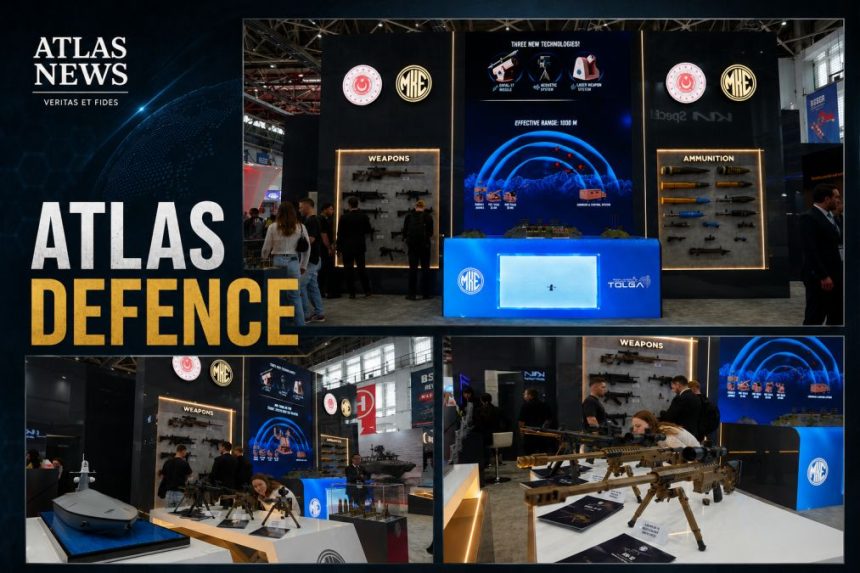
MKE has developed a comprehensive system that can be considered a unique solution for short-range air defence requirements, known as TOLGA SHORAD.”
The MKE official explained that the system employs fragmented ammunition in 12.7 mm, 20 mm, and 35 mm calibres to neutralize drones at significantly lower operational costs compared to conventional missile-based interception systems.
“Instead of using high-cost missiles against low-cost drones, TOLGA provides an effective yet affordable counter-UAV solution. The system can integrate external radars, electronic jamming systems, missile systems, and laser weapons, making it highly adaptable to evolving battlefield requirements.”
“Romania Can Become a Regional Hub”
Atlas News: How does MKE see the evolution of European demand over the next decade, and what cooperation model does it consider realistic with the Romanian industry?
Ali Hakan Şafak: “The European defence market is entering a decade of sustained demand, driven by both capability gaps and the need for industrial resilience. We see future cooperation models evolving beyond simple procurement.
Licensing, co-production, and value-chain integration will become increasingly important. With Romania, we believe a hybrid model is realistic—combining local production, joint development in selected areas, and collaboration for third markets.”
Asked about Romania’s role in MKE’s regional strategy beyond BSDA 2026, the MKE official explicitly pointed to the possibility of Romania becoming a regional industrial and logistical hub for NATO’s Eastern Flank.
“Romania holds significant potential in multiple dimensions of MKE’s regional strategy. It can serve as a strong industrial partner, a production and maintenance hub, and a gateway to the Eastern Flank of NATO.
Its geographic position, industrial base, and political alignment make it uniquely suited for such a role.
For MKE, the goal is not to define Romania under a single function, but to develop a multi-layered partnership—where market access, industrial cooperation, and regional contribution reinforce each other.”
The interview granted to Atlas News by Mr. Ali Hakan Şafak reflects the increasingly visible strategic and industrial convergence between Romania and Türkiye in the defence sector, at a time when Europe is seeking rearmament, industrial resilience and secure supply chains simultaneously. For Bucharest, the central issue is no longer limited to procurement alone, but increasingly concerns Romania’s positioning as a regional actor within NATO’s emerging Eastern Flank industrial architecture.
Read also
B9 Summit Opens Today in Bucharest. Atlas News Present at Cotroceni and BSDA 2026