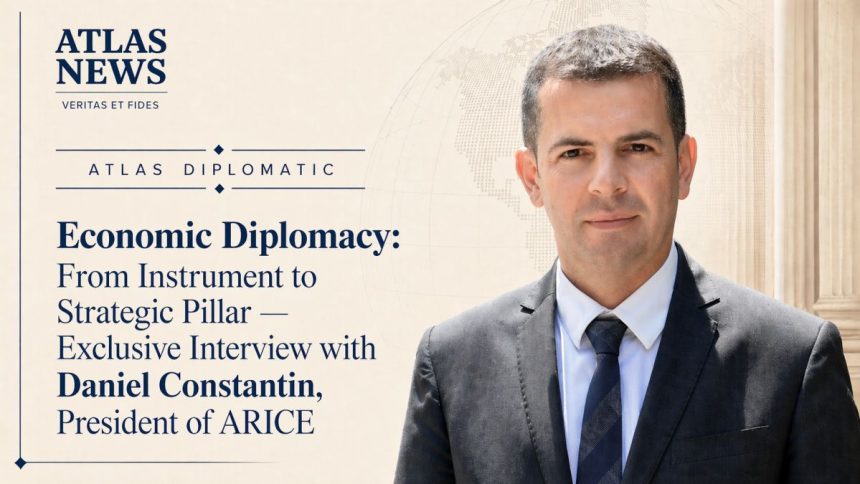
Economic diplomacy occupies an increasingly central place in debates about Romania’s competitiveness and international positioning, in a global context defined by geopolitical realignments, commercial pressures, and intense competition for investment and markets. Daniel Constantin, President of the Romanian Agency for Investment and Foreign Trade (ARICE), granted an exclusive interview to Atlas News România as part of the Atlas Diplomatic series, in which he outlines the institution’s strategic priorities, the instruments available to support Romanian exporters, and his vision for the role economic diplomacy must play in Romania’s national architecture.
Atlas News: In the current international context, marked by economic pressures, geopolitical realignments, and increasingly fierce competition for markets, how important should economic diplomacy become in Romania’s strategic architecture?
Daniel Constantin: Economic diplomacy is by definition the discipline of deploying diplomatic resources, skills, and instruments in the service of economic growth — through attracting foreign investment, promoting the products and services of domestic companies abroad, and fostering partnerships and economic cooperation projects with other states.
In today’s increasingly complex international context, defined by economic pressures, geopolitical realignments, and intensifying global competition, economic diplomacy must be elevated from the status of an important public policy instrument to that of a central strategic pillar of Romania’s national architecture.

We no longer operate in a context where economic diplomacy is optional or merely complementary. It is, in fact, one of the principal instruments through which Romania can secure its long-term economic resilience, competitiveness, and prosperity. The countries succeeding today are those that actively deploy economic diplomacy to position themselves within global value chains, attract strategic investment, and protect their economic interests abroad.
For Romania, this means integrating economic diplomacy at the highest level of strategic decision-making and ensuring full alignment between government institutions, investment promotion efforts, and external economic representation. It must become a coordinated, proactive, and results-oriented mechanism — not a reactive one.
From the perspective of the Romanian Agency for Investment and Foreign Trade, economic diplomacy is essential in both directions: it opens markets for Romanian companies and, equally, firmly anchors Romania on the global investment map. Through our network of economic advisors and institutional partnerships, we actively engage with investors, facilitate strategic projects, support the internationalisation and export capacity of Romanian companies, and communicate Romania’s value proposition in an intensely competitive international environment.
Furthermore, in the context of the reconfiguration of global supply chains, nearshoring dynamics, and competition for strategic industries, economic diplomacy is becoming a decisive competitive advantage. It enables Romania not merely to respond to global shifts, but to anticipate and capitalise on them.
In essence, if Romania aims to consolidate its role as a regional hub for investment, innovation, and industrial development — while strengthening its export performance and the global competitiveness of its companies — then economic diplomacy must be treated as a central engine of national economic policy: fully integrated, adequately resourced, and strategically implemented.
It is not merely important. It is indispensable to Romania’s economic future.
Atlas News: Romania speaks frequently about attracting investment, but far less about supporting exports. Do you believe the Romanian state has for too long underestimated its own interest in building a foreign policy with clear economic objectives?
Daniel Constantin: Attracting foreign investment is closely correlated with export performance, as foreign investing companies play a crucial role in Romania’s economy by generating exports of goods and services. This correlation is the catalyst of economic development — the two objectives cannot be separated.
In this regard, and in the context of Romania’s accession target to the Organisation for Economic Co-operation and Development (OECD), ARICE has developed — in response to recommendations made by OECD evaluation missions in our country — an Export Promotion Strategy, which could serve, in the period ahead, as the foundation from which a National Export Strategy for Romania might be built.
The strategy developed at ARICE level identifies a prioritisation of economic sectors expected to have the greatest impact on export growth and diversification, with the consequence of reducing the trade deficit, as well as directions of action regarding economic diplomacy, strengthening inter-institutional dialogue, and engagement with the Romanian business community.
To this end, the strategy was presented and debated in November 2025 within the Export Council, taking into account contributions received from ten representative sector associations and employer organisations consulted during the drafting process.
Atlas News: From the position you hold today, what is your candid assessment: why does the Romanian exporter not yet perceive the state as a sufficiently powerful ally in external competition?
Daniel Constantin: The Export Promotion Strategy indicates that internationalisation remains a challenge for Romanian companies, reflecting the need for greater education regarding the approach to international markets and the necessity of more intensive use of the governmental instruments and mechanisms designed to support promotion and market entry abroad.
The reluctance of some Romanian firms to engage in export activity — even when many of them possess established product brands — is driven by a complex of factors including mental barriers (fear of the unknown), entrepreneurial education, the use of new technologies, financial instrument protection, and insufficient awareness of international promotion tools.
The dialogue being built between our agency and the Export Council — a non-governmental organisation comprising professional associations, employer federations, and sector-based organisations with economic activity, to whose membership belong representatives of the relevant economic ministries, and to whose observer status belong chambers of commerce and other institutions — aims to draw as many Romanian companies as possible into participating in promotional actions partially financed from the state budget, in order to promote their products and services on external markets.
Atlas News: How can ARICE move beyond the status of an institution perceived as largely formal, and become an actor that genuinely matters in supporting foreign trade and opening markets for Romanian companies?
Daniel Constantin: Building on this key role of economic diplomacy, for Romania this objective translates into strengthening ARICE’s external economic and commercial network, which encompasses, under current legislation, 76 economic representative posts operating within Romania’s diplomatic missions — the so-called Commercial and Economic Promotion Offices (BPCEs) — of which only 32 posts are currently filled.
Through its activity, ARICE’s external commercial and economic network contributes to transforming Romania’s economic presence abroad into an active instrument of economic growth, consolidation of trade relations, and attraction of investment in strategic sectors for Romania’s sustainable development.
The agency’s representatives within these offices are responsible for maintaining contact with the principal entities dealing with economic, commercial, and investment matters in their countries of accreditation; identifying business opportunities and transmitting them to the Romanian business community; facilitating contacts between Romanian companies and external partners; promoting the economic offer of Romanian firms on international markets; and attracting foreign investors to Romania.
In the context of efforts to consolidate and increase the efficiency of the external economic representation network, and to ensure a geographic balance responsive to the dynamics of international economic developments, ARICE intends to act on two fronts:
— the reallocation of some of the existing vacant or vacatable external posts to regions with export and foreign investment attraction potential, particularly in the non-EU space;
— the (re)establishment of certain Commercial and Economic Promotion Offices, including those in Mumbai, Izmir, Tunis, Miami, and others.
Additional steps have recently been taken to consolidate the agency’s standing, including:
— ARICE has been designated as the national coordinating institution at government level for the „Team Romania” team within the Global Gateway Programme, administered by the European Commission, through which the European Union seeks to deliver, at global level, a high-quality offer of smart, clean, and sustainable connectivity, in order to stimulate trade, consolidate value chains, and expand economic opportunities for EU member states and their partner countries. ARICE’s role as national coordinator is to endorse — together with the other institutional partners designated by the Romanian Government, namely the Ministry of Foreign Affairs, which provides the secretariat of Team Romania, Exim Banca Românească, the Investment and Development Bank (BID), and other relevant ministries — projects that may be initiated by Romanian companies in third markets, or in which they may participate alongside those initiated by the European Commission.
— ARICE has submitted to the Prime Minister’s Chancellery a document regarding the opportunity to establish an Inter-Institutional Committee for the attraction of foreign investment and the promotion of exports, with the aim of improving governmental coordination in these areas, in line with internationally recognised best practices, including OECD recommendations.
Atlas News: Where, concretely, are the greatest bottlenecks in Romania’s external promotion system: in the legislative framework, in inter-institutional coordination, in the absence of financial instruments, or in the underutilisation of the diplomatic network?
Daniel Constantin: The promotion of Romanian companies on international markets has been carried out continuously, since the agency’s establishment, in close collaboration with the members of the Export Council. This is evidenced by last year’s figures: participation was organised in 66 international trade fairs and 7 economic missions abroad. In 2025, more than 850 Romanian companies benefited from this integrated set of promotional instruments — encompassing participation in international trade fairs and exhibitions, the organisation of economic missions and business forums, and the facilitation of business-to-business meetings between Romanian companies and external partners, carried out also through ARICE’s external representatives. For this year’s promotional programme, more than 100 promotional actions are planned.
With regard to the legislative framework, at the most recent meeting of the Export Council we initiated the process of amending and supplementing the legislation governing the constitution of the Export Council, its internal rules of procedure, and the Ordinance on the system of export support and promotion partially financed from the state budget.
With regard to ARICE’s external economic network, due to the absence, over the past four years, of any competitive selection process for filling the network’s vacant posts, the network currently has only 32 filled positions out of 76. We have therefore set out to examine the organisation of an internal competition that would, in a first phase, cover approximately 30 to 35 posts, with all remaining posts to be filled in no more than two subsequent phases. It is also relevant to note that the Export Promotion Strategy addressed the necessity — felt acutely against the backdrop of current global developments, including European Commission initiatives to broaden the framework of trade agreements with third countries such as India, Australia, and MERCOSUR — of increasing the number of economic and commercial representatives to nearly 120, and of course of allocating appropriate budgets for the conduct of these activities.
The diplomatic network plays a vital role in this equation. Romania’s embassies and economic representatives hold a primary role in identifying opportunities and facilitating connections. By strengthening coordination, establishing clear priorities, and equipping them with the appropriate tools, we can enhance their contribution to our overall objectives.
Rather than focusing on elements of „blockage”, our approach is one of continuous construction, building on existing strengths, adapting the legislative framework, improving coordination, modernising instruments, and leveraging our diplomatic presence. This forward-oriented approach enables Romania to remain resilient in a complex global environment and to consolidate its position as a competitive actor in international trade and an attractive destination for investment.
Atlas News: Is there today a genuine assessment of the foreign trade apparatus within Romania’s diplomatic missions? And, more importantly, do you believe this network is functioning at the level demanded by the new international economic competition?
Daniel Constantin: As I noted previously, ARICE’s external economic representation network has been in continuous numerical decline over the past fifteen years, reaching its current level of 32 filled posts out of 76 allocated under Government Decision no. 153/2023 establishing the agency. This figure is very low compared with earlier periods — for example, in 2010 the external network had 130 posts — and is likewise significantly below the external networks of other EU member states, including those in Central Europe. Compounding this is the permanent constraint of annual budget restrictions: the BPCEs, for instance, have no funds available for promotional activities.
To give a sense of the complexity of the work performed by ARICE’s external economic network representatives, I will enumerate some of their responsibilities: providing assistance to Romanian companies seeking to enter foreign markets; identifying new cooperation partners or assisting with the establishment of subsidiaries or branches in other countries; maintaining institutional dialogue with external partners in the economic sphere, including organising bilateral economic cooperation mechanisms (joint commissions, cooperation councils, committees, sectoral working groups, etc.); contributing to the economic dimension of actions at the level of the President, Prime Minister, members of parliament, ministers, and other senior officials; disseminating Romania’s product and services offer abroad; transmitting business opportunities identified on external markets; organising events to promote Romania’s economy internationally (forums, seminars, round tables, conferences); organising economic missions to promote exports and providing assistance for individual participation in international trade fairs (beyond those with partial state budget funding); assisting foreign firms seeking supply sources or cooperation partners in Romania; identifying and supporting foreign investors; initiating memoranda of cooperation, bilateral protocols, and so on.
ARICE’s external economic network representatives submit monthly, quarterly, semi-annual, and annual activity reports to ARICE headquarters. A number of their actions — such as organising forums in Romania on the occasion of joint commissions, bilateral consultations, economic missions, or visits by foreign officials — are also carried out with the support and coordination of specialised staff within ARICE’s Department of Foreign Trade.
For a general overview of the principal activities carried out by BPCE representatives, ARICE’s annual reports are available on the agency’s website.
Atlas News: What needs to change for Romanian economic diplomacy to move beyond mere presence and protocol, and become one of results, with clear objectives, target markets, and measurable accountability?
Daniel Constantin: ARICE’s priorities for increasing the efficiency of the external economic representation network centre on ensuring a geographic balance responsive to the dynamics of international economic developments, with particular emphasis on the need to reallocate some of the existing vacant external posts to regions with export and foreign investment attraction potential, as well as to consolidate presence in those regions and countries with which Romania has concluded strategic partnerships.
Our agency’s efforts to revitalise the economic diplomacy component are conducted in permanent coordination with the Ministry of Foreign Affairs and Romania’s diplomatic missions, as well as with other governmental institutions.
Economic diplomacy is an essential component of foreign policy, and in today’s global economic context — marked by geopolitical and commercial challenges and tensions — it must represent the key to ensuring Romania’s active and adaptable presence within global ecosystems.
Atlas News: One of the recurring criticisms from the business community is that Romanian exporters do not benefit sufficiently from guarantees, credits, and support instruments comparable to those available in other countries. How serious is this vulnerability, and how can it be addressed?
Daniel Constantin: Financial support for exports is provided by our agency through the Export Promotion Programme, with partial financing from the state budget and in compliance with European Commission rules on the granting of de minimis aid. This programme is implemented at the request of the business community, through consultation with the Export Council. The participation of Romanian companies in international trade fairs and economic missions abroad offers them the opportunity to promote their products and services to international partners, contributing to the consolidation of trade relations and the opening of new export channels.
These de minimis aid schemes are implemented across all EU member states, designed to support the growth of SMEs’ and start-ups’ competitiveness across various economic sectors.
Other forms of financial support for Romanian exporters — such as export credits and guarantees — fall under the administration of Exim Banca Românească, while the more recently established Investment and Development Bank (BID) was created to stimulate sustainable economic development, enhance competitiveness and innovation, and facilitate access to finance.
Atlas News: If you were to identify three concrete measures that could be set in motion relatively quickly to strengthen the external position of Romanian companies, what would they be?
Daniel Constantin:
1. The creation of a country brand, complemented by sectoral brands
2. The improvement of export support and promotion mechanisms, including their adequate budgetary allocation
3. The enhancement of Romanian products’ competitiveness through innovation
Atlas News: If this interview opens a broader debate about the future of Romanian economic diplomacy, what would your message be to those who believe Romania can still rebuild a more ambitious, better-prepared diplomatic tradition, one more firmly oriented towards the national interest?
Daniel Constantin: Being a good diplomat requires a body of knowledge encompassing foreign policy, economics, trade policy, communication, and public diplomacy, complemented by linguistic, negotiation, and protocol competencies.
By raising awareness of the importance of commercial diplomacy, we will be able to position Romania as a dynamic actor on external markets.