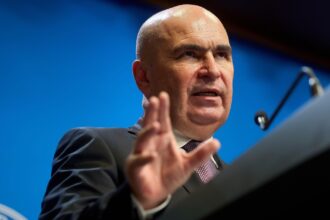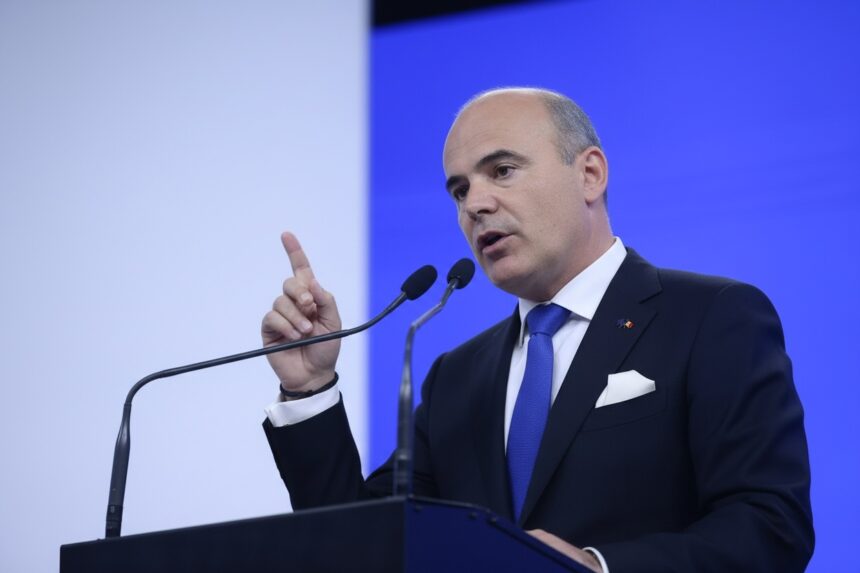
Amid the political crisis triggered by PSD’s withdrawal of support for Prime Minister Ilie Bolojan, the National Liberal Party (PNL) convened on Tuesday in an extended meeting of its National Political Bureau to define its course and reconfirm its backing for the head of government. In this tense context, Rareș Bogdan delivered one of the most forceful interventions within the party, publicly reaffirming his conservative line and warning that PNL must not lose its fundamental benchmarks. His most direct message targeted the party’s identity: “I have said before that I do not want the Rainbow Flag on PNL headquarters; I want the Romanian flag and the Christian Cross, because we stand for family and tradition, not other unnatural things.”

His intervention, however, went well beyond the statement that quickly dominated the public space. Rareș Bogdan articulated a broader message structured around three core axes: the party’s doctrinal identity, responsibility for the direction of governance, and the need to reconnect with PNL’s traditional electorate.
The MEP criticized the party leadership for becoming overly reactive and for losing political initiative. In his view, the problem is not one of communication or style, but of substance: a party that has been in government for six and a half years cannot credibly claim to be discovering now realities it should have long understood and addressed. He also pointed out that some party leaders appear to be only now acknowledging the anti-reformist nature of PSD — a reality that, in his assessment, has long been evident and should not come as a surprise.


PNL between identity and a disconnect from its electorate
One of the central themes of his intervention concerned the party’s relationship with its own electoral base. Rareș Bogdan warned that PNL cannot abandon rural Romania and smaller urban areas in favor of large metropolitan centers. His argument was direct: 63% of Romanians live in small urban communities and rural areas, and ignoring this segment is not merely a strategic misstep — it represents a disconnect from the country’s social reality. PNL must neither dilute its core benchmarks nor lose its anchoring in a value framework that remains recognizable to its electorate.
Responsibility for governance and the limits of compromise
The most severe tone of his intervention targeted the state of the economy and the failures in the absorption of funds under the National Recovery and Resilience Plan (PNRR). Rareș Bogdan warned that it is deeply problematic for the party to appear to be “turning on the lights” only now, while some of the individuals appointed to boards of directors with an anti-reformist profile have been supported even by ministers and representatives from within PNL’s own sphere of influence. His criticism did not stop at the political opponent — it extended directly into the party’s internal ranks.
The party’s European profile was also called into question. Rareș Bogdan stated that he does not see how he could explain in Brussels, to his colleagues, any potential negotiations with parties such as those led by Geert Wilders, AfD or Vox — an alignment which, in his view, would undermine PNL’s credibility within the European political space. In the same vein, he rejected the idea of turning the President of Romania into a political target and advocated instead for a genuine partnership between the party and the head of state.
Rareș Bogdan’s intervention brought together, within the same framework, conservative values, political initiative, governance, the economic crisis, the absorption of PNRR funds, and the limits of compromises that could carry significant costs for PNL at the European level — a clear message of positioning, delivered at a moment when the party is, under pressure, searching for a new direction.