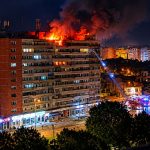
Iran war global tourism map changed abruptly on February 28, 2026, when the first U.S.-Israeli strikes hit Iran. At that moment, tens of thousands of passengers were waiting to board in the major air hubs of Dubai, Doha, and Abu Dhabi. Within hours, those same terminals were nearly empty. Aircraft were grounded. Marine insurers refused to cover transit through the Strait of Hormuz. Hotels on Palm Jumeirah began receiving waves of cancellation requests.
Dubai did not need to be bombed. It was enough for the world to watch missiles being intercepted above it.
That is the defining lesson of the 2026 tourism crisis: in the travel industry, perception can matter more than reality. And perception changed in a matter of hours, after two decades in which the Persian Gulf had invested heavily in presenting itself as an oasis of stability in a volatile region. That image — the region’s most valuable tourism asset — was not destroyed by bombs, but by viral footage of missile defense systems activated above the glass towers of one of the most photographed cities in the world.
What follows is a large-scale redistribution of global tourism flows, with winners and losers that do not always follow the most obvious geographic logic.

The scale of the collapse
Tourism Economics, the specialized division of Oxford Economics, has published two scenarios measuring the impact of the conflict on Middle Eastern tourism in 2026. Both are severe.
In a rapid-resolution scenario lasting between one and three weeks, the region would record an 11% decline in international arrivals compared with 2025, equivalent to 23 million fewer visitors and $34 billion in losses. In a prolonged-conflict scenario of roughly two months, the numbers deteriorate sharply: a 27% drop in arrivals, 38 million lost visitors, and $56 billion in evaporated revenue. The World Travel & Tourism Council estimates that, during the acute phase of the crisis, the Middle East is losing around $600 million per day from tourism alone.
To understand why these figures have global consequences rather than merely regional ones, one technical point is essential. Before the conflict, the three major Gulf hubs accounted for roughly 14% of global international transit traffic. Dubai, Doha, and Abu Dhabi are not just tourism destinations; they are central nodes in the connective architecture linking Europe, Asia, and Africa. Their disruption does not simply redirect holidaymakers. It also reshapes airline routes, tour operator contracts, and hotel strategies across the medium term.
Another overlooked technical point is equally important: Iran did not close the Strait of Hormuz through a classic naval blockade. Instead, it used inexpensive drones to paralyze marine insurers. The same logic applies to tourism. It was not the objective reality of danger, but the perception of danger, that emptied hotels in Dubai in less than a week.
The losers — an unpleasant surprise on the map
The statistical picture of the losers comes from Mabrian, the travel intelligence company that measures real travel intent through the analysis of millions of flight searches in key source markets — the United States, the United Kingdom, Germany, France, and Italy. Through its Perception of Security Index (PSI), Mabrian captures not what tourists say in surveys, but what they actually do when they search for a holiday.
Bahrain suffered the steepest collapse in perceived security, with its score falling by 81 points to 9.6 out of 100. Oman lost 56.7 points, dropping to 24.8. Qatar declined by 54.9 points to 18.4, compounded by the Iranian attacks on the Ras Laffan complex and QatarEnergy’s force majeure declaration. The United Arab Emirates, the most resilient state in the Gulf, lost 48.3 points, remaining at 51.9. Saudi Arabia, with a more limited decline of 13.6 points to 85.3, remains the least affected in the bloc.
The case of Cyprus best illustrates the mechanics of perception. The island is not in the conflict zone, did not suffer relevant direct attacks, and issued no travel warning of its own. Yet bookings for March and April 2026 dropped by 40%, according to Aegean Airlines and tour operators cited by Reuters. The Central Bank of Cyprus revised its 2026 GDP growth forecast from 3.0% to 2.7% on that basis alone. Cyprus paid the price of its position on the map, not of real danger. It is perhaps the clearest available example of how risk psychology works in tourism.
Turkey illustrates the same mechanism on a larger scale. With more than 50 million international visitors in 2025, Turkey should theoretically have been among the main beneficiaries of redirected demand from the Gulf. Mabrian’s data show the opposite. Turkey’s share of global flight searches fell by 0.46 percentage points compared with the same period in 2025, reaching 2.61%. The drop may appear modest in absolute terms, but it is significant in context because it comes precisely when competing destinations are gaining ground. Iranian missiles landed or were intercepted on Turkish territory — an incident confirmed by Ankara. The fact that President Erdoğan deliberately chose not to invoke NATO Article 5, for reasons of his own diplomatic calculation, did not change how European tourists read the headlines and made their booking decisions.
The winners — what the redistribution data show
The redistribution of demand is measurable, not speculative. Mabrian has published shifts in global market share in flight searches, compared with the same period in 2025, based on millions of searches recorded between February 28 and March 14, 2026.
The emerging picture is clear. Spain leads with a 2.99% share of the global market, up 0.38 percentage points — the largest absolute gain among all destinations analyzed. Italy follows with 2.62% and a gain of 0.23 points. Greece records a modest increase of 0.05 percentage points, reaching 0.75% — a real benefit, though far from the boom often implied in headlines. Portugal does not appear separately in Mabrian’s published data, but Ryanair CEO Michael O’Leary publicly confirmed a sharp rise in demand for Lisbon and comparable destinations.
Even more notable is Egypt, which posted the strongest percentage gain among all destinations in Mabrian’s analysis — up 0.47 percentage points, reaching a 2.14% global market share.
Egypt — how loss turns into opportunity
At first glance, Egypt does not appear an obvious winner. It lies in the same broader region, borders the area of instability, and initially suffered from the same contagion of perception. Its PSI fell by 32.6 points in the U.S. market, reaching its lowest level, while some European operators reported cancellations for Egypt in the first days of the war.
What happened next is revealing. Egypt recovered quickly and moved above its pre-conflict level of travel intent, outperforming all European destinations in market-share gains. The explanation is not geopolitical but cultural. The Grand Egyptian Museum, fully opened in 2025 and now the largest museum of antiquities in the world, has transformed Cairo into a cultural pilgrimage destination for European travelers. Easter 2026 charter flights from Spain had already sold out in November 2025, before the conflict began. Hurghada and Sharm el-Sheikh continue to operate normally, thousands of kilometers away from any active theater of operations. Egyptian airspace remains open.
Egypt has achieved something rare: it has managed to leave the mental equation of regional risk while staying fully inside the equation of appeal. That position remains fragile. Any change in Western government travel advisories could reverse it quickly. For now, however, Egypt demonstrates that in tourism, narrative matters almost as much as geography.
Morocco — confirmed by data, not just sentiment
Morocco has been repeatedly cited by tour operators in Germany and the United Kingdom as a destination gaining momentum. British travelers are moving toward Marrakech and Agadir, while German demand has placed Morocco alongside Greece among the preferred substitutes for canceled or postponed Gulf holidays.
Unlike earlier iterations of this analysis, Mabrian’s data now confirm that shift. Morocco records a 0.74% global share in flight searches, with an increase of 0.74 percentage points compared with the same period in 2025. That is a remarkable relative gain, even if Morocco still operates on a smaller absolute base than Spain or Italy. Its structural advantages are clear: sufficient distance from the conflict, direct air connections from across Europe, and an attractive combination of exotic appeal and relative affordability. Morocco is no longer just a plausible beneficiary. It is a market-validated winner.
Why the redistribution will outlast the conflict
There is a tendency in economic analysis to treat tourism crises as temporary shocks, lasting a few months before flows normalize. Recent history suggests something more persistent.
After the Arab Spring in 2011, tourism in Egypt and Tunisia suffered severe declines that lasted several years, even though the most acute political instability was much shorter. Southern Europe became the direct beneficiary. Risk Perception Theory, consistently applied in tourism behavior studies, suggests that once a destination becomes associated with instability in the collective memory of source markets, restoring its security brand may take two to three times longer than the event that triggered the damage.
The Persian Gulf enters this crisis with an additional disadvantage. Images of missiles being intercepted above some of the most recognizable skylines in the world spread instantly across social platforms. A tourist planning an August holiday does not think statistically; he visualizes. And what he now visualizes are missiles above Palm Jumeirah, not probability models of attack.
There is also a broader economic factor intensifying and prolonging the shift. Crude oil climbed above $100 per barrel after February 28, peaking at $126. Airfares are rising globally, and that dynamic structurally benefits destinations reachable by short-haul flights. The European traveler recalculates almost instinctively: a three-hour flight to Barcelona or Hurghada appears more attractive than a seven-hour flight to a destination already linked, fairly or unfairly, to conflict.
Eastern Europe and Romania — a rare window of opportunity
In this equation, Eastern Europe and Romania occupy an intermediate position. They are neither among the immediate winners nor among the obvious losers, but they may emerge as secondary beneficiaries of a trend that many models still overlook.
The mechanism is straightforward. When Spain and Italy begin operating near full capacity during the summer season — as becomes highly likely if redirected Gulf demand materializes at the projected scale — prices rise, and part of that demand shifts toward more affordable alternatives. Romania enters that equation through the Black Sea coast, the Danube Delta, and its mountain destinations. Not as a substitute for Gulf luxury hubs, but as an option for medium-budget Western European travelers who discover that Mykonos or the Amalfi Coast are no longer financially accessible.
There is also a diplomatic argument that has not been commercially used to its full potential. On March 21, Romania signed the joint declaration on securing the Strait of Hormuz, alongside the United States, Canada, the Baltic states, and Australia. The geopolitical stability of NATO’s eastern flank — to which Romania contributes in concrete terms — is an image advantage that the Romanian tourism industry has never fully integrated into its international marketing narrative.
Nothing disappears — it is redistributed
The $56 billion the Middle East risks losing from tourism in 2026 will not disappear from the global economy. It will be redistributed. The available data indicate that Spain and Italy are absorbing much of the immediate redirected demand, Egypt is recovering strongly thanks to a carefully built cultural advantage, Morocco is gaining with firm data now behind it, and Greece is benefiting, though more modestly than headlines often suggest. Turkey and Cyprus, by contrast, are paying a disproportionate price for actual or perceived geographic proximity.
What no forecast can model precisely is duration. Every additional week of conflict reinforces the new booking behavior of the global traveler and widens the distance from the period when the Persian Gulf appeared to be the safest place in the world for a luxury holiday. Four weeks after February 28, the redistribution is no longer a short-term anomaly. It is beginning to take on the contours of a structural shift.
Sources: Tourism Economics / Oxford Economics — official report, March 2026 | World Travel & Tourism Council (WTTC) | Mabrian by Data Appeal — Perception of Security Index (PSI) and Share of Searches Index, February 28–March 14, 2026 | Cirium Aviation Analytics | Reuters | Michael O’Leary / Ryanair — public statements | Euronews Travel | CNN Travel | Aegean Airlines | Breaking Travel News | Atlantic Council
Read also