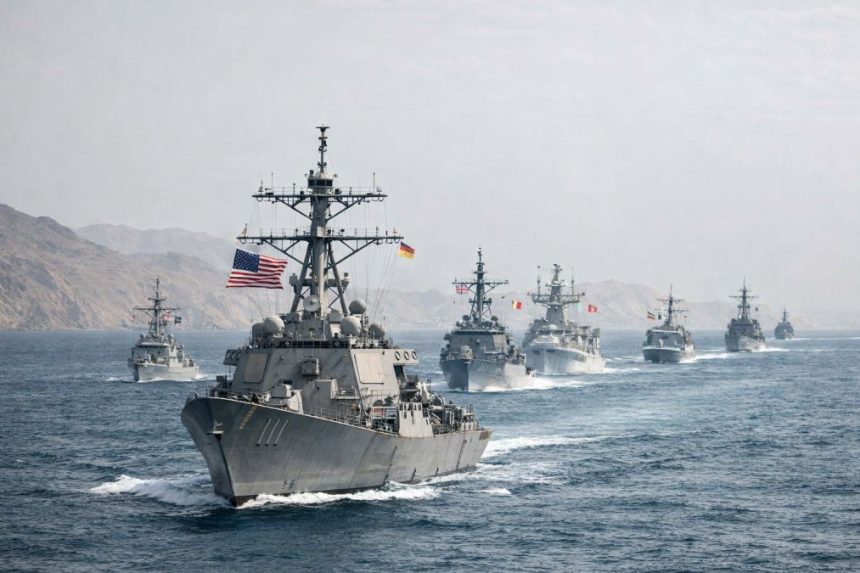
Within seventy-two hours, the governments of France, Germany, Italy, Japan and the United Kingdom moved from categorical public rejection to formal co-endorsement of a joint statement on the Strait of Hormuz. The shift was not the product of a revised military assessment, a new legal interpretation of the conflict, or a change in declared political values. It was, by all available evidence, the result of compounding economic pressure — and a carefully calibrated political calculation about the cost of continued non-alignment with Washington.
The episode offers one of the clearest recent illustrations of how contemporary Western alliances fracture, reconstitute, and ultimately cohere — and what actually drives that process when shared values prove insufficient.
The Context: A De Facto Closure and Its Consequences
On 28 February 2026, the United States and Israel launched Operation Epic Fury, a coordinated air and maritime campaign targeting Iranian military infrastructure. Iran’s response was immediate and far-reaching. An IRGC senior commander announced that the Strait of Hormuz was closed, and that any vessel attempting passage would be intercepted by Revolutionary Guard and regular navy forces.
The combination of kinetic attacks on commercial vessels, sustained GPS jamming across Gulf waters, and explicit Iranian threats created conditions under which commercial operators largely halted movement or withdrew from the region entirely. At least 150 tankers were anchored in open Gulf waters by early March. Major carriers including Maersk, CMA CGM and Hapag-Lloyd suspended transits, with vessels rerouting around the Cape of Good Hope, adding ten to fourteen days to journey times.

Oil prices surged above one hundred dollars per barrel from a pre-war level of approximately sixty-five dollars — an increase of more than forty percent. European natural gas prices followed. The International Energy Agency’s thirty-two member states unanimously agreed to release four hundred million barrels of oil from emergency reserves in an attempt to stabilise markets. The strait closure had become the central economic crisis of the conflict.
The Initial Response: A Collective Refusal
Washington’s appeals for allied military support met with categorical and public rejection across multiple capitals.
A German government spokesperson stated that for as long as the war continued, Berlin would not participate — not even in any effort to keep the Strait of Hormuz open by military means. France’s position, articulated by President Macron, was that France was not party to the conflict and would not participate in operations to reopen the strait in the current context. Prime Minister Starmer told the media that the United Kingdom would not be drawn into the wider war. Greece similarly ruled out any military engagement.
Japan maintained studied silence. Its economy is structurally dependent on Gulf energy: 95 percent of its crude oil imports originate in the Middle East, with 70 percent of that volume transiting the Strait of Hormuz. Tokyo’s exposure was acute — but its public posture remained non-committal.
The alignment of these refusals was notable. Governments that differed on most aspects of foreign policy — France and Germany, Japan and Australia, the Baltic states and the larger European powers — converged on the same position: this was not their war, and military involvement was not on offer.
The Pressure Applied
On 20 March, President Trump posted on Truth Social: „They complain about the high oil prices they are forced to pay, but don’t want to help open the Strait of Hormuz,” describing the operation as „a simple military maneuver” and the strait’s closure as „the single reason for the high oil prices.” He concluded: „So easy for them to do, with so little risk. COWARDS, and we will REMEMBER!”
In a separate post, Trump warned that without the United States, NATO was „A PAPER TIGER” — a formulation that allied governments interpreted not as rhetorical frustration but as a standing signal about the future terms of transatlantic relations.
The subtext was understood across allied capitals: failure to contribute to a Hormuz coalition was likely to be cited in every subsequent negotiation over trade access, defence guarantees, and the architecture of the alliance itself. The threat of being remembered was, in diplomatic terms, a threat with concrete and durable consequences.
The Mechanics of Reversal
Behind the scenes, the United Kingdom had been working for several days to assemble as many co-signatories as possible. NATO Secretary General Marc Rutte was part of that effort. German Chancellor Friedrich Merz was deeply sceptical. French President Macron opposed forming any coalition except as part of a post-war agreement with Iran. With Paris withholding support, many other European governments declined to move forward.
On the morning of 19 March, Secretary General Rutte and Prime Minister Starmer spoke directly with Macron and persuaded him to lift his objection to a political declaration of support, while deferring questions of operational commitment to a later stage.
Japan’s adhesion followed a parallel and distinct logic. Prime Minister Sanae Takaichi was due to meet President Trump at the White House that same day. Iran had signalled a readiness to facilitate safe passage for Japanese vessels — but Tokyo calculated that attending Washington without a tangible gesture of alignment carried costs that outweighed the risks of signing. Japan joined the statement at the last moment.
The resulting declaration, published on 19 March 2026, was signed by the leaders of the United Kingdom, France, Germany, Italy, the Netherlands, Japan, Canada, the Republic of Korea, New Zealand, Denmark, Latvia, Slovenia, Estonia, Norway, Sweden, Finland, Czechia, Bahrain and Lithuania. Hours later, London went further still: the British government authorised the use of its military bases for United States strikes against Iranian missile sites targeting commercial shipping in the strait.
The Declaration and Its Limits
The text of the joint statement warrants precise reading. The signatories condemned Iranian attacks on unarmed commercial vessels, called on Iran to cease the laying of mines and to halt drone and missile attacks, and affirmed that freedom of navigation is a fundamental principle of international law under the United Nations Convention on the Law of the Sea.
What the statement does not contain is equally significant. It includes no commitment to deploy naval vessels or any other military assets. By the assessment of those directly involved in its negotiation, the declaration was primarily a political gesture — intended to provide President Trump with visible evidence of allied solidarity without binding any government to operational participation.
France, Germany, Italy and Japan had all previously ruled out, explicitly and publicly, the deployment of warships to the strait during active hostilities. Whether any of them intends to revise that position following the declaration remains unclear. Several allies subsequently reaffirmed that they would not participate militarily until hostilities had ceased.
Trump acknowledged the gap. On the same day he described allied governments as cowards, he signalled that the United States was considering a reduction in its military operations against Iran — and stated that the Strait of Hormuz would henceforth need to be guarded and policed by the nations that use it, explicitly noting that the United States did not consider itself among them.
The Structural Logic: Vulnerability as the New Cement
The pattern that emerges from this sequence carries implications well beyond the specifics of the Hormuz crisis.
No government changed its position because of a revised legal or strategic assessment of the conflict. The shift from refusal to endorsement correlated, in each case, with the point at which the economic cost of non-alignment — measured in energy prices, supply disruption, inflationary pressure, and political exposure in Washington — exceeded the domestic political cost of signing.
France faced a sixty percent increase in natural gas prices relative to pre-conflict levels. Germany confronted structural risks to an already fragile industrial economy. Japan faced both acute supply disruption and the prospect of entering a White House meeting without a gesture of goodwill. South Korea and other LNG-dependent economies were exposed to force majeure declarations from Gulf suppliers.
China, which imports approximately forty percent of its crude oil and thirty percent of its LNG through the Strait of Hormuz, did not associate itself with the coalition. Beijing holds strategic petroleum reserves estimated at approximately 1.4 billion barrels, providing a buffer that reduced the immediacy of its economic exposure and, with it, the incentive to align. The contrast is instructive: where the buffer existed, the pressure to endorse was absent.
The pattern suggests a general principle governing current alliance behaviour. Solidarity holds when the economic cost of non-alignment exceeds the political cost of commitment. It holds only formally — or not at all — when the calculation runs the other way.
What the Declaration Opens
Trump’s signal that the United States was considering winding down operations came with an explicit transfer of responsibility: the strait would need to be guarded and policed by the nations that use it. This opens a considerably more demanding negotiation than the one that produced the declaration of 19 March.
The United Kingdom has already sent military officers to CENTCOM headquarters in Tampa, Florida, to begin planning for a Hormuz security coalition. Translating that planning into operational reality — with naval vessels, mine-clearance capabilities, rules of engagement, command arrangements, and force contributions from governments that have not yet committed to any of these — is a task of an entirely different order from signing a joint statement.
Which governments prove willing to move from political endorsement to operational participation will determine the practical architecture of Gulf security for the years ahead. The gap between the two is not procedural. It is the distance between an alliance that functions and one that performs.
What the Hormuz episode ultimately reveals is not a temporary fracture in Western cohesion, but the emergence of a structural pattern: alliances in their current form are no longer activated by political consensus but triggered by economic exposure. In the absence of shared strategic vision, what produced alignment was not common values, common leadership, or common threat perception — but common vulnerability. That inversion carries consequences well beyond the strait. It suggests that the durability of collective Western action will, going forward, be determined less by political will than by the depth of economic interdependence — and by whoever proves willing to leverage it.
Read also
NATO Without the United States: The Anatomy of a Strategic Shock for Europe