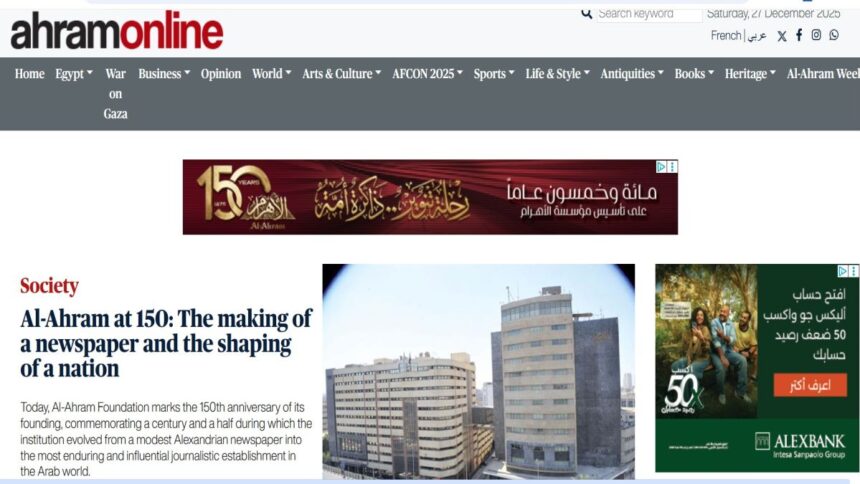
Few newspapers can credibly speak of a legacy that spans radically different eras without their name becoming merely a symbol of the past. Al-Ahram remains one of those rare exceptions: a global press institution, a cornerstone of Egyptian journalism, and a reference point for the Arab media landscape—built on continuity, authority, and a sustained sense of editorial responsibility.
Over the past 150 years, Al-Ahram has evolved from a printed daily into a comprehensive editorial institution, respected nationally and recognised internationally. In a media environment defined by constant transformation, such continuity is not the result of inertia, but of deliberate, long-term effort—grounded in professional rigour and an ability to adapt without losing editorial identity.
From Print Origins to an Institution with Editorial Memory
Al-Ahram’s history runs in parallel with that of modern Egypt itself. Across generations, the newspaper has documented profound transformations: political transitions, regional realignments, moments of crisis, and periods of renewal. In doing so, it has not merely reported events, but has contributed—through disciplined journalism—to the public conversation that shapes a society’s understanding of its own trajectory.
What distinguishes Al-Ahram is not only its longevity, but its capacity to preserve a clear and recognisable editorial character while journalism as a profession has been compelled to reinvent its formats, platforms, and rhythms. The transition to digital publishing, the outreach to international audiences, and the diversification of editorial formats have been pursued without sacrificing clarity, balance, or analytical depth—qualities that remain central to the publication’s standing.

Journalism as a Reference Point in a Complex Region
The Middle East remains one of the world’s most sensitive and dynamic geopolitical regions. In such an environment, journalism never operates in a vacuum, and editorial responsibility carries particular weight. Al-Ahram has succeeded in positioning itself as a point of stability and coherence, offering a structured and measured approach to understanding regional realities.
Through its various editions and its international-facing content, the newspaper has become a reference point for readers seeking to understand Egypt and the wider region through an informed, balanced, and contextualised lens. The ability to address diverse audiences while maintaining internal coherence stands among Al-Ahram’s most enduring editorial achievements.
Amr Yehia — A Voice That Strengthens Al-Ahram’s Contemporary Presence
Strong media institutions are defined not only by archives and tradition, but also by the journalists who give them a living voice in the present. Within Al-Ahram, Amr Yehia stands out as one of the recognisable voices of its international edition and an important contributor to the publication’s professional profile abroad.
With solid experience and a consistent editorial presence, Amr Yehia has distinguished himself through articles and interviews focused on diplomacy, international relations, and events of strategic relevance. His work reflects rigour, balance, and a capacity to situate facts within a broader context—providing readers with clarity in complex subject areas.
Beyond the newsroom, his participation in international dialogues and forums positions him not only as a journalist, but as a professional representative of Al-Ahram in settings where journalism intersects with analysis and diplomacy. Such voices underscore the reality that Al-Ahram is not only an institution shaped by history, but one firmly engaged with the present.
A Lesson in Building Media for the Long Term
For contemporary journalism, Al-Ahram’s trajectory offers an essential lesson—not about scale or momentary influence, but about long-term construction, editorial discipline, and respect for readers. In an era defined by speed, fragmentation, and short attention cycles, institutions that have endured demonstrate that serious journalism remains both possible and necessary.
Al-Ahram shows that institutional journalism is neither improvised nor built on passing trends, but earned through continuity, professionalism, and a sustained sense of responsibility toward the public sphere.
A Message of Appreciation from Atlas News
Atlas News, the fastest-rising media project of 2025 in Romania, expresses its open admiration for Al-Ahram’s editorial journey and for the way this institution has combined tradition with contemporary relevance.
We regard Al-Ahram not only as a symbol of press history, but as a living institution—sustained by journalists who give substance to the present and continuity to the future.