The Hidden Face of Change in Budapest
On the surface, the picture appears straightforward. Viktor Orbán is leaving office after 16 years in power. Péter Magyar and Tisza have secured a two-thirds constitutional majority, winning 138 of 199 seats in an election marked by turnout of nearly 80%. Markets have welcomed the prospect of unfreezing European funds, the forint has strengthened, Brussels is breathing more easily, and Western capitals are reading the result as Hungary’s return to the European orbit. Reuters captured precisely this Western interpretation of the moment, while European Commission President Ursula von der Leyen summed up the mood in Brussels with a line that says almost everything about how the result has been understood: “Europe’s heart is beating stronger in Hungary tonight.”
This is precisely where serious analysis begins, not where it ends. Spectacular political change often produces an old confusion: the fact that a government is detested by the establishment does not guarantee that replacing it will better serve the national interest of the state in question. What appears to be a moral liberation can, in practice, become a narrowing of negotiating room, a more disciplined reintegration, and a change whose real costs emerge only after the euphoria of victory has faded. The real question is not whether Hungary looks better in the West’s post-election photograph, but whether it will be better positioned in terms of its own strategic interest.
Relevance Through Friction: What Hungary May Lose as It Gains Respectability
Under Orbán, Hungary was isolated, criticized, and portrayed as the European Union’s internal problem. Yet Budapest was, at the same time, impossible to ignore. It mattered in major dossiers precisely because it did not move automatically in the direction of the European center. It blocked, delayed, negotiated hard, and turned the status of an awkward actor into an instrument of real influence. Reuters and Associated Press describe exactly this paradox: Orbán became increasingly isolated in the West, but that very isolation preserved for Budapest a disproportionate relevance inside the EU.
Replacing this formula with a more conciliatory one may bring institutional respectability back to Budapest. The risk is that Hungary could lose precisely what made it relevant over the past decade: the ability to force the European center to negotiate. A country that is more easily accepted is not automatically a more influential country. It can very quickly become a more predictable country for Brussels, and less able to convert its own dissent into political leverage. From this perspective, the change in Budapest is not merely a democratic alternation in power; it is also a test of how much autonomy a mid-sized Central European state can preserve once it abandons a strategy of confrontation.
European Funds: Not a Reward, but a Mechanism of Conditionality
The central pillar of post-election enthusiasm is the prospect of unlocking the billions of euros frozen by the European Union. The financial picture is broader than it usually appears in immediate commentary. The Council of the European Union states that roughly €6.3 billion was suspended under the rule-of-law conditionality mechanism, while the European Parliament notes that Hungary’s Recovery and Resilience Plan amounts to €10.4 billion. At the same time, Reuters reported that investors have begun betting on the release of a total volume of around €18 billion, while European Newsroom reported that more than €1 billion was already lost permanently at the beginning of 2026.
These funds will not be released as a reward for Orbán’s departure alone. They will come, if they come at all, in exchange for verifiable reforms, institutional alignment, and a much clearer relationship of compliance with the Commission’s requirements. Reuters notes that the immediate and realistic objective is the release of more than €6.4 billion from recovery funds, but also that European diplomats and rating agencies are waiting for tangible reforms, not political enthusiasm. In other words, Hungary may secure vital financial resources, but only by moving more deeply into a system of political conditionality that the previous government denounced precisely because it limited the state’s decision-making sovereignty.
The essential distinction is this: access to money and the gain of autonomy are not the same thing. A government can receive European financing and, simultaneously, lose strategic room for manoeuvre. It can become fiscally more stable and politically more dependent. That is why, for part of Hungary’s conservative electorate, the question will not simply be how much money comes in, but what kind of governance must be accepted in order for that money to arrive.
Tisza Is Not the Total Rupture the Triumphalist Narrative Suggests
One element systematically overlooked in the post-election euphoria is Péter Magyar’s real profile. He is not a laboratory-made Brussels liberal. Reuters describes him as the leader of a center-right party that emerged from within the Fidesz ecosystem, with a pro-Western program but with conservative reflexes preserved on several sensitive issues. Tisza promises anti-corruption measures, institutional reconstruction, and euro adoption by 2030, but it does not propose a complete dismantling of Hungary’s sovereignist line.
More importantly, the underlying tension is visible in foreign and European policy. The European Policy Centre, drawing on an Eulytix analysis , argues that Tisza’s MEPs have shown tactical alignment with Fidesz on dossiers such as Ukraine, migration, and agriculture. In parallel, Reuters notes that Magyar opposes Ukraine’s accelerated accession to the EU and rejects a rapid move away from Russian energy, which he sees on a timeline extending to 2035 rather than in the pace demanded by Brussels. The difference from Orbán is not one of substance in every respect, but above all of tone, style, and willingness to repair relations with the West.
This means that the underlying tension does not disappear with the change of government; it merely shifts. Brussels projects onto Tisza the hope of a fully reintegrated and disciplined Hungary. The domestic electorate that voted for it is not expecting Budapest’s strategic capitulation, but rather a more competent, less corrupt, and less toxic version of the Hungarian national interest. If these two expectations come into conflict, and the conditions for such a conflict are clearly present, Tisza will find itself caught between external applause and internal frustration. In the same register, ECFR suggests that a change of power in Budapest does not automatically amount to a total change of strategic paradigm.
Total Victory Can Manufacture Total Disappointment
The more categorical the victory, the greater the expectations become, and the less room remains for excuses. The more insistently change is sold as an exit from darkness and an entry into normality, the more the new government inherits not only the state, but also an immense emotional debt to its own electorate.
In Central and Eastern Europe, this pattern is already recognizable. Electoral campaigns often elevate change to the rank of a universal remedy: the old regime is presented as the source of all blockages, and its simple replacement is packaged as a rapid solution for markets, investment, monetary stability, and prices. Yet it is precisely after victory that the real constraints begin to show: strained budgets, painful reforms, external conditionalities, slow administrations, and costs that do not disappear merely because the name at the top of power has changed. Reuters already warns that market optimism does not automatically mean easy reforms or quick money.
An electorate that votes for historic change does not judge the new government by the elegance of Brussels’ reactions, but by the pace at which it changes everyday life: bills, prices, wages, investment, infrastructure. A two-thirds majority provides institutional strength, but it also raises the standard of delivery to an almost impossible level. If too large a gap opens between external applause and internal expectations, the very vote that today appears to be a historic liberation may, within a year or two, turn into a new collective frustration. It is not the promise of change that produces disappointment, but the exaggerated promise of a cost-free change.
Energy: The Most Concrete Cost of “Normalization”
The energy dossier is probably where the change in Budapest may produce the fastest political tensions. Reuters reports that the state energy group MVM was importing around 3.5 billion cubic metres of Russian gas annually in a country whose consumption stands at roughly 8 billion cubic metres per year. At the same time, the company had already prepared alternatives, including 1 billion cubic metres via the Krk LNG terminal and additional volumes from Shell and Engie, but it acknowledges that replacing Russian gas will increase prices, including because of transport costs. In other words, disentanglement from Russia is technically feasible, but not economically neutral.
At the same time, the European framework has tightened decisively. The Council of the European Union adopted, on 26 January 2026, the regulation on the gradual prohibition of Russian gas imports by pipeline and LNG. This means that Budapest’s room for manoeuvre will depend not only on the political will of the new government, but also on European legislation already in motion. And Reuters notes that Magyar himself speaks of ending dependence on Russian energy only by 2035, far beyond the European target.
If the price of Hungary’s “re-westernization” is perceived by the public as higher bills, weaker industrial competitiveness, and less affordable energy, the symbolic victory over Orbán could produce a very concrete political loss for his successors. Geopolitics ultimately translates into cost of living.
What Europe Loses with Orbán’s Disappearance
Europe gains from this change a more fluid decision-making mechanism. Orbán repeatedly blocked major dossiers, from aid to Ukraine to sanctions and the management of Kyiv’s European track, and the disappearance of this resistance simplifies procedures and reduces the political cost of internal consensus. Reuters and Associated Press show clearly how strong the sense of relief was in European capitals.
But a more fluid Europe is not necessarily a more reflective Europe. Orbán forced the Union to confront, uncomfortably but genuinely, questions it often prefers to wrap in moral language: how much sovereignty member states actually retain, how elastic the EU’s internal pluralism really is, and to what extent common values become selective instruments of political discipline. Without Orbán’s Budapest, European consensus may become easier to build. The risk is that it also becomes less contested from within, and therefore less compelled to justify its own limits. In the same vein, Reuters Breakingviews suggests that the Hungarian result is being read in the West as a reconfirmation of Europe’s liberal case.
Between Reintegration and Lost Relevance
The real question is not whether Budapest looks better in post-election photographs. The real question is whether Hungary will pass through the classic post-populist European sequence over the next 12 to 24 months: the moral euphoria of change, followed by the realization that the new order brings conditionalities, adjustments, energy costs, and a narrower negotiating margin than the old system did.
The alternative scenario does exist. If Tisza manages to secure European funds without political humiliation, diversify energy supply without social shock, and normalize relations with the EU without dissolving Budapest’s autonomy, then Hungary may prove that there is strategic life after Orbán. For now, however, that remains a working hypothesis, not a conclusion. And this is precisely where Reuters remains cautious: the victory is large, but the costs of governing are only just beginning.
The real stake is deeper than Orbán’s removal. Hungary is testing whether it can remain relevant without him. Whether it can buy external respectability without selling too much autonomy. Whether re-entering Europe’s good graces will bring prosperity, or higher bills and a more compliant foreign policy that is less useful to its own interests.
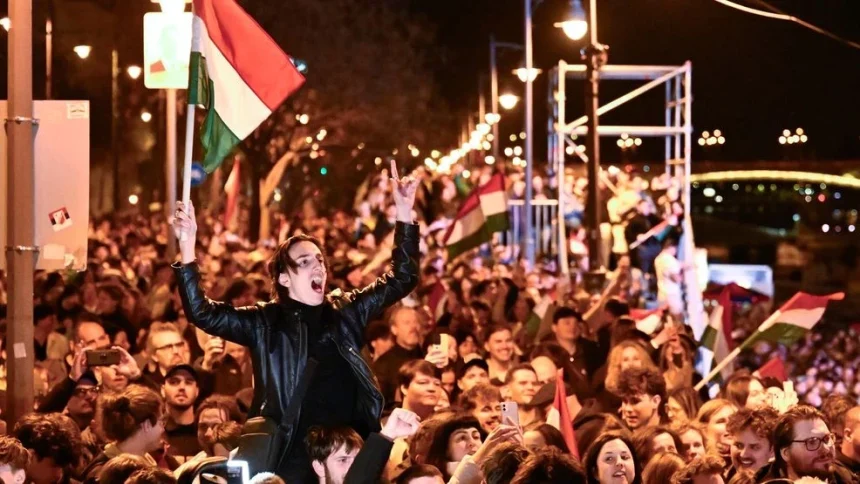
The joy in the streets is real. But in politics, especially in today’s Europe, the joy of victory and the cost of change almost never arrive on the same day.