The ASEAN Regional Forum in Manila has emerged as the diplomatic centre of the crisis linking the Strait of Hormuz to Bab el-Mandeb. The foreign ministers gathered in the Philippine capital had come prepared to discuss Indo-Pacific security, tensions in the South China Sea, and the war in Ukraine. The escalation between the United States and Iran, the near-total closure of traffic through Hormuz, and the attacks claimed by Houthi rebels on Saudi oil tankers have, however, shifted the centre of gravity of the meeting.
At the heart of this reconfiguration stands US Secretary of State Marco Rubio. His strategy is not confined to securing support for American military operations. Washington is seeking to reframe Iran’s conduct from a bilateral problem into a shared threat to the world economy and to freedom of navigation.
The distinction is essential. Asian states are unwilling to enter a military alliance against Iran or to endorse every American action by default. Nor can they overlook a strategy that simultaneously threatens energy shipments through the Persian Gulf and access to the Suez Canal.
Iran is attempting to use two of the world’s most important maritime straits as instruments of pressure. Marco Rubio is attempting to turn that pressure into a diplomatic trap.
Manila, the diplomatic centre of a global crisis
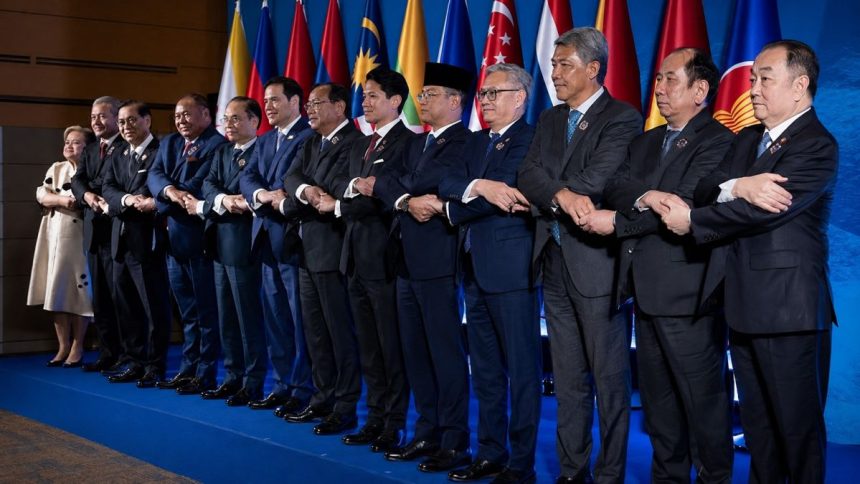
The Manila meeting has drawn diplomats from Asia, Europe, and North America, according to Reuters, including Secretary of State Marco Rubio, Russian Foreign Minister Sergei Lavrov, EU High Representative Kaja Kallas, and senior officials from China, India, Japan, Australia, and the United Kingdom. The war with Iran and the blockade of the Strait of Hormuz have become the dominant themes of the ASEAN Regional Forum, an organisation that brings together 11 states with a combined gross domestic product of roughly USD 3.8 trillion and economies heavily dependent on oil imported from the Middle East.
Philippine Foreign Secretary Maria Theresa Lazaro opened the meeting by warning that the world is passing through a period of profound geopolitical and geoeconomic uncertainty, and that no state can any longer respond alone to the current security environment.
The message is not ceremonial. Southeast Asia is one of the regions most exposed to disruptions of energy flows from the Gulf. Any reduction in deliveries translates into higher fuel prices, inflationary pressure, additional costs for industry and transport, and the risk of an economic slowdown.
Manila thus offers Washington an audience that does not need to be persuaded of the economic importance of the Strait of Hormuz. Rubio’s task is more demanding: to convert that economic vulnerability into a political position coherent enough to raise the pressure on Tehran.
Rubio internationalises the Hormuz case
Marco Rubio has framed Iran’s attempt to control traffic through the Strait of Hormuz as a threat to the international maritime order, not merely as a tactic in its war with the United States.
According to the Manila Times, the American Secretary of State told Asian leaders: „If we create a precedent in the Middle East where a nation-state can decide to control an international waterway, charge a toll, and blow up your ships if you don’t pay, we have created a very dangerous precedent that will repeat itself in other parts of the world, including this region.”
The argument is deliberately tailored to the ASEAN audience. In the South China Sea, states such as the Philippines, Vietnam, Malaysia, Brunei, and Indonesia already face pressure from a power that claims extensive control over maritime spaces. If Iran’s actions in Hormuz are accepted as a legitimate instrument of coercion, the same principle could be invoked, in a different form, near Taiwan or in other contested areas.
Rubio thereby ties two distinct geographical theatres to a single norm: freedom of navigation. Washington is not asking ASEAN states to treat Iran as a strategic adversary. It is asking them to accept that navigation through an international strait cannot depend on the payment of unilateral tolls, on the approval of a coastal power, or on the threat of attacks against commercial shipping.
The formula is far harder to reject than a direct call to support the American war. According to the Associated Press, Rubio described Iran directly as „the troublemaker of the region”, holding Tehran responsible for the destabilisation of global energy and trade routes.
A coalition built in concentric circles
The diplomatic effort led by Rubio has not yet produced a formal coalition, nor a common commitment on the use of force. What is being built in Manila is a gradual convergence among states whose interests are directly affected by Iranian pressure.
The first circle consists of the ASEAN states, exposed to the direct energy shock but committed to a prudent diplomatic tradition that avoids rigid alignments between the major powers. For Washington, the realistic objective is not to draw them into an anti-Iranian alliance, but to obtain a common position on the reopening of Hormuz and the protection of commercial shipping.
The second circle is formed by the maritime partners of the United States. In Manila, Rubio held consultations with Australia, India, and Japan — the states that make up the Quad mechanism together with the US. These maritime powers, whose economies depend on the stability of energy routes, can provide surveillance capabilities, intelligence sharing, naval coordination, and shipping protection, should the crisis move beyond the stage of political declarations.
The third circle is the most difficult and includes states that will not join a front led by Washington, but that have reasons to limit escalation: China, Russia, Pakistan, and the Arab actors. Rubio held consultations in Manila with Chinese and Russian diplomats. These discussions do not turn Beijing and Moscow into members of an American coalition. They do, however, test the limits of the support that the two powers are prepared to extend to Iran.
China maintains strategic ties with Tehran, but is also one of the leading buyers of Gulf energy. For Beijing, the stability of Hormuz is a concrete economic interest. Russia may benefit from rising oil prices and from Washington’s difficulties, but a prolonged regional blockade could generate instability that Moscow cannot control.
Rubio does not need Russia and China to adopt the American position. For the moment, it is enough that they refrain from legitimising Iran’s permanent control over an international waterway.
From Hormuz to Bab el-Mandeb
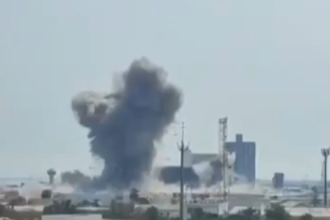
While diplomats negotiated in Manila, the maritime conflict expanded into the Red Sea. The Houthi rebels in Yemen have claimed missile and drone attacks on the Saudi oil tankers Encelia and Layla, as part of a naval blockade against Saudi Arabia.
According to Reuters, the Encelia transmitted a distress call over VHF radio, reporting that it had been struck by a missile near the Saudi port of Jizan and that a fire had broken out on board. The British maritime security group Vanguard reported that the Saudi-flagged tanker had been struck by an unknown projectile on its starboard side, roughly 70 nautical miles southwest of Al Shuqaiq. The attack on the Layla had not been independently confirmed at the time of publication.
Five tankers changed course in the Red Sea before the attack, with two signalling the Suez Canal as their new destination. The Houthis claimed to have forced around ten vessels to turn back.
The effect of a blockade does not depend solely on the physical closure of the strait. It is sufficient that risk rises, that insurance costs become prohibitive, that crews refuse to transit, and that operators choose the longer route around Africa. Geography remains open. The economy closes on its own.
The war of the two straits
Hormuz and Bab el-Mandeb can no longer be analysed separately.
In the Strait of Hormuz, Iran exerts direct pressure on commercial traffic. The Revolutionary Guards have claimed that the route lies under Iranian control and that no vessel can enter or leave without Tehran’s coordination. Iranian authorities have stated that certain lanes in the strait have been mined and have warned that they could halt regional energy exports entirely — claims that have not been independently confirmed.
In Bab el-Mandeb, the pressure is exerted by the Houthi movement, aligned with Iran but with its own political and military calculus. There is no public evidence that every Houthi operation is commanded directly from Tehran. According to sources cited by Reuters, however, the Iranian leadership has explicitly asked the Yemeni rebels to stand ready to close the Bab el-Mandeb Strait should the United States strike Iranian energy infrastructure. A source close to the movement indicated that the Houthis had already completed preparations for attacks on shipping by deploying missiles and drones in the vicinity of the strait, awaiting only the order to begin.
An earlier Reuters analysis had warned that Iran could use Bab el-Mandeb as its second major point of pressure on the world economy, turning a bilateral confrontation into an assault on the routes that sustain global energy trade.
The tactical advantage for Tehran is evident. The United States and its partners are compelled to divide resources between the Persian Gulf and the Red Sea. Saudi Arabia sees its alternative export route threatened. Egypt risks additional losses at the Suez Canal. Asian states face higher prices and less predictable deliveries.
The danger to Iran, however, is just as great: every additional state affected becomes a potential participant in the diplomatic pressure Rubio is building.
Saudi Arabia loses its alternative to Hormuz
Following the restriction of traffic through the Strait of Hormuz, Saudi Arabia has accelerated the transport of crude through the East–West Pipeline (Petroline) to the port of Yanbu on the Red Sea. The infrastructure allows the Persian Gulf to be bypassed: crude is transported overland to Yanbu, loaded onto vessels, and sent to Asian markets via Bab el-Mandeb.
The route has become essential. According to figures cited by Ahram Online, all Saudi seaborne exports in April and May 2026 departed via Yanbu, and in June the port accounted for approximately 92 percent of Saudi crude shipped by sea. Industry sources cited by Argus Media confirm that Petroline is running at its maximum capacity of 7 million barrels per day.
The activation of the Houthi front strikes precisely at this solution.
If Hormuz remains closed, Saudi Arabia relies on Yanbu. If access through Bab el-Mandeb becomes too dangerous, that alternative loses much of its value. Vessels bound for Asian markets would be forced either to transit the Suez Canal, the Mediterranean, and the Strait of Gibraltar before rounding Africa, or to abandon the route temporarily, with delays of weeks and substantial logistical costs.
Iran and the Houthis are therefore not attacking two independent routes. They are threatening the two ends of the same energy architecture.
Egypt, the state that stands to lose economically
For Egypt, Bab el-Mandeb is not a foreign problem. It is the southern gateway of the economic system built around the Suez Canal.
The canal can remain technically open and lose traffic at the same time. A shipping company does not have to wait for the formal closure of the strait. It is enough for the risk of attacks to outweigh the advantage of the Suez route.
Cairo reacted before the tankers were struck. The Egyptian Ministry of Foreign Affairs condemned the Houthi threat against Saudi Arabia, describing it as an „irresponsible escalation” that endangers maritime transport, vital routes, and regional stability.
According to Ahram Online, Egypt invoked international law, the UN Convention on the Law of the Sea, and UN Security Council resolutions, and expressed full solidarity with Saudi Arabia and the states of the Gulf Cooperation Council. Cairo separately condemned the attack on a Kuwaiti tanker in the Strait of Hormuz, and in consultations with the United Arab Emirates rejected the Iranian attacks on Arab states and called for the protection of freedom of navigation in accordance with international law.
The presence of Egyptian Foreign Minister Badr Abdelatty in Manila reinforces this positioning. According to Ahram Online, Abdelatty held separate discussions with Sergei Lavrov and with Pakistani Foreign Minister Mohammad Ishaq Dar on regional crises and on the resumption of negotiations between the United States and Iran, advocating de-escalation and a negotiated settlement.
Egypt thus occupies a distinctive position. It supports diplomacy and seeks to prevent a broader regional war, but it cannot accept that the Houthis turn Bab el-Mandeb into a permanent instrument of coercion. In Rubio’s equation, Cairo may become an essential partner: not an automatic participant in American military strategy, but one of the Arab states that can demonstrate that freedom of navigation is a matter of national economic security.
Pakistan, the mediator that condemns escalation
Pakistan is another important piece in this diplomatic construction.
Islamabad maintains channels of communication with Iran and is attempting to facilitate a return to negotiations. At the same time, it holds deep strategic ties with Saudi Arabia and cannot afford to overlook the Houthi threat to Saudi maritime transport.
According to the Associated Press, Pakistan has condemned the threats against navigation in the Red Sea and warned that any harm to its maritime interests would be treated as a matter of serious national security.
This position is valuable to Washington. Rubio needs not only states willing to condemn Iran, but also interlocutors who can convey messages to Tehran without those messages being perceived exclusively as American ultimatums.
Manila is therefore giving shape to an unusual diplomatic architecture: ASEAN provides multilateral legitimacy, the Quad offers maritime capacity, Egypt and the Gulf states bring Arab pressure, and Pakistan preserves a bridge to the Iranian leadership.
Marco Rubio’s diplomatic trap
By threatening both straits, Iran risks becoming the principal common source of insecurity for states that until recently did not regard it as an adversary.
For as long as the conflict could be presented as a confrontation between Iran, the United States, and Israel, Tehran could count on the cautious neutrality of a significant portion of the international community. That calculus changes when the actions of Iran and its partners begin to affect energy bills, commercial shipping, port revenues, and the economic stability of states thousands of kilometres from the conflict.
Iran is no longer striking only American interests. It is striking Saudi exports, Asian energy security, Egyptian revenues, Indian supply, Chinese calculations, and European costs.
Tehran thus risks turning itself into „public enemy number one” of the maritime order — not through ideological consensus, but through the accumulation of injured economic interests.
This is the trap Marco Rubio has been building with patience.
The American Secretary of State is not trying to convince every state that Washington is right at each stage of the war. He is showing them that Iran is generating costs they will be obliged to bear. With every ship attacked, every tanker turned back, and every blockade threat, Tehran expands the group of states that have reasons to defend freedom of navigation.
The activation of the Houthis, conceived as a force multiplier, risks becoming an accelerator of isolation. Militarily, the Yemeni movement forces the United States and Saudi Arabia to divide resources and defend an additional front. Diplomatically, its attacks provide Rubio with the argument he needs to demonstrate that the Iranian regional network is no longer merely a Middle Eastern security problem, but a threat to international trade.
Tehran also faces an internal leadership problem. Following the killing of Ali Khamenei in February 2026, the Revolutionary Guards and the security structures have assumed a dominant role in decision-making, according to a Reuters analysis that describes a system in which the incontestable arbiter who previously governed the relationship between the armed forces, the clergy, the government, and the diplomatic apparatus no longer exists. The new Supreme Leader, Mojtaba Khamenei, has remained absent from public life. Bloomberg reported on 21 July 2026 that the Supreme Leader, appointed in March, had made no public appearance as of that date, and that President Masoud Pezeshkian felt compelled to state that he now enjoys „greater access” to Khamenei and that all governmental decisions are based on his guidance.
Iran is not without command. The Revolutionary Guards retain military strength, mobilisation capacity, and influence over regional strategy. What appears to be missing is a political centre strong enough to translate this force into a coherent compromise. The Iranian leadership is militarised enough to escalate, yet does not seem flexible enough to negotiate a rapid exit from escalation.
This weakness is being exploited by Rubio.
Washington is formally keeping the path of negotiations open. According to the Manila Times, the Secretary of State declared in Manila that the United States remains „open and willing to engage in positive and constructive negotiations and discussions, provided that the commitments made are honored”, adding that „the problem we are currently facing is that they are not taking the negotiations seriously”. The American position is straightforward: if Tehran accepts negotiation, the channel remains open; if it refuses, Washington will continue its operations to protect its interests and allies.
The trap does not consist in Iran having exhausted its military options. Tehran can continue its attacks, prolong the conflict, use the Houthis, and seek political support from Russia and China. The problem is that each of these options narrows its diplomatic space.
If Iran continues the blockade of Hormuz, Asian states become more receptive to Rubio’s arguments. If the Houthis expand attacks in Bab el-Mandeb, Egypt, Saudi Arabia, Pakistan, and the major importing economies are pushed closer to a common position. If Tehran claims it cannot control the Houthis, it admits the limits of its own regional network and cannot offer guarantees in any eventual agreement. If it admits that it can stop them, it implicitly accepts a political responsibility for the continuation of the attacks. If it calls for their cessation, it demonstrates that American diplomatic pressure is producing results.
Rubio has not closed off all of Iran’s exits. He has, however, made them progressively more costly.
The only exit that would allow Tehran to reverse its isolation is a return to the negotiating table and the acceptance of Washington’s essential terms: the reopening of navigation, the cessation of attacks against shipping, and limits on the use of regional networks as instruments of coercion. This would not amount to a full Iranian capitulation. It would, however, amount to acceptance of the diplomatic architecture Rubio has constructed.
The limits of the Manila front
The American construction is not without vulnerabilities.
ASEAN states will not readily allow themselves to be drawn into a distant war. China will reject any mechanism that appears designed to consolidate American maritime dominance. Russia will seek to preserve its relationship with Iran and exploit Washington’s difficulties. India will continue to balance its partnership with the United States, its ties with the Arab states, and its own channels with Tehran.
Nor do Egypt and Pakistan automatically support American military strategy. Both states insist on negotiations and are trying to prevent a regional escalation that would be impossible to control.
Rubio is therefore not building a classical alliance. He is building a diplomatic majority around a minimal common interest.
That majority can support freedom of navigation without endorsing every American strike. It can condemn the Houthi attacks without accepting a new war in Yemen. It can call for the reopening of Hormuz without supporting a change of regime in Tehran or all American objectives concerning the Iranian nuclear programme.
The strength of the strategy lies precisely in the limited nature of its objective. To isolate Iran, Rubio does not need every state to become an ally of the United States. He needs them to conclude that Tehran’s current conduct is more dangerous to their interests than the pressure exerted by Washington.
The battle for the maritime order
The war of the two straits demonstrates that a major regional power does not need to close a waterway entirely in order to produce the effects of a blockade. It is enough to create uncertainty, raise the risk, force vessels to turn back, and transform every transit into a security calculation.
Iran is attempting to use Hormuz as a guarantee of its strategic survival. Through the Houthis, it extends the same logic to Bab el-Mandeb, threatening the Saudi route via Yanbu, access to the Suez Canal, and the energy link between the Middle East and Asia.
Tactically, the strategy is delivering results. According to CNBC, Brent for September delivery rose by 1.6 percent to USD 95.61 per barrel, on concerns over the two maritime chokepoints and following President Donald Trump’s threats to strike Iranian infrastructure.
Diplomatically, however, Iran risks destroying its own advantage.
The power of Hormuz depends on the fact that the world needs the strait. But that same dependency can drive the affected states to coalesce against whoever turns it into a weapon.
In Manila, Marco Rubio is trying to accelerate precisely that transformation. Iran entered the conflict by using geography to constrain the United States. The American Secretary of State is now attempting to use the global economy to constrain Iran.
The outcome will not be decided solely by warships, by mines in the Strait of Hormuz, or by missiles fired in the Red Sea. It will also be decided by the number of states that conclude that neutrality no longer protects their interests.
Every new Houthi attack may appear a demonstration of strength by the Iranian network. At the same time, every such attack adds one more state to the list of those Marco Rubio is trying to persuade.
Tehran still has military options. Its diplomatic space, however, is narrowing by the day. The Manila trap, for the moment, has only one exit that can remain legitimate before an ever-growing number of states: a return to negotiations, and an end to the transformation of the two straits into weapons directed against the world economy.
Read also