For the first time since the founding of the North Atlantic Alliance, the prospect of a United States withdrawal from NATO has entered the strategic calculations of member states. Not as an academic hypothesis, not as a simulation exercise, but as an active planning scenario considered in European chancelleries, in the Alliance’s analytical structures and in capitals that, for eight decades, have built their security on the premise that the American presence in Europe was irrevocable. That premise is no longer firm. With it, the entire framework of certainties on which Romania has built its external reflexes over the past thirty years is entering a zone of uncertainty without precedent in its post-communist history.
The world in which Bucharest learned to move diplomatically no longer exists in the form it once did. The war in Ukraine has shattered Europe’s security equilibrium. The transatlantic relationship is going through the most serious crisis of substance of the post-Cold War era, not one of tone or protocol, but one of foundation. The major powers are operating in an openly competitive register, without the restraining mechanisms that limited friction in previous decades. New centres of power are reshaping the global distribution of influence. And vulnerabilities in energy, commercial and technological supply chains are returning to the foreground at a pace that Europe spent a generation trying to ignore.
For Romania, these changes go beyond mere context. They call into question the assumptions that have guided the state’s strategic thinking for three decades. What once appeared stable is becoming negotiable. What once appeared guaranteed now requires constant political upkeep, anticipation and institutional coherence. In a world that is more fluid and more transactional, simple membership in strong alliances no longer automatically generates influence, and a state that treated that membership as a point of arrival rather than as an instrument now finds itself facing a test for which it has not prepared systematically.
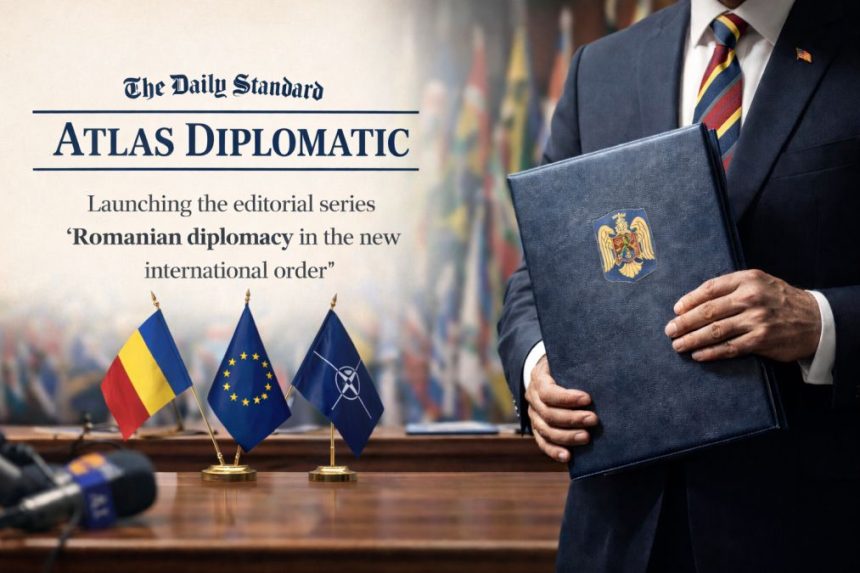
Does Romania have a diplomatic project of its own? Does it have the people, the institutions and the political will required to act not only correctly, but also meaningfully? Can Bucharest become more than a predictable ally and assert itself as an actor with a voice, with weight and with the capacity to formulate rather than merely execute? This is the central purpose of the editorial series that Atlas News is launching today.

Geography confers relevance, but not influence
Romania enters this historical phase with objective advantages that no serious analysis can ignore. NATO’s eastern flank, membership in the European Union, access to the Black Sea, proximity to the Republic of Moldova and direct involvement in the security dossiers of Eastern Europe all give it genuine strategic relevance, not one constructed rhetorically. In an era in which geography has once again become a major political factor, these elements matter.
Yet positional relevance does not in itself produce influence. The map offers opportunity, not power. Without a coherent vision, without institutions capable of acting in an integrated manner and without a strategic culture that goes beyond immediate reaction, geographical advantage risks remaining precisely what it is: insufficiently capitalised potential. Between being well placed and truly mattering lies a distance that only vision, coherence and institutional capacity can reduce. This is the dividing line between states that participate in the international order and states that attempt to shape it within their area of interest.
Romanian diplomacy has functioned, to a significant extent, according to a logic of prudence and alignment. That choice had serious reasons behind it and produced important benefits: predictability, risk reduction and the consolidation of the credibility of a state that deliberately tied its security and development to its Western anchorage. Integration into NATO and the European Union was not a passive consequence of history; it was the result of sustained political and diplomatic effort, and it deserves to be recognised as such.
But the same model that worked well in a period of relative stability is now showing its limits. A world that is more competitive and less generous toward mere alignment demands something more: the capacity to formulate distinct interests, to connect security to the economic dimension, to turn the neighbourhood into a sphere of action and to integrate foreign policy into a broader national strategy. The problem is not that Bucharest has been insufficiently vocal. The problem is that, too often, it has not been sufficiently conceptual.
Diplomacy cannot be improvised
Meaningful diplomacy cannot be improvised, nor does it depend on the talent of a single minister or the inspiration of a transient administration. It requires institutional memory, rigorous selection of human resources, indigenous analytical capacity, real coordination among centres of decision-making and continuity beyond domestic political cycles.
The question of Romania’s foreign policy is, at the same time, a question about the Romanian state itself. Are its institutions designed for a world in which crises overlap and do not respect the domestic electoral calendar? Is there a functional relationship between classical diplomacy, strategic analysis, economic interests and instruments of external projection? Is the decision-making architecture — the Ministry of Foreign Affairs, the Presidency, expert structures and the mechanisms of economic diplomacy — capable of producing strategy rather than merely administering files?
Romania is not starting from scratch. It possesses accumulated experience, competent professionals, solid partnerships and a position that gives it access to important dossiers. The essential question is not whether it has points of support, but whether it knows how to build on them a more articulated and more consistent external profile — one capable of producing ideas rather than merely responses, and one that links external projection more effectively to the national interest. In an era in which competition among states unfolds simultaneously in the military, economic, technological and informational spheres, diplomacy can no longer function as a realm separate from the rest of state power.
Why this debate can no longer be postponed
Atlas News is launching this series for a reason that does not lend itself to diplomatic phrasing: serious debate on Romania’s foreign policy is missing from the public space to a degree wholly disproportionate to the gravity of the moment. This is not a subject reserved for chancelleries. It is a matter of national interest, because the quality of external positioning determines security, access, credibility and room for manoeuvre in a world that is being reordered rapidly and with little consideration for those who are unprepared.
The series will bring forward those who directly define, execute or influence the foreign policy of the Romanian state: the foreign minister, the leadership of the Romanian Diplomatic Institute, the architects of economic diplomacy, experts with field experience and decision-makers from the relevant structures. Not to produce a succession of ceremonial interviews, but to build, through direct questions and accountable answers, a clear picture of Romania’s real diplomatic capacity at this moment.
The questions that will accompany each instalment are direct. Is the institutional architecture of Romanian diplomacy designed for the complexity of the present, or has it remained calibrated to a more stable world that no longer exists? Is there a coherent strategy for managing the relationship with Washington under the most unpredictable American administration in decades? What concrete role does Romania seek at the Black Sea, in the dossier of the Republic of Moldova, in the Western Balkans and in the new axes of connectivity that are reshaping the region? Can economic diplomacy become a genuine pillar of external influence, or does it remain an administrative appendage? And, above all, can the Romanian state move from the reflex of adaptation to the exercise of initiative — and, if so, with what people, with what institutions and with what strategy?
Beyond positioning, the real stake is one of substance
In a world in which security guarantees are no longer automatic, in which transatlantic relations are being renegotiated under the pressure of forces Europe does not control, and in which every state is judged by its capacity to generate relevance, not merely by its fidelity to partnerships, Romania faces a diplomatic challenge without precedent.
In the final analysis, the question is no longer whether Romania stands on the right side of the Western world. The question is how clearly it understands what it can and wants to obtain from that belonging in an international order that no longer operates on old guarantees. This is not a matter of image. It is a matter of substance.
This series exists because that answer deserves to be given in public. Not ceremonially. Truthfully.