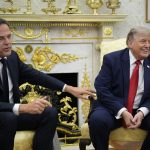
Mark Rutte Trump Europe Iran is the formula through which a diplomatic meeting in Washington acquired, less than two weeks before the NATO Summit in Ankara, a strategic weight far greater than that of a simple bilateral discussion. Romania was mentioned in the Oval Office in a sensitive passage concerning logistical support granted to the United States in the conflict with Iran. But this is not the central theme of the meeting. Romania is an important chapter, not the axis of the analysis.
The real stake of Mark Rutte’s visit to Washington was the NATO Secretary General’s attempt to change Donald Trump’s perception of European allies ahead of the summit in Türkiye. Rutte did not go to the White House merely for consultations. He went there to convince the American president that NATO is not a burden, that Europe is not merely a consumer of American security, and that the allies can become, in concrete and measurable terms, an extension of the strategic power of the United States.
The entire meeting must be read as a diplomatic plea. Rutte exerted himself fully: he flattered, argued, brought figures, used operational examples and tried to move the discussion out of the register of political resentment and into the register of strategic utility. Faced with a Trump who judges the Alliance through costs, loyalty and results, the NATO Secretary General sought to prove that Europeans are not only beneficiaries of the American guarantee, but multipliers of it.
The Washington meeting was the prologue to the Ankara summit
Mark Rutte’s visit to the United States was officially announced by NATO, which stated that the Secretary General would be in Washington between June 23 and 25, 2026, and would meet President Donald Trump at the White House on June 24. The context was clear: preparation for the NATO Summit in Ankara, scheduled for July 7–8, 2026, at the Beștepe Presidential Compound, according to the official announcement published by NATO.


Formally, the discussion was one between the President of the United States and the Secretary General of the Alliance. Politically, however, it was much more: a calibration meeting ahead of a summit that risks redefining the relationship between America and Europe within NATO. Not only through the well-known 5% of GDP defence target, but through a harder question: what do the United States receive, in real terms, from the allies it protects?
This is the question Rutte tried to anticipate. In front of Trump, he did not present NATO as an abstract community of values, but as an instrument of power. He tried to show that the Alliance generates money for the American defence industry, infrastructure for American operations, bases, overflight, logistical support and political legitimacy. In other words, Rutte translated NATO into Trump’s language.
Trump is not asking only for money. He is asking for visible loyalty
The transcript of the exchange between Donald Trump and Mark Rutte, available through Roll Call Factbase, shows that the real tension was not merely financial. Trump was not irritated solely by the level of European defence spending. He was irritated by what he perceived as a lack of political solidarity in the conflict with Iran.
The key moment comes when Rutte tries to argue that European allies stood with the United States. Trump cuts him off bluntly: “They weren’t.” This short, sharp reply is the psychological centre of the meeting. It shows that, for Trump, the NATO problem is not only a matter of accounting. It is a matter of demonstrated loyalty.
In the logic of the American president, an ally is not assessed only by how much it spends, but by how it positions itself when Washington enters a major confrontation. This is where Rutte’s effort begins. The Secretary General understands that it is not enough to invoke communiqués, percentages or formulas of solidarity. He must show that Europe was useful when the United States needed it.
This is the difference in language between the two men. Trump speaks in terms of political loyalty, public visibility and direct reciprocity. Rutte responds in terms of infrastructure, bases, flights, military procurement and capabilities. The meeting is, in essence, the attempt of a European diplomat to turn a political-military alliance into a dossier of results that Trump can accept.
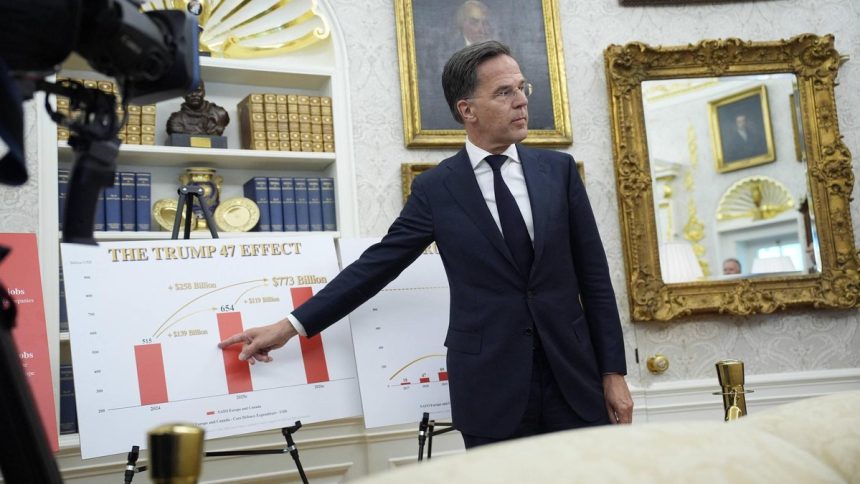
Rutte came with figures, charts and examples to dismantle Trump’s anti-European reflex
Rutte did not improvise. His plea was built on a clear architecture: first, he acknowledges Trump’s leadership; then, he shows that American pressure has produced effects; finally, he demonstrates that European allies are operationally useful. This is not a simple diplomatic conversation. It is an operation of persuasion.
According to Roll Call Factbase, Rutte invoked figures related to European defence spending, military procurement and the use of European infrastructure by the United States. In his logic, all these elements had to build a single conclusion: Trump was right to pressure the allies, but precisely that pressure has begun to produce a NATO that is more useful to America.
This is the subtlety of the moment. Rutte does not contradict Trump head-on. He does not tell him that his perception of the allies is wrong. On the contrary, he validates his political instinct and tries to lead him toward a different conclusion: if Trump wanted more serious allies, then NATO is beginning to deliver exactly that result. If Trump wanted higher spending, it is rising. If Trump wanted procurement that supports the American industry, allies are making it. If Trump wanted operational utility, Europe has provided bases, logistics and space for projection.
It is an intelligent diplomatic technique: Rutte does not try to educate Trump in NATO’s traditional language; he tries to save NATO by using Trump’s own language.
Europe as a platform for projecting American power
Rutte’s most important strategic argument is not the budgetary one, but the operational one. The Secretary General tried to show that Europe is not merely a territory protected by America, but a platform from which America can project force.
According to the transcript published by Roll Call Factbase, Rutte argued that between 4,000 and 5,000 American aircraft had taken off from European bases during the six weeks of the conflict with Iran. This figure is not a technical detail. It is the central piece of his demonstration: Europe was not merely a political spectator, but operational infrastructure for American forces.
Rutte also clarified, according to the same transcript, that this was not, strictly speaking, a NATO operation, but a matter of bilateral commitments between the United States and member states. This distinction is essential. NATO as an organisation must not be confused with bilateral agreements on bases, overflight, logistics or military access. But for Trump, the political effect Rutte was seeking was different: to show that the European allied network amplifies American power.
This is the key formula of the meeting: Europe as a platform for projection. Not Europe as a burden. Not Europe as a passive beneficiary. Not Europe as a budgetary problem. But Europe as America’s strategic infrastructure.
Ahead of the Ankara summit, this is the message Rutte wants to establish: NATO does not diminish the freedom of action of the United States; it expands it.
Romania appears as an example, not as the central subject
In this demonstration, Romania appears as one of the concrete illustrations of Rutte’s argument. According to the transcript available through Roll Call Factbase, the Secretary General mentioned Bucharest, respectively an airport in Romania, as an example of logistical support in the context of American operations related to Iran. Rutte stated that the airport had to interrupt commercial traffic in order to allow an American tanker aircraft to take off.
This is the sensitive part for Bucharest, but it should not be turned into the artificial centre of the analysis. Romania is not the main subject of the meeting. The main subject is Rutte’s effort to convince Trump that European allies have strategic value for America. Romania is an example within this dossier of persuasion.
The responsible formulation is clear: Romania was invoked by Mark Rutte as an example of European logistical support for the United States. The transcript supports the register of “logistical support”, “infrastructure” and “platform for projection”. It does not support the formulation that Romania participated militarily in attacks against Iran. At this point, there is no public official Romanian confirmation regarding the scope, date, exact location or nature of the specific support mentioned by Rutte.
There is, however, a broader public framework, separately confirmed from the Oval Office transcript. As early as March 2026, following a meeting of the Supreme Council of National Defence and a vote in Parliament — 272 votes in favour — Romania approved an American request concerning the temporary deployment on its territory of refuelling aircraft, monitoring equipment and satellite communications equipment in connection with American operations related to Iran, according to press reports from that period. President Nicușor Dan described the equipment at the time as defensive and specified that it was not equipped with live ammunition. The bases concerned were Mihail Kogălniceanu and Câmpia Turzii, while the first KC-135 tanker aircraft were stationed, according to the same report, at Otopeni Airport in the Bucharest area.
Italy shows the risk of Rutte’s strategy
Rutte’s plea came at a cost. In order to convince Trump, the Secretary General brought into the public space concrete examples of the use of European infrastructure. But this type of argument can become uncomfortable for allied capitals, especially when domestic public opinion or constitutional constraints require firm distancing from external military operations.
The case of Italy is relevant. Reuters reported that Rome rejected the interpretation that it had authorised the use of Italian territory for combat operations against Iran. Italian Defence Minister Guido Crosetto stated that the government had authorised exclusively technical and logistical, non-kinetic activities, and rejected requests that went beyond those limits.
The same Reuters report cites a NATO official who sought to limit the interpretation of Rutte’s statements, explaining that the Secretary General was referring to the way in which allies, including Italy, had fulfilled their existing bilateral agreements on bases and overflight. This clarification is important for Romania as well. It shows that logistical support should not automatically be confused with combat participation.
Diplomatically, the Italian episode reveals the tension between two contradictory needs. Rutte needs to demonstrate to Trump that Europe was useful. Member states need to preserve control over their own public explanations. When the Secretary General turns discreet support into a public argument, frictions appear.
Iran politically exploits every ambiguity
Rutte’s statements were quickly exploited by Iran as well. The state agency Tasnim presented accusations against Italy and Romania, suggesting their complicity in aggression against Iran.
This claim must be treated strictly as an Iranian position, not as factual validation. Iran has an obvious political interest in turning any Western logistical support into an accusation of participation in aggression. Precisely for this reason, the analysis must preserve the line of demarcation: one thing is what Rutte said in the Oval Office; another is how Tehran exploits those statements; and something else entirely would be official confirmation of direct military participation, which does not exist in the available sources.
For Romania, the risk is not only military or legal, but also communicational. A reference made by Rutte in order to save NATO’s argument before Trump can be taken up by geopolitical adversaries and turned into propaganda ammunition. That is why Bucharest needs precision, not ambiguity.
Ankara: the summit where NATO must become transactional without politically disintegrating
The NATO Summit in Ankara will not be only about the 5% of GDP figure. It will be about the Alliance’s ability to adapt to an American administration that no longer accepts the classical formulas of transatlantic solidarity without concrete proof of utility.
Ahead of the summit, NATO stated that the priority is turning spending into real capabilities and assuming greater responsibility by European allies and Canada, supported by American power. In parallel, the 5% commitment by 2035 is presented by NATO as a structure composed of at least 3.5% of GDP for core defence requirements and up to 1.5% for critical infrastructure, resilience, innovation and the defence industrial base.
But the figures do not tell the whole story. In fact, Rutte is attempting a more difficult operation: to turn NATO into an alliance that is sufficiently transactional for Trump, without reducing it to a mere marketplace for military services. This is the real stake of Ankara.
If the summit is read only through the formula “5% of GDP”, it will be understood incompletely. Ankara is about money, but also about political hierarchy. It is about capabilities, but also about the American president’s trust in allies. It is about the defence industry, but also about the question of whether Europe can still convince Washington that it remains indispensable.
Rutte plays the role of translator between old NATO and the new America
In this episode, Mark Rutte appears as a translator between two worlds. On the one hand, the old NATO, built on the language of solidarity, consultation and collective guarantee. On the other hand, Trump’s new political America, which demands shared costs, visible loyalty, concrete procurement and rapid results.
The Secretary General cannot change Trump’s political instinct. He can, however, try to use it. That is why he presents the increase in European spending as an effect of Trump’s pressure. He presents military procurement as a benefit for American industry. He presents European bases as infrastructure for U.S. military power. He presents allies not as dependents, but as strategic assets.
This is the essence of the meeting: Rutte is not asking for indulgence for Europe. He is trying to sell NATO as an American advantage.
For Romania, the lesson is serious: its strategic profile is growing, but so is its exposure
The Romanian chapter must be read in this key. Romania is not the centre of the story, but it is one of the pieces of evidence used in Rutte’s plea. That says something important about Bucharest’s place in the current security architecture.
Romania is no longer only the eastern flank state asking for protection. It is also a relevant logistical space for American operations that can extend beyond strictly European geography. This position brings strategic weight, but also exposure. The more useful Romania becomes to the United States, the more visible it will become to America’s adversaries.
For Bucharest, the challenge is twofold. Strategically, Romania must capitalise on its status as a credible allied node. Diplomatically, it must avoid having this status interpreted as direct involvement in conflicts for which there are no clear public confirmations. Not every form of logistical support is combat participation. But every ambiguity can be exploited.
This analysis is based on the publicly available transcript through Roll Call Factbase, on official NATO communications and on press reports concerning subsequent reactions and the framework approved in March 2026. The central source for the Rutte–Trump exchange is a third-party transcript, not a full official transcript published by the White House. For this reason, formulations concerning Romania must remain cautious.
The real conclusion: Rutte did not defend Europe. He tried to make it useful in Trump’s eyes
Mark Rutte’s visit to Washington should not be read as a meeting about Romania, nor as a simple discussion about Iran. It should be read as the moment when the NATO Secretary General tried to save the transatlantic relationship in the form in which Donald Trump can accept it.
Rutte understood that the old language of the Alliance is no longer enough. It is no longer sufficient to say “solidarity”. One must show aircraft, bases, money, contracts, capabilities and loyalty. It is no longer enough to invoke Western unity. One must demonstrate that America gains something concrete from NATO’s existence.
This is the real stake ahead of the Ankara summit. Not only whether allies will spend 5%. Not only whether Romania was mentioned in a passage about logistical support. But whether Mark Rutte manages to turn NATO from an obligation Trump suspects into an instrument Trump considers useful.
In the Oval Office, Rutte was not speaking only to the President of the United States. He was speaking to the Alliance’s new political condition: NATO will survive as a strong transatlantic project only if it can demonstrate, in figures and facts, that Europe does not merely consume American power, but amplifies it.
Read also