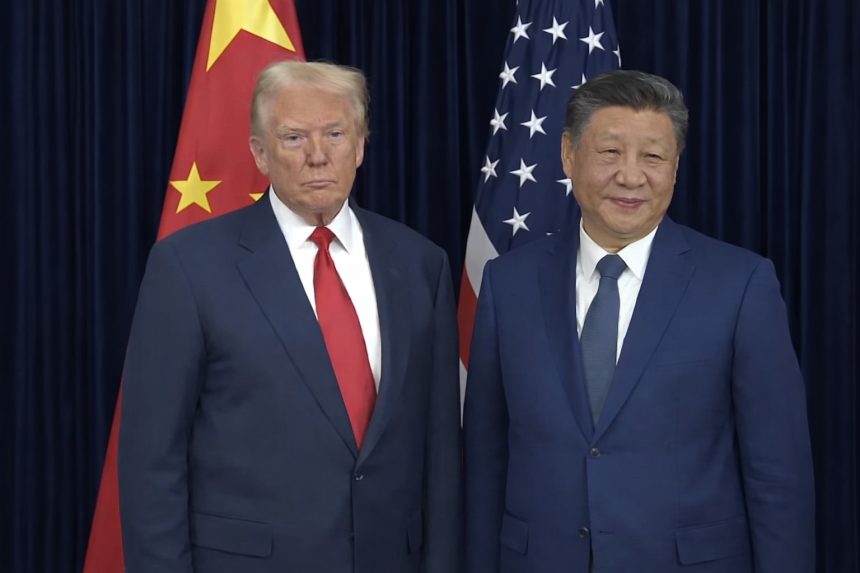
The Beijing summit should not be read as the birth of a functional G2, in which the United States and China would already be managing the world through a consolidated bilateral mechanism. What is more visible, more precisely, is the emergence of a selective co-management of rivalry: two major powers seeking to reduce friction on sensitive files, avoid an economic rupture, and contain strategic escalation, without providing a legitimate and inclusive framework for the other actors affected.
At the Great Hall of the People, Xi Jinping spoke of a “constructive and strategically stable” relationship between China and the United States, a formula presented by Beijing as a new direction for bilateral relations over the next three years. The Ministry of Foreign Affairs of the People’s Republic of China described this formula as the basis for a “stable, healthy and sustainable” relationship. The stability being invoked, however, is not necessarily the stability of the international system. It is the stability of the relationship between Washington and Beijing.
Selective co-management, not a G2 order
To speak of a functional G2 would be premature. There is no formal mechanism accepted by the rest of the international system, no legitimate division of global responsibilities, and no stable architecture of joint governance. There are, instead, limited agreements, new diplomatic formulas, risk-reduction channels and an attempt to manage rivalry before it spirals out of control.
This is the more accurate logic of the summit: not global governance by two powers, but bilateral stabilisation with global effects.

The asymmetry of objectives is structural. For the United States, the meeting produced presentable economic outcomes. According to Reuters, Washington expects Chinese purchases of U.S. agricultural products worth tens of billions of dollars annually. Trump said Beijing had agreed to purchase 200 Boeing aircraft, while Reuters sources had previously indicated the possibility of a broader package of around 500 aircraft. Treasury Secretary Scott Bessent, however, tempered expectations of spectacular new targets — soybeans were “all taken care of”, he said, without announcing new figures, according to Reuters.
Trump also announced that China would invest “hundreds of billions of dollars” in companies led by the CEOs in the U.S. delegation — a grand and vague formula, familiar from his first term. The Council on Foreign Relations notes that the 2017 experience shows that spectacular announcements do not guarantee durable economic outcomes.
For Beijing, the stakes were broader than a list of purchases. China sought recognition of status, language of strategic parity and the positioning of Taiwan at the centre of its relationship with the United States. Reuters reported that Xi Jinping explicitly praised the “new positioning” of relations with the United States. Washington pursued transactional results; Beijing pursued long-term strategic positioning.
The U.S. delegation — which included Elon Musk, Tim Cook, Larry Fink, Jensen Huang and Boeing CEO Kelly Ortberg — was not merely a signal of commercial intent. It turned companies into instruments of political validation and, for Beijing, into a readable map of American interests. This logic points to a structural risk that the summit does not resolve: foreign policy assessed through discrete contracts, rather than long-term strategic advantage.
Europe was not at the table, but it is not absent from the game
The phrase “Europe, the great absentee” has journalistic force, but it requires analytical nuance. Europe was not at the negotiating table in Beijing, but it is not entirely absent from the strategic equation. The European Union indirectly shapes essential files through regulation, technological standards, trade policy, export controls and industrial instruments.
The issue is different: Europe influences the context, but does not control the negotiation.
The Trump–Xi summit is not only about U.S.–China relations. It is about the risk that the European Union may be caught between two superpowers negotiating tactical arrangements on trade, technology, energy and security, while European interests are treated as secondary or mediated through Washington’s priorities. Euronews recorded that Europe could find itself in a “lose-lose” position: regardless of the summit’s outcome, its industrial and strategic interests remain exposed.
The EU has its own disputes with China over subsidies, market access and industrial dependencies. At the same time, the transatlantic relationship is strained by tariffs, export controls and different approaches towards Beijing. CEPA has underlined that, for China, this Western fragmentation is useful: Chinese negotiators directly benefit from divisions between Washington and Brussels. For Europe, it is costly.
European strategic autonomy can no longer remain a declaratory concept. The Beijing summit shows that real autonomy is measured by industrial capacity, strategic stockpiles, access to raw materials and resilience under simultaneous pressure from Washington and Beijing. Europe can produce rules. The harder question is whether it can secure critical supply chains.
Critical minerals: the absence of an agreement is part of the message
One of the summit’s most important files was the supply chain of critical minerals and rare earths. Precisely here, the absence of a major agreement is significant in itself. Foreign Policy reported that no major agreement on critical minerals or artificial intelligence was announced in Beijing.
Beijing may accept discussions on aviation, agriculture or energy, but it remains highly cautious on files that provide it with structural leverage. Rare earths, permanent magnets and critical materials are not merely industrial goods. They support the production of advanced weapons, energy systems, electric vehicles, digital technology and modern military capabilities.
For the United States, the vulnerability is evident: the accelerated consumption of munitions and advanced systems in Ukraine and the Middle East is putting pressure on a defence industrial base that, in certain critical segments, depends on materials, processing and components under significant Chinese influence. The Council on Foreign Relations has argued that the centre of gravity in U.S.–China relations has shifted from tariffs towards control over critical minerals and magnet supply chains — inputs that underpin modern military capability. For Beijing, control over essential nodes of processing and exports remains a strategic lever it did not choose to trade away in Beijing.
Critical minerals are not a technical file. They are the silent infrastructure of power. The absence of a major agreement on this issue is, in itself, an important signal.
Taiwan: two readouts, two political messages
Taiwan was one of the summit’s most sensitive files, and the divergence between Chinese and American messaging is one of the key analytical points of the meeting.
Beijing placed Taiwan at the centre of the agenda. Xi Jinping described the Taiwan issue as “the most important” in China–U.S. relations, warning that mishandling it could lead to “clashes and even conflicts, putting the entire relationship in great peril”, as reported by The Guardian. The White House readout did not mention Taiwan, focusing instead on trade, Iran and the bilateral relationship — an absence explicitly noted by NPR.
This asymmetry should not be treated as a drafting detail. It reflects two deliberate communication strategies. China sent a firm message to Taipei, to its own internal apparatus and to Washington. The United States preferred the optics of an economic and stabilising summit, avoiding public amplification of the most combustible bilateral issue.
There is no evidence of an explicit American concession on Taiwan. But the omission of Taiwan from a presidential readout, after Xi had placed it at the top of the agenda, is not neutral. In diplomacy, omissions can sometimes prepare the ground for cumulative ambiguities.
Iran and Hormuz: limited coordination, not Chinese mediation
The Iran file and the Strait of Hormuz gave the summit a global crisis context. NBC News reported that the two leaders agreed that the Strait of Hormuz must remain open and free for navigation, and that Iran must not obtain a nuclear weapon. Secretary of State Marco Rubio separately clarified that the United States had not asked China for help in ending the war with Iran.
This clarification matters. It points to one of the clearest formulas of the summit: declaratory coordination around minimal common interests, not strategic resolution. Washington did not present China as an active mediator, but retained diplomatic control over the file. Beijing gained the image advantage of acting as a responsible global player, without being required to exert verifiable pressure on Tehran. CSIS noted that China positioned itself as a potential mediator without committing to concrete action towards Iran.
A co-management of optics, not crisis diplomacy.
Bilateral stabilisation, redistributed risk
The paradox of the Beijing summit is that stabilisation between the United States and China may reduce some global risks while redistributing others.
If trade tensions ease, markets breathe. If communication channels on technology, energy and security are maintained, the risk of direct escalation decreases. If economic rupture is avoided, the global economy gains time. The IMF, quoted by Reuters, said that constructive dialogue and reduced tensions between the United States and China are positive for the world economy.
But bilateral stabilisation does not automatically resolve the vulnerabilities of third actors. Europe remains exposed on critical supply chains. Taiwan remains vulnerable to diplomatic ambiguities. Southeast Asian states must navigate between rival techno-economic ecosystems. Emerging economies may discover that neutrality is becoming increasingly costly.
The most useful concept is not “G2”, but “selective stabilisation of rivalry”. The two superpowers are trying to prevent competition from becoming uncontrollable, but they are not building an inclusive order. They are stabilising their own bilateral channel. They are not stabilising, to the same extent, the international system.
Middle powers will not wait passively
The Beijing summit will not be interpreted only in Brussels, Taipei or Tokyo. It will be read closely in New Delhi, Ankara, Riyadh, Jakarta, Brasília, Seoul and Abu Dhabi.
If the perception of selective U.S.–China co-management consolidates, the response of middle powers will not be automatic alignment. It will be strategic diversification. The EU Institute for Security Studies has underlined that the summit marks tactical stabilisation, not a strategic reset — an essential distinction for how middle powers will calibrate their own responses.
India will continue to preserve its strategic autonomy through a flexible foreign policy, avoiding exclusive dependence on any single power bloc while simultaneously cultivating relevant relationships with the United States, Europe, Russia, China and partners across the Global South. Turkey will continue to play a relevant role in the Euro-Atlantic architecture and the wider neighbourhood, leveraging its strategic position, NATO membership and regional diplomatic channels to contribute to security balances between Europe, the Black Sea, the Middle East and Asia. Indonesia and other Southeast Asian states will avoid making a definitive choice between Washington and Beijing. South Korea and Japan will remain anchored in the U.S. alliance system, but will watch any ambiguity over Taiwan with concern.
This is the real limit of any G2 formula: the world is no longer disciplined enough to accept dual leadership without reactions. Major powers may try to manage rivalry. Middle powers will try not to be managed.
What was not seen in Beijing
The Trump–Xi summit should not be judged only by the documents published, the purchases announced or the diplomatic formulas repeated in press briefings. Its deeper significance is that it points to a stage in which the United States and China are trying to reduce the risk of direct confrontation without rebuilding a legitimate framework for the other actors affected.
It is not a G2, nor a new global order. It is something more fluid and perhaps more difficult to contest: a grey zone between competition and coordination, between rivalry and transaction, between bilateral stabilisation and systemic uncertainty.
In Beijing, Trump and Xi did not negotiate only trade, Taiwan, energy or rare earths. They tested how far their rivalry can be managed through a privileged bilateral channel, while other actors are left to infer, from communiqués and omissions, what may be coming next.
The most important image of the summit is the absent image: Europe, Taiwan, Indo-Pacific states, middle powers and economies dependent on critical supply chains — all outside the frame, yet directly exposed to its consequences.
The Beijing summit did not establish a new global order. It pointed to the direction of a world in which major powers no longer need to decide everything in order to influence everything. Sometimes, it is enough for them to stabilise between themselves what the rest of the world will then have to manage.
Read also