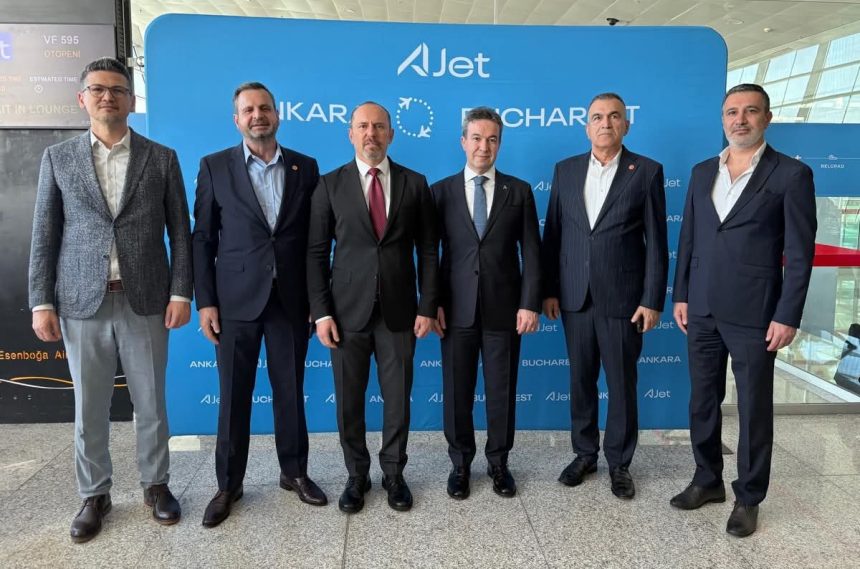
AJet, a subsidiary of Turkish Airlines, has inaugurated the direct Ankara–Bucharest route, establishing a new air connection between the capitals of Türkiye and Romania at a time when bilateral relations already rest on a solid economic foundation. The route creates a direct link between two key political, administrative, and economic centers, while the inaugural moment carried a clear institutional dimension.
In a message published on X, His Excellency Özgür Kıvanç Altan, Ambassador of the Republic of Türkiye to Romania, welcomed AJet’s first flight connecting Ankara and Bucharest, emphasizing that the new route links the capitals of two NATO allies and strategic partners. The message reflects not only the diplomatic significance of the moment, but also the broader economic context in which this connection is taking shape.
Also present at the inaugural event was Mr. Ufuk Tandoğan, President of TIAD, alongside representatives of the association. TIAD’s participation is fully consistent with its role in supporting Romanian–Turkish economic relations. According to data provided by the organization, TIAD represents approximately 95% of Turkish capital invested in Romania and operates as a platform for dialogue and support for Turkish investors active on the local market. In an interview with Atlas News, Ufuk Tandoğan described TIAD as a “mechanism of stability” that facilitates the activity of Turkish entrepreneurs and their engagement with Romanian authorities.
Figures that define the relationship
The economic significance of Romanian–Turkish relations is underscored by concrete data. According to Ufuk Tandoğan, more than 19,000 companies with Turkish capital are officially registered in Romania, of which approximately 2,300 are active. The total volume of direct and indirect Turkish investments is estimated at USD 9–10 billion. At the same time, the combined turnover of Turkish companies operating in Romania reached approximately EUR 11 billion in 2024, illustrating a substantial and diversified economic presence.

These figures provide the key to understanding the relevance of the Ankara–Bucharest route. This is not merely a commercial expansion within an airline network, but a connection serving an already mature economic ecosystem. For investors, entrepreneurs, and institutions, direct access to Ankara — the administrative and political capital of Türkiye — reduces travel time and facilitates direct engagement with decision-making centers.
Another indicator of the scale of this economic relationship is reflected in infrastructure projects. In the same interview with Atlas News, Ufuk Tandoğan stated that, over the past three to four years, Turkish companies have secured infrastructure projects in Romania worth nearly EUR 15 billion. This level of involvement highlights the tangible contribution of Turkish capital to Romania’s economic development.
A relationship built over time
In this context, TIAD emerges as an institutional vector of a long-standing economic relationship. Romanian–Turkish cooperation is sustained not only by agreements and statistics, but also by a culture of long-term partnership, stable business communities, and active institutions.
The inauguration of the Ankara–Bucharest route can therefore be seen as a natural extension of this established relationship. The new air connection is designed to support an already existing economic dynamic and to facilitate faster and more efficient interaction between key stakeholders in both countries.
The presence of Ambassador Özgür Kıvanç Altan and TIAD President Ufuk Tandoğan gave the inaugural moment a clear diplomatic and economic dimension. The Ankara–Bucharest route is not simply an expansion of an airline network, but a concrete step in strengthening a bilateral relationship that is already operating on solid and well-established foundations.
Read also