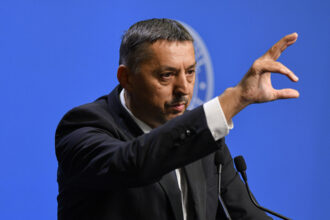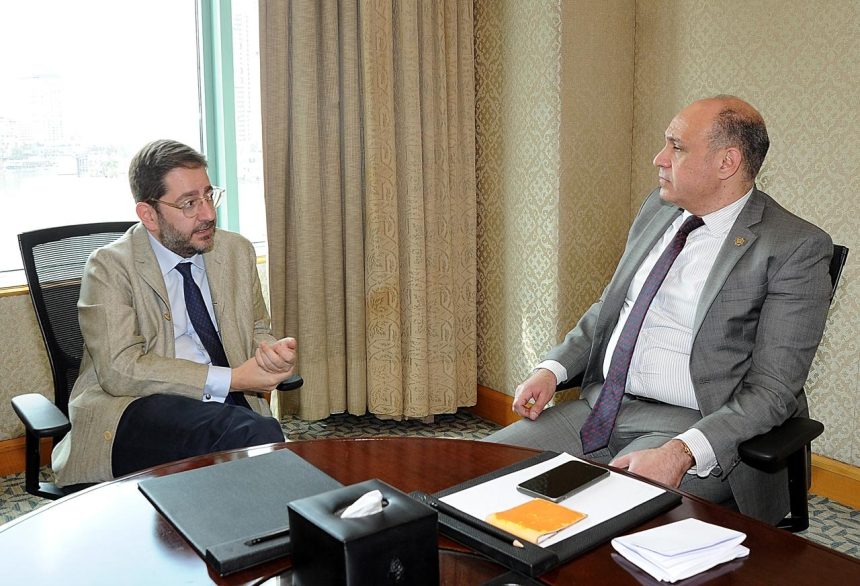
As Cairo continues to solidify its position as a regional hub for educational excellence, the arrival of world-class institutions represents a pivotal chapter in Egypt’s Vision 2030. In an exclusive interview with Dr. Manuel Muñiz, Rector of the prestigious IE University and a distinguished Professor of Practice in International Relations, he discusses the university’s transformation from a magnet for top Egyptian talent to a firmly established institutional partner. Through its initiatives in Egypt,
Dr. Muñiz, who previously championed the „Global Spain” initiative, brings a unique diplomatic lens to this academic expansion. He highlights that the relationship is far from a one-way transfer of European standards; rather, it is a sophisticated „bridge of collaboration” designed to integrate Egypt’s vibrant intellectual ecosystem into a global framework.
With over 120 Egyptian students currently on its campuses and a growing alumni, and a network of 250 professionals across the country, IE University is no stranger to the Egyptian talent pool. However, the announcement of a dedicated presence in Cairo by 2026 signals a transformative shift.
Dr. Muñiz’s vision is rooted in „co-creation”—working alongside Egyptian foundations, universities, and corporate leaders to build an educational model that is both technologically advanced and locally relevant. IE University aims to distinguish itself in Egypt’s increasingly competitive international education sector. Dr. Muñiz emphasizes that the goal is not merely to mirror the Madrid curriculum, but to foster a two-way exchange of innovation and cultural understanding, from scholarship opportunities for high-achieving youth to aligning academic outcomes with the demands of the regional labor market.

Atlas News (AN): How was your visit to Cairo and what were its most important outcomes?
Dr. Manuel Muñiz: It’s been very productive. We had meetings with the Higher Education Minister, with the Telecommunications Minister, and also with the Industry Minister—who is actually an alumnus of IE. He studied with us and did our DBA, which is our doctoral program. It was wonderful to see one of our former students who is clearly doing very well.
I find in Egypt a country that is looking into the future and is very committed to its education landscape, particularly higher education. I discovered how much change has been brought to the space here—with new private and national universities being designed, and a lot of investment in bringing international institutions into Egypt.
The country is dynamic, and the education space is a real priority. Egypt is looking to develop this with its own resources, but also by bringing international institutions through partnerships and engagements into the mix. We will leave with two or three very promising projects.
We are thinking of building something we’re calling a ‘3-plus-1’ or a ‘4-plus-1.’ This would be a project to identify high-potential Egyptian students during their undergraduate studies, most likely in STEM areas—science, technology, and engineering. We are thinking of bringing them to IE for one year to do a Master’s in Management, Finance, or an MBA. They can then come back to Egypt with knowledge in both technical and business areas to work or create companies. We are also going to mobilize resources and financial aid so that there are scholarships available for Egyptian students from very different backgrounds.
The other project is that we want to continue to work with Egyptian corporates on high-level corporate education. We are a big corporate education provider, and we want to work with the Egyptian economic and business world. We have already expanded a partnership we have with Elsewedy, but we’ve had meetings with a number of other Egyptian firms to explore this.
We run a big entrepreneurship gathering called the South Summit. These are huge gatherings of entrepreneurs, startups, and investors—it’s a very large event of 30,000 people. We run it in Spain, Brazil, and Korea, and we are looking for a location in this region. Cairo has a booming entrepreneurship landscape and a startup ecosystem, and we are thinking of running a South Summit here. This would entail partnering with the government and the Telecommunications Ministry. All in all, there are at least these three initiatives, which is quite a bit. It’s an exciting visit.
(AN): Dr. Muñiz, given your distinguished career in diplomacy and international relations, how does the establishment of an IE University branch in Cairo reflect the current strength of bilateral relations between Spain and Egypt?
Dr. Muñiz: Our engagement with Egypt should be understood as part of a broader effort to deepen an already strong and evolving bilateral relationship between Spain and Egypt, particularly in the field of higher education. At this stage, our focus is on building partnerships and engaging in a process of dialogue with Egyptian institutions, foundations, and corporate actors, with the aim of identifying areas for meaningful and long-term collaboration.
IE is, by design, a deeply international institution. We bring together more than 10,000 students across undergraduate and graduate programs, with over 160 nationalities represented on campus and a network of more than 84,000 alumni in 185 countries. This global scale and diversity shape how we approach partnerships and international engagement.
IE already has a meaningful connection with the country. We currently have more than 120 Egyptian students across undergraduate and graduate programs, and a community of approximately 250 alumni based in Egypt. Since 2020, around 445 Egyptian students and graduates have been part of our institution. What this phase is about is building on that foundation—strengthening institutional ties, engaging with key stakeholders, and exploring avenues for deeper collaboration that can contribute to talent development and knowledge exchange between our two countries.
(AN): Why has IE University chosen Egypt as its next global hub for 2026, and how does this move align with Egypt’s Vision 2030 for higher education reform?
Dr. Muñiz: We see Egypt as a country of enormous strategic relevance, both regionally and globally. Its demographic dynamism and its strong academic base make it a natural partner for an institution like IE, which is consistently ranked among the top universities globally by the Financial Times, The Economist, QS, and others, and is deeply focused on talent, innovation, and global connectivity.
Our approach at this stage is to engage deeply with the local ecosystem—to understand priorities and to identify areas where collaboration with universities, foundations, and industry can generate meaningful and lasting impact. This phase is very much about engagement and co-creation—working alongside local partners to define the most effective forms of collaboration.
(AN): Given the current geopolitical climate, how do you view Egypt’s resilience as a ‘promised land’ for global education, and can international academic hubs like IE University help mitigate the effects of regional instability on cross-border cooperation?
Dr. Muñiz: My sense is that Egypt has historically attempted to play a role of stabilizer in the region. This has been the case in the Palestinian conflict where Egypt has tried to mediate and to be an active proponent of peace and a supporter of the existence and flourishing of a Palestinian state—the two-state solution. It has consistently tried to play this role in other conflicts as well.
I am concerned with developments in the region because I believe that what we have witnessed in the attack on Iran is a clear weakening of international law and international legal frameworks. I fear that we are about to learn why these international norms—particularly the respect for the sovereignty and the territorial integrity of states—were important principles to start off with.
People forget, but these international law principles were born out of the experience in Europe of centuries of constant warfare. The fact that there are rules about what justifies aggression, defense, and the use of force is the product of a hard-learned conclusion: if we live in a world that is devoid of norms, you enter a world where the use of force is much more prevalent. It is very disorderly and there is more conflict.
You can have a very negative opinion of the regime in Iran and still believe that it is good for us overall for there to be restrictions on the use of force against a country, unless you’ve been directly attacked or there’s an imminent threat to national security. It is a very strict list of reasons that can justify the level of aggression that we have seen on Iran. I find the precedent to be problematic, and I think there is a risk that the region pays a high price for this—it already is, on the energy, infrastructure, tourism, and transportation fronts.
My hope is that Egypt continues to play a role in attempting to bring a quick, swift, and hopefully stable end to the conflict, so that the region can return to the path of economic growth, investment in education, and investment in human capital. Egypt can play an active diplomatic role because it is a peacemaker with bridges of dialogue across parties, a strong relationship with the U.S., and a very clear regional anchoring.
(AN): In your former role, you championed „Global Spain.” Do these initiatives serve as a permanent bridge for the transfer of European innovation and scientific excellence to the heart of the Middle East?
Dr. Muñiz: What we are advancing is, fundamentally, a bridge of collaboration. Through our engagement with Egyptian academic institutions, foundations, and corporate partners, we are exploring ways to facilitate the exchange of knowledge, innovation, and talent. This is very much aligned with the spirit of Global Spain—building forward-looking, mutually beneficial connections.
Importantly, this is a two-way exchange. Egypt brings a vibrant academic and intellectual ecosystem, and integrating that into our global network is as important as what we contribute.
(AN): Beyond academics, how will the university foster deeper cultural understanding between the youth of Spain and Egypt? Are there plans for cultural exchange programs or Spanish language integration?
Dr. Muñiz: Education, in our view, is inherently a cultural experience. IE’s classrooms are already deeply international, with more than 160 nationalities represented and over 90% of students coming from outside Spain. This diversity creates a natural environment for cross-cultural understanding.
Our programs are primarily delivered in English, reflecting the global nature of our student body, but language learning is an important part of the IE experience. Students are encouraged to develop additional languages—including Spanish, and increasingly other languages relevant to their professional trajectories, such as Arabic in this context. Language, in this sense, becomes both a professional asset and a bridge between cultures.
In Egypt, we are exploring opportunities for joint academic initiatives, exchanges, and collaborative projects that further strengthen these people-to-people connections.
(AN): Which specific undergraduate and postgraduate programs will be available at the Cairo campus? Will they mirror the Madrid curriculum, and how will they be adapted to the local market needs?
Dr. Muñiz: At this stage, the focus is not on defining a fixed academic offering, but on understanding how best to collaborate with the Egyptian ecosystem. We are in active dialogue with universities, foundations, and industry actors to identify areas where joint programs, executive education, or other academic initiatives could be developed in alignment with local needs and priorities.
(AN): Egypt is seeing a rise in international university branches (UK, German, Canadian). How does IE University plan to distinguish itself in this competitive landscape?
Dr. Muñiz: Our approach differs in that it is rooted in partnership rather than in predefined models of expansion. At the same time, IE brings a distinctive value proposition. We combine a highly international student body, a technology-driven learning model, and a strong focus on employability and career outcomes. Our graduates consistently access opportunities in leading global organizations, and our focus on employability is reflected in international rankings and career outcomes. We believe that long-term impact comes from working closely with local institutions and co-developing initiatives that are aligned with the specific context. This requires listening, building trust, and creating shared value.
(AN): How has your team studied the Egyptian labor market to ensure that IE graduates are the most sought-after by regional and international employers?
Dr. Muñiz: Our understanding of the Egyptian ecosystem is informed by two complementary elements. First, our own community of Egyptian students and alumni, many of whom are already integrated into leading organizations both locally and internationally. And second, our ongoing dialogue with companies, academic institutions, and foundations. At IE, employability is not an outcome—it is a design principle embedded in our programs, combining academic excellence with real-world application, global exposure, and close engagement with employers.
(AN): How does IE plan to integrate Egyptian students into its global network of 160+ countries?
Dr. Muñiz: International exposure is a defining feature of the IE experience. As we explore collaboration opportunities in Egypt, incorporating a global dimension—through interaction with our campuses and international network—is naturally part of how we think about education. The specific formats will evolve as partnerships take shape.
(AN): IE is famous for its „Liquid Learning” approach. How will Egyptian students benefit from this hybrid, flexible, and technologically advanced education model compared to traditional methods?
Dr. Muñiz: IE’s model is built around flexibility, innovation, and global connectivity. This includes a technology-enabled learning environment, a highly diverse classroom, and a methodology that combines academic rigor with practical, real-world application. As we engage with partners in Egypt, we are exploring how elements of this model can be shared through collaborative initiatives, always adapting them to the local context and ensuring they enhance the learning experience.
(AN): What specific „privileges” or scholarships will IE University offer to high-achieving Egyptian students to ensure the campus is a meritocratic hub for the country’s future leaders?
Dr. Muñiz: Any future initiative we develop will be guided by principles that are central to IE: meritocracy, inclusion, and access to opportunity. While it is still early to define specific mechanisms, our commitment is clear—ensuring that talent is identified, supported, and developed.
(AN): Finally, as a Professor of Practice in International Relations, what is your personal message to the Egyptian educational community and the parents who are looking for a European-standard education on Egyptian soil?
Dr. Muñiz: My message is one of partnership and long-term commitment. IE is a deeply international institution, but also one that believes in the value of building strong, locally anchored collaborations. Egypt is not new to us—we already have a vibrant and growing community of students and alumni, many of whom come from leading institutions such as the American University in Cairo, the German University in Cairo, and a wide network of international schools.
What we are seeking now is to build on that foundation—to move toward deeper institutional collaboration, working together with Egyptian partners to create opportunities that support talent, knowledge, and global connection. This is a process that we approach with a long-term perspective—focused on building relationships first, and on ensuring that any future initiatives are grounded in strong local partnerships and shared objectives.
Read also
Nabil Fahmy Backs Arab Security and Stability After Nomination for League of Arab States Leadership