On 27 March 2026, several American military aircraft were already airborne over the Mediterranean, with flight plans that included a stopover at the Sigonella naval air station in Sicily before continuing toward the Middle East. The flight plan had been communicated to Italian authorities while the aircraft were already in the air. Italy’s Chief of Defence Staff, General Luciano Portolano, established that no prior authorisation had been sought and that no consultation with Italian military leadership had taken place. Checks confirmed that the flights did not fall within the category of routine or logistical operations covered by the bilateral US-Italy treaty.
Defence Minister Guido Crosetto issued the directive: the aircraft would not be permitted to land. He subsequently made clear that the decision did not reflect tensions with the United States and that American bases in Italy remain active and in use. „Someone is trying to put out the message that Italy has decided to suspend the use of its bases to US assets,” Crosetto wrote on X. „That is simply false, because the bases are active, in use, and nothing has changed.”
The Sigonella episode illustrates, in concrete operational terms, a structural tension that has run through NATO since the outbreak of the Iran conflict: the distinction between the logistical support European allies are prepared to extend and direct participation in offensive combat missions, which they are not.
What the Treaties Stipulate and What Occurred
The legal framework is unambiguous and long predates 2026. The use of American military installations on Italian soil is governed by several agreements: the NATO Status of Forces Agreement of 1951, the Bilateral Infrastructure Agreement of 1954 as amended in 1973, and the US-Italy Memorandum of Understanding of 1995. Under these arrangements, American forces may use bases such as Sigonella for routine logistical and surveillance purposes. Any use as a launching point for combat operations requires the express authorisation of the Italian government.

The Italian government had stated this position publicly from the outset of the conflict. When the United States dispatched the aircraft without requesting authorisation, the mechanism established by treaty in 1954 operated precisely as designed. „The Government continues to do what all Italian Governments have always done, fully adhering to the commitments made in Parliament and to the line reiterated in the Supreme Defence Council, in continuity with all previous Councils over the decades,” Crosetto stated.
Spain adopted a more categorical stance, closing its airspace to American military aircraft linked to Iran operations and denying access to the jointly operated bases at Rota and Morón. Prime Minister Pedro Sánchez’s government invoked both the international legal framework and its opposition to operations it regards as unsanctioned by the United Nations. President Trump responded with trade threats; Madrid did not alter its position.
Actual Support vs. Declared Refusal — A Necessary Distinction
The narrative of an Alliance in open disagreement with Washington omits essential facts.
Bases in the United Kingdom, France, Germany, Greece, Italy and Portugal supported the logistics of one of the most operationally complex American military undertakings in decades. Spain was the only country to deny access to its bases prior to the Sigonella episode of 27 March. Sigonella itself had, in preceding weeks, hosted a markedly increased volume of American logistical and surveillance activity.
On 19 March, an extensive group of NATO member states — including the United Kingdom, France, Germany, Italy, the Netherlands, Canada, Romania, Denmark, Norway, Sweden, Finland, Estonia, Latvia, Lithuania, the Czech Republic, Slovenia and others — signed a joint statement condemning in the strongest terms Iranian attacks on commercial vessels, the de facto closure of the Strait of Hormuz and strikes against civilian infrastructure in the Gulf.
This is the accurate picture: broad political convergence in condemning Iranian conduct, consistent logistical support, but a uniform refusal to participate directly in offensive combat operations.
The American Logic and the European Logic — Both Coherent
A balanced understanding of the crisis requires presenting both positions on their own terms.
Washington operates from its own logic, with internal coherence. The American argument was straightforward: if European allies depend on energy from the Middle East, they have a direct interest in defending the route through which it reaches them. The Strait of Hormuz carried, prior to the blockade, approximately 20 percent of the world’s oil supply. From Washington’s perspective, an alliance whose purpose is collective security ought to function when its most powerful member initiates an operation — not only when European territory is directly threatened.
Trump articulated this argument plainly: the refusal of allies constitutes „a very foolish mistake” and amounts to „a great test, because we don’t need them, but they should have been there.” The statement reflects a long-standing frustration over the unequal distribution of burdens within the Alliance — a concern that transcends administrations and is not unique to Trump’s foreign policy.
European capitals, for their part, operate from a distinct logic, equally coherent. The central argument is not hostility toward American strategic objectives. German Chancellor Friedrich Merz stated explicitly that Germany „shares the interest of the United States and Israel in seeing an end to this regime’s terror and its dangerous nuclear and ballistic armament.” The divergence concerns methods, the legal framework and — critically — the absence of prior consultation.
European hesitation is also shaped by concern that allies would find themselves dependent on a strategy they neither designed nor control. The operation’s stated objectives shifted on multiple occasions during its first four weeks, substantially complicating any decision to participate for governments accountable to national parliaments.
There is also a constitutional dimension that no serious analysis can set aside. The national parliaments of NATO member states hold, in the vast majority of cases, direct competence over their governments’ external military commitments. No European head of government can commit national forces to a conflict without a parliamentary process — regardless of Alliance dynamics.
What the Iranian Crisis Is Truly Testing
Debates within NATO have historically focused on the defence of Alliance territory, not on participation in American operations beyond its central area. This question — what allies ought to do in out-of-area contingencies — generated tensions during the Vietnam War, the 2003 Iraq invasion and the 2011 Libya operations. What 2026 adds is a heightened degree of urgency: an operation with direct and immediate economic consequences for Europe, launched without consultation, with evolving objectives, and requesting retroactive participation.
NATO as an organisation has maintained a clear position: no direct participation in offensive operations, with its role confined to logistical support and missile defence. Secretary General Mark Rutte publicly commended the strikes for degrading Iran’s nuclear and ballistic capabilities, while consistently emphasising that there are no plans for NATO participation in the conflict. This position reflects the Alliance’s genuine consensus — not a rupture.
Toward Ankara: The Unanswered Questions
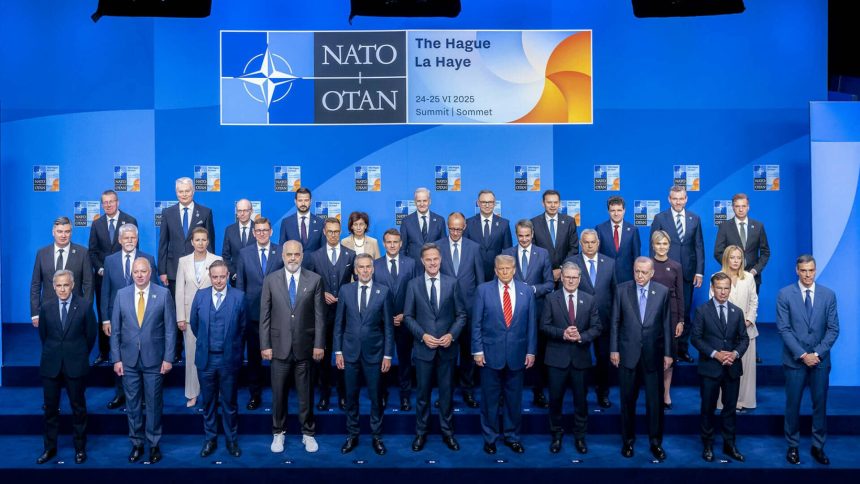
NATO leaders will convene in Ankara on 7-8 July 2026, at a moment the organisers describe as „critical for European and Euro-Atlantic security.” The future direction of the Alliance is among the summit’s stated priorities.
Two structural questions will dominate the real agenda of the summit, regardless of the language of official communiqués.
The first: what is the scope of allied obligations? NATO was founded on the principle of the collective defence of member states’ territory. The Iranian crisis tests whether the Alliance can and should extend to offensive operations initiated unilaterally by its most powerful member, outside its traditional geographic area.
The second: who decides, and how? The absence of prior consultation before 28 February 2026 confronted European allies with a fait accompli and a subsequent request to endorse it. Whatever the substantive assessment of the operation itself, this mechanism raises serious questions about the practical functioning of an alliance of 32 members with diverse political and constitutional systems.
The answers to these questions will be neither simple nor universally satisfying. They will determine, however, what NATO means in the decade ahead — more so than any press statement issued in the past four weeks.
Sources: ANSA, Corriere della Sera, Reuters, Wanted in Rome, The Washington Post, Al Jazeera, GLOBSEC, NATO Watch, Anadolu Agency, Johns Hopkins SAIS, Joint Statement of 19 March 2026 (gov.uk), European Policy Centre.
Read also
Diplomacy in the Trenches: The Actors Building the Political Capital of This War