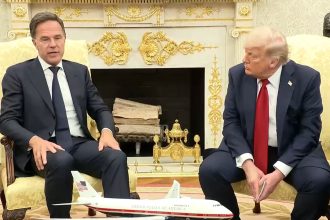
The discussion surrounding a possible withdrawal of the United States from NATO can no longer be treated as a mere campaign provocation or as an exercise in rhetoric designed to pressure European allies. Following the refusal of several Western capitals to support Washington in an operation to reopen the Strait of Hormuz, the question has become more serious: what would happen if America were to choose, formally or informally, to step back from the centre of gravity of the Alliance?
The short answer is that NATO would not disappear juridically overnight. The strategic answer, however, is much harsher: NATO without the United States would continue to exist as a treaty, as an institution, and as a political forum, but it would lose precisely those elements that turn a military alliance into a credible instrument of deterrence and warfare. The issue is not merely that the United States spends more than any other member. The real problem is that the entire architecture of the Alliance — from command and control to nuclear deterrence and large-scale logistical support — has been built, for decades, around American power.
America Is Not Merely the Largest Member. It Is the Alliance’s Centre of Gravity
In terms of defence spending, the imbalance is clear. The United States accounts for, by far, the largest share of the Alliance’s total military effort, while Europe and Canada make up the remainder. Yet these figures, as striking as they are, explain only part of the problem. NATO’s common budgets are relatively small compared with the total military expenditures of the Allies. The true issue is not that Washington sustains the Alliance’s accounting framework, but that it provides the critical mass of military power, operational command, technological support, and capabilities without which the allied mechanism becomes slower, heavier, and far less credible.
Put differently, if the United States were removed from NATO’s equation, Europeans would not simply lose the wealthiest member; they would lose the pillar that binds the system’s key capabilities together. In simple terms, NATO without America would not be an abolished alliance, but an alliance disconnected from its own strategic engine.

Could Washington Legally Leave NATO?
Formally, the treaty allows for withdrawal. Article 13 of the North Atlantic Treaty clearly states that any party may denounce the treaty, with one year’s notice. From a strictly international legal perspective, therefore, withdrawal is possible. Yet within the American domestic system, the reality is more complicated. The U.S. Congress has introduced an explicit limitation: the President may not suspend, denounce, or withdraw the United States from the treaty without the approval of two-thirds of the Senate or an act of Congress. In addition, federal funds may not be used to support such a unilateral withdrawal.
This means that a formal withdrawal is, in theory, possible, but politically and legally far more difficult than public rhetoric might suggest. The existence of this barrier, however, does not eliminate the real danger. It merely shifts it from the realm of formal withdrawal to that of de facto retrenchment.
A De Facto Exit Would Be More Dangerous Than a Formal One
For Europe, the most serious scenario is not necessarily a dramatic, officially announced withdrawal. Far more dangerous would be a gradual process in which the United States remains within the treaty, yet reduces personnel, diminishes its presence, transfers responsibilities to Europeans, weakens planning mechanisms, and avoids the most sensitive operational commitments. In such a scenario, NATO would continue to exist on paper, but its military credibility would begin to erode before the treaty itself were ever touched.
This is Europe’s great vulnerability: the Alliance may survive, juridically, an American distancing, while suffering strategically even without an official withdrawal. For the states on the eastern flank, this distinction is essential. It is not the document itself that deters adversaries, but the belief that the United States will, if necessary, provide command, firepower, logistics, intelligence, and a nuclear umbrella.
NATO Without the United States Would Not Die Instantly, but It Would Lose Its Vital Functions
Any serious analysis must avoid easy exaggeration. It is not correct to say that nothing would remain without America. Europe and Canada possess significant armed forces, modern navies, capable air forces, and an industrial base that could be expanded. Yet it is equally wrong to minimize the structural dependence on Washington.
In the domains that transform military mass into coherent combat power, dependence on the United States remains decisive: strategic transport, aerial refuelling, intelligence, surveillance and reconnaissance, communications, ballistic missile defence, electronic warfare, command and control, large-scale logistical support, advanced munitions, and extended nuclear deterrence. These are precisely the capabilities that are hardest to replace, and the ones whose substitution would require years of investment, reorganization, and accelerated production.
Accordingly, the proper metaphor is not that NATO without the United States would be a completely destroyed vehicle. More precisely, it would be a vehicle that still has a chassis, passengers, and fuel, but without its main engine, without part of its wheels, without its navigation system, and without any guarantee that it could still stay on the road under fire.
The Chain of Dependence: Not Only Budgetary, but Also Command, Technology, and Logistics
Europe’s problem does not end with missing capabilities. It extends into the realm of equipment and the broader technological ecosystem. In recent years, as Europeans have increased their defence expenditures, they have purchased a very large share of their equipment from the United States. This creates a major strategic contradiction. Europe is spending more precisely in response to American pressure, yet in doing so it is, in many cases, reinforcing its dependence on American technology, software, maintenance, logistical chains, and munitions packages.
In the case of high-end platforms, dependence does not stop at hardware. It encompasses the entire operating environment: spare parts, updates, integration, maintenance support, data systems, and interoperability. Any Europeans who genuinely wish to reduce their dependence on Washington would have to build precisely those capabilities that, today, only the U.S. military can provide at scale.
NATO’s Command Structure Is Built Around America
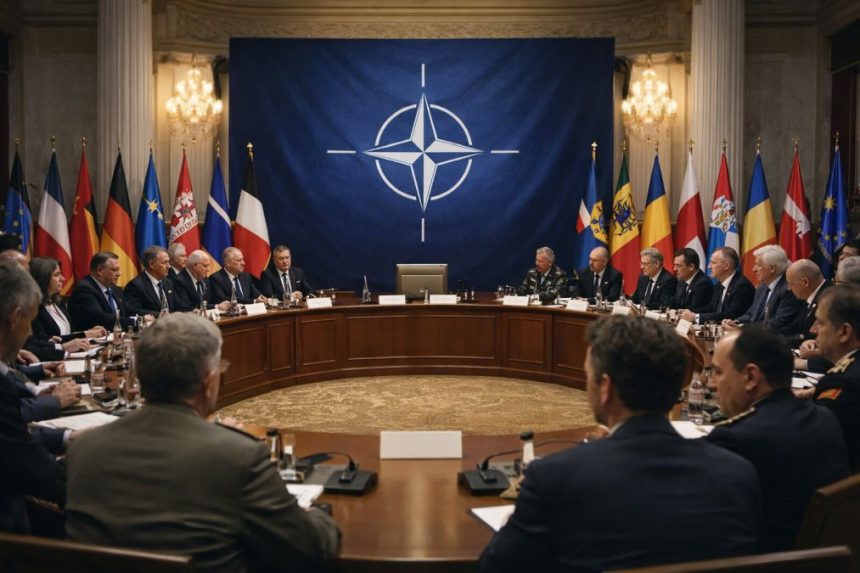
There is also an institutional dimension that public debate often overlooks. The post of Supreme Allied Commander Europe, or SACEUR, has traditionally been held by an American general. This officer exercises strategic command over all Alliance operations, while SHAPE serves as the principal operational centre of NATO’s military structure.
In other words, removing the United States from the equation would not simply mean losing a major provider of troops; it would also mean displacing the centre of command and the operational logic upon which NATO has rested for decades. Such a change might, over time, be managed through the accelerated Europeanization of command structures. But that cannot be improvised within a year. One does not replace overnight the operational culture, the networks, the procedures, or the institutional reflexes formed within a system in which America has always been the pivot.
Nuclear Deterrence: The True Breaking Point
The most sensitive issue remains the nuclear one. Europe has two nuclear powers, France and the United Kingdom. Yet NATO’s nuclear deterrence has functioned principally on the basis of the American umbrella and the strategic credibility of Washington.
If the United States were to withdraw, or even significantly weaken its guarantee, the entire psychology of European security would change. For states such as Poland, Romania, Finland, or the Baltic countries, that change might be more serious than the loss of conventional units. At that point, the discussion would no longer concern merely the absence of certain capabilities, but the credibility of deterrence at its ultimate level.
Four Scenarios for NATO Without the United States
The first scenario is a formal American withdrawal. This is the most dramatic scenario and, at present, the most difficult to produce legally. Yet if it were to occur, it would open a year of strategic shock, of reconfiguring chains of command, of repositioning forces, and of profoundly reassessing security guarantees across Europe.
The second scenario is a de facto exit. Here, the United States remains within the treaty but steadily reduces its presence, its key capabilities, and its willingness to lead Europe’s conventional defence. For the eastern flank, this may be the most dangerous scenario, because it produces strategic insecurity without the clear rupture that would compel Europe to react immediately.
The third scenario is the accelerated Europeanization of NATO. In this variant, America does not leave, but compels Europe to build, over the next five to ten years, its own set of critical capabilities, its own industrial mass, its own stockpiles, and a more robust command structure. This is the hard, expensive, but manageable scenario.
The fourth scenario is preventive European adaptation. In this case, fear of American decoupling produces the opposite effect: Europeans accelerate spending, industry, and capability integration precisely in order to make the Alliance sufficiently balanced that Washington can no longer invoke the classic argument of disproportionate burden-sharing.
NATO without the United States would not collapse within twenty-four hours. But it would immediately lose precisely those elements that give it speed, operational reach, coherence, and strategic credibility. In the first phase, the points of failure would not necessarily be the most visible politically, but the most important militarily: command and control, intelligence, aerial refuelling, strategic transport, nuclear deterrence, and high-intensity logistics. And it is precisely there, in reality, that the question is decided whether an alliance can fight or merely issue declarations.
That is why the correct question is not whether Europe could, in theory, survive without America. The real question is how much it would cost, how long it would take, and which adversaries would test the Alliance during that interval of vulnerability.
And the strategic answer is an uncomfortable one: NATO without the United States would remain standing in form, but would enter immediately into a crisis of substance.
Read also
The Queen’s Gambit: How the Hormuz Crisis Is Redrawing the Global Order