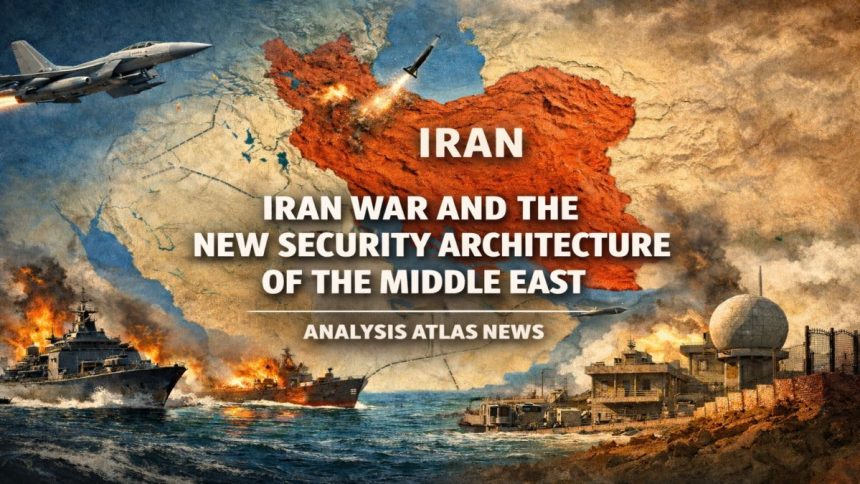
The Iran war has entered a decisive stage in which the stakes are no longer limited to direct military confrontation, but extend to the reshaping of the entire balance of power in the Middle East. What is unfolding on the ground is more than a sequence of strikes and reprisals. It is the beginning of a contest over the future regional order: who will define security, who will control strategic routes, and who will have the capacity to impose stability in a region that has for too long been held hostage by threat, coercion, and unpredictability.
Within this equation, Iran is attempting to demonstrate that it can still raise the cost of the conflict for all its adversaries. Strikes against maritime traffic, tension in the Strait of Hormuz, and pressure on energy markets all convey the same message: even if Tehran cannot militarily dominate the coalition formed around the United States and Israel, it can still impose costs, disrupt commercial flows, and force the region to live under the shadow of permanent crisis. Yet this is precisely where Iran’s strategic vulnerability becomes visible: an actor that projects power primarily through destabilization implicitly admits that it cannot build anything durable, but can only threaten, disrupt, and delay.
Iran, the Region’s Last Major Source of Unpredictability
For years, Iran has functioned as the principal center of instability in the region. Not only because of its arsenal or its ideological rhetoric, but because of its broader method of action: proxy networks, pressure on Arab neighbors, threats to maritime navigation, the instrumentalization of peripheral conflicts, and the maintenance of almost permanent tension across multiple theaters at once. In reality, the fundamental problem for the Gulf states has not simply been the existence of a regional rival, but the existence of one that has consistently favored destabilization over predictability.
From this perspective, the current conflict can also be read as a confrontation between two competing models of regional order. On one side stands the US-Israel axis, increasingly supported by Arab states that understand economic development and security cannot coexist with a permanent Iranian threat. On the other stands a regime that has preserved its influence precisely by sustaining controlled chaos. When such an actor is struck in its ability to project fear and destabilize strategic routes, the entire region begins to realign.

The Gulf States Are Bearing the Cost Now, but May Gain the Most in the Long Term
It is true that, at this stage of the war, the Gulf states are carrying a heavy burden. Critical infrastructure is under pressure, markets are unsettled, maritime transport has been affected, and energy volatility is directly hitting the region’s economic interests. In the short term, these are real, concrete, and painful losses. There is no way to disguise the fact that the Gulf monarchies are paying a significant share of the price of a confrontation that exposes them both economically and strategically.
But this is precisely where the deeper stake emerges — the one that matters most in strategic analysis. If this war decisively reduces Iran’s ability to threaten navigation, project force through proxies, intimidate its neighbors, and sustain the constant sense that the region can erupt at any moment, then the Gulf states may emerge from this crisis more secure than they have been in years. In other words, the cost of the present may become the price of future regional stability.
This is the logic that many capitals already understand: genuine development, massive investment, major infrastructure projects, trade corridors, and the Gulf’s economic ambitions cannot fully reach their potential so long as Iran remains capable of strategically blackmailing the region. A region in which the principal destabilizing actor has been weakened does not automatically become perfect, but it does become markedly more predictable. And for the Gulf states, predictability means capital, influence, security, and time gained for construction and growth.
Why the US-Israel Axis Remains Decisive
In this broader picture, the role of the United States and Israel is essential. Not merely because they possess military superiority, but because they are the only actors capable of pushing the conflict toward a strategic outcome rather than a purely tactical or operational one. Individual strikes matter, but what matters more is whether this campaign can reduce, over the long term, Iran’s ability to intimidate the region and impose disproportionate costs on its rivals. If the answer is yes, then this is no longer simply a military operation, but the beginning of a new security architecture in the Middle East.
The real challenge is not a symbolic victory, but a durable outcome. Iran is seeking to turn the conflict into a war of attrition precisely because it understands that time and cost can erode the will of its adversaries. That is why the Western axis and its regional partners require not only force, but also strategic clarity: the objective cannot be the mere punishment of Iran, but the long-term reduction of its capacity to generate instability. Only under such conditions can current costs be justified by the new order that may follow.
Romania Enters the West’s Strategic Equation
This broader context is also essential to understanding Bucharest’s decision to grant the United States access to military bases in Romania for defensive and logistical missions. It is an important decision not because it changes the course of the war on its own, but because it clearly demonstrates where Romania stands at a moment of strategic rupture. Bucharest has not chosen ambiguity, cosmetic neutrality, or a double game. It has chosen the continuity of its strategic partnership with Washington and a deeper integration into the Western security framework.
This positioning has its own logic. If the Middle East is entering a period of severe realignment, then every secure logistical node, every predictable ally, and every stable military infrastructure gains greater value than in normal times. Romania thus becomes not a frontline actor, but a credible element within the West’s strategic chain. For Washington, this is precisely the kind of partnership that matters: predictable, disciplined, and firmly anchored in the same security vision.
There is, of course, also a cost to such clarity. The more useful Romania becomes in logistical and strategic terms, the more visible it becomes within the broader equation of the conflict. But in reality, this is the natural price of belonging to a serious alliance. States that matter cannot ask for Western protection, Western investment, and Western guarantees, only to disappear into the fog precisely when the security order is being tested. From this perspective, the vote in Bucharest was also a test of geopolitical maturity.
The Iran war is no longer merely a military confrontation. It is a battle over the political and strategic shape of the Middle East after the conflict. Iran can still inflict pain, still generate shocks, and still raise the bill for the entire region. Yet it is precisely this capacity for destabilization that explains why an increasing number of actors see its weakening not merely as a tactical success, but as a possible precondition for genuine regional stability.
In the short term, the Gulf states are losing money, calm, and predictability. In the long term, however, they may gain precisely what has been missing for years: a region less vulnerable to Iran’s strategic blackmail. And Romania, through its decision to facilitate American logistical support, has shown that it clearly understands where this contest is being decided and why there is no longer any real room for ambiguity. In major moments of geopolitical realignment, it is not only strength that matters, but also the clarity of the side one chooses to stand with.
Read also
Romania Risks Becoming the Economic Casualty of Global Wars and Its Own Political Chaos