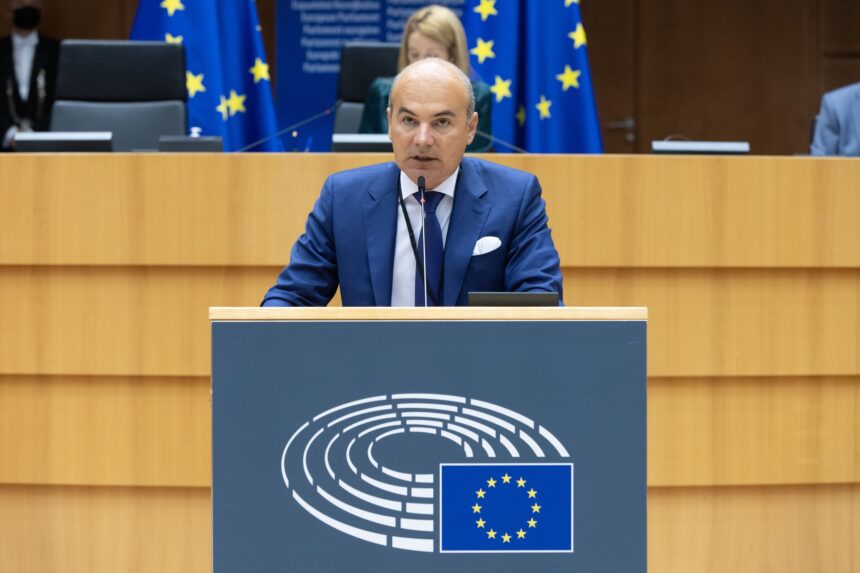
Romanian Member of the European Parliament Rareș Bogdan has issued a warning regarding the current geopolitical developments in the Middle East and their implications for European security, emphasizing the importance of strengthening defense investments and strategic alliances within the Western community.
His remarks come amid the intensification of tensions in the region and growing debates about the future of European security architecture.
“We Must Defend Our Home”
In a public message, the Romanian MEP argued that European leaders must recognize the importance of strengthening defense capabilities and maintaining the transatlantic partnership.
“When all we want is to be safe and to have the certainty that our children will live in a less dangerous world, politicians who question defense investments — such as the Deveselu missile defense shield and those that will follow — may become aware that it is essential to defend our home: the European Union.


We do not know how solid the Moscow–Tehran–Beijing axis is, but we must defend our home. The Brussels–Washington axis,” Bogdan wrote.
He warned that Europe risks losing its foundations if it fails to defend its values and security.
“Those are not just empty walls, but if we do not defend them seriously, Europe risks becoming a citadel eaten away by moths. We will lose our roots; we will destroy the history that taught us that dictatorship, totalitarianism, and terror are incompatible with our spirit — that Europe is the cradle of generous ideas and has always defended its civilization and faith,” he added.
Bogdan also criticized what he described as naïve attitudes toward geopolitical threats.
“I would like those floating in the clouds of progressivism to imagine the absence of freedom, to try for one minute to live in the shoes of people who do not know what tomorrow will bring — or whether tomorrow will come at all,” he wrote.
At the same time, he argued that crises often reveal the importance of unity among Western allies.
“The good part of misfortune is that it unites us. But could we not be more united without waiting for disasters? Could we not remember who our allies are, who stood by us in times of catastrophe, and who wanted — and still wants — to destroy us?” Bogdan asked.
The Middle East as a Geopolitical Test
According to the Romanian MEP, the current developments in the Middle East also serve as a political and strategic litmus test.
“What is happening in the Middle East is also a litmus test. It is interesting how it reveals the faces — the hidden corners, consciously or not — of all those who support, more or less openly, the Moscow–Tehran–Beijing axis and its interests,” he said.
Bogdan believes that the ongoing crisis could ultimately strengthen the strategic relationship between Europe and the United States.
“Europe’s defense is a priority that EU leaders are aware of. Discussions with the United States have begun regarding defensive measures to protect military and civilian personnel in the Middle East, and I am convinced that this crisis will shorten the distance between Washington, D.C., and Brussels.
The minds of Europeans and Americans, working together, are the only ones capable of reaching solutions that can bring peace. That is what most people in Brussels are saying these days,” he added.

The European Parliament’s Agenda
Bogdan also referred to the European Parliament’s working agenda for the week, noting that while the institution continues to follow its scheduled activities, discussions are largely dominated by the situation in the Middle East.
Among the topics currently on the agenda are:
-debates within the LIBE Committee on the risks that artificial intelligence systems pose to media pluralism and editorial autonomy
-proposals to extend exemptions from online confidentiality rules to allow companies to detect materials depicting sexual abuse of children
-discussions on the European Parliament’s priorities for the 2027 EU budget ahead of next week’s plenary session
-the ongoing housing affordability crisis within the European Union
-support for the Common Agricultural Policy for the 2028–2034 period
The plenary session scheduled for next week is also expected to address EU–U.S. political relations, joint defense procurement, economic policy coordination, EU enlargement, the energy package for citizens, strengthening relations with Canada, and passenger services.
However, according to Bogdan, the evolving situation in the Middle East will likely dominate the political discussions in Brussels in the coming days.
Read also
Rareș Bogdan: The U.S. Supreme Court Disarms America in the Face of Economic Warfare