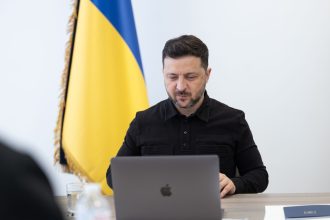
Trump’s confrontation with Zelensky is not the crisis. It is the political symptom of a military and diplomatic strategy that is running out of credible options. The emerging ceasefire initiative may be less a pathway to peace than an attempt to freeze an unfavourable battlefield before the balance deteriorates further.
The confrontation between Donald Trump and Volodymyr Zelensky has generated precisely the kind of political spectacle that contemporary Western media understands best: a personal dispute between powerful personalities, accusations of betrayal, dramatic declarations, institutional intrigue and speculation about the future of Ukrainian leadership. The diesel agreement between Washington and Moscow, Zelensky’s increasingly defiant response, American threats to restrict intelligence support and the controversy surrounding Starlink have together created the impression that the central issue is a breakdown in relations between two presidents.
It is not.
The central issue is that Ukraine’s strategic position is becoming progressively more precarious, while its Western supporters are struggling to reconcile their political commitments with a military situation that offers diminishing prospects of achieving their declared objectives.

Russia continues to advance and retains the ability to inflict extensive damage upon Ukrainian energy infrastructure.
The most troubling development for Ukraine is not simply territorial loss. It is the cumulative erosion of strategic options.
Ukraine faces simultaneous pressures involving manpower, air defence, energy infrastructure, financing, political cohesion and dependence upon external intelligence and communications systems.
Ukraine’s strategic problem is no longer principally how to win the war on the terms originally presented to Western audiences. It is how to prevent further deterioration without accepting a settlement that would expose the failure of those ambitions.
That is the reality behind the diplomatic theatre.
1.The diesel agreement is an exercise in blame redistribution
Trump’s agreement with Putin over Russian diesel exports is economically modest but politically revealing.
The initial volumes cannot, by themselves, transform international energy prices. Their importance resides in the political narrative surrounding the transaction.
Trump faces midterm elections amid rising fuel prices and the economic consequences of American involvement in the confrontation with Iran. Admitting that energy inflation is substantially connected to his administration’s own Middle Eastern policies would create an obvious electoral liability.
A far more convenient explanation is available: fuel prices are rising because Ukraine is attacking Russian refineries and disrupting energy markets.
The diesel agreement permits Trump to present himself as the leader attempting to restore supply, while increasingly casting Zelensky as an obstacle to stabilisation.
This is a classic mechanism of political influence: responsibility displacement through causal reframing.
The agreement also benefits Moscow. Russia obtains an opportunity to resume commercial activity under arrangements facilitated by Washington, while the political controversy weakens the previously uncompromising Western message concerning economic isolation.
This does not make Washington an ally of Moscow. It demonstrates that weakening Russia has ceased to be an overriding American priority when it conflicts with other objectives.
Ukraine is discovering that its most important sponsor is prepared to restrict Ukrainian military options when they interfere with American domestic political interests.
The dispute is therefore not about diesel. It is about who possesses the authority to define the war’s acceptable costs.
2.Zelensky is gambling on Trump’s political weakness because his other options are narrowing
Zelensky’s increasingly confrontational behaviour toward Trump initially appears irrational.
Ukraine depends heavily upon American capabilities, yet its president publicly challenges Washington, criticises the diesel agreement and seeks European support for resisting American pressure.
Zelensky and sympathetic European leaders may calculate that Trump will emerge politically weakened from the midterms, especially if the opposition gains control of the Senate. They may expect congressional resistance, institutional continuity and competing priorities within the American security establishment to constrain the president’s capacities
Political defiance can be the behaviour of an actor whose room for manoeuvre is shrinking.
His public confrontation with Trump serves several purposes. It reassures domestic audiences that he has not surrendered Ukrainian sovereignty. It pressures European governments to demonstrate solidarity. It appeals to American political and institutional constituencies opposed to Trump’s approach. And it attempts to raise the political costs of any American decision to reduce assistance.
But the strategy contains an obvious danger.
Congressional opposition to Trump cannot manufacture military capabilities that Ukraine lacks. European declarations cannot replace every American system. Institutional resistance in Washington cannot guarantee uninterrupted operational support.
3.The American war effort is becoming institutionally incoherent
The confrontation also exposes the increasingly artificial assumption that Washington possesses one coherent policy toward Ukraine.
The president wants a ceasefire, lower energy prices and a diplomatic outcome that can be presented as an achievement. Security institutions such as the CIA and American military planners are directly involved in coordinating strike on Russia, preserving Ukrainian capabilities and avoiding a military outcome that damages American credibility.
European governments have their own calculations, while congressional actors respond to yet another set of political incentives.
These priorities are not identical.
Washington can demand restraint from Ukraine while maintaining programmes that sustain its military effectiveness. American officials can discuss negotiations while security institutions continue planning for prolonged confrontation. Political leaders can call for peace while their proposed security guarantees preserve elements of the existing strategic rivalry.
The result is a policy increasingly difficult to evaluate according to one consistent objective.
Washington appears to want to avoid a Kabul moment in Ukraine (a humiliating defeat and fall of their ally), Russia to accept a ceasefire, American energy prices to decline and the United States to retain strategic leverage—without fully resolving the contradictions among these objectives.
This is less a strategy than an accumulation of incompatible preferences.
And Ukraine bears much of the practical cost.
4. Intelligence and Starlink expose the fragility of Ukrainian operational sovereignty
The dispute over American intelligence sharing and Starlink restrictions has brought Ukraine’s military dependency into unusually sharp focus.
Advanced military operations depend upon intelligence collection, target identification, communications, satellite access, technical integration, logistical support and systems capable of providing timely warnings against incoming attacks.
A country cannot claim operational autonomy when another actor can materially affect its military capabilities by changing access to a communications network.
The intelligence controversy is even more troubling.
Claims that Washington withheld warning information from Ukraine have emerged alongside reports of Russian strikes that allegedly arrived without adequate advance warning.
There are two possible explanations that deserve examination.
One is deliberate political coercion: Washington restricts intelligence to compel Zelensky to change his behaviour.
The other is operational failure: Western warning systems fail to provide adequate detection and Ukraine does not have systems capable of intercepting Russian missiles.
If Washington deliberately withheld intelligence, Ukraine’s vulnerability to American political pressure is greater than its public rhetoric admits.
If detection and interception failed, Ukraine and its Western sponsors face a potentially serious technological vulnerability against evolving Russian strike capabilities.
In the first case, the problem is dependency. In the second, it is military effectiveness.
And both expose the weakness of a strategy that relies upon capabilities Ukraine does not control.
5. Russia does not need a spectacular breakthrough to improve its position
Public discussion of the war frequently mention that Russia has failed because it has not achieved rapid territorial conquest.
But modern wars of attrition do not necessarily end through spectacular offensives. They can be decided through the cumulative degradation of manpower, logistics, infrastructure, financial capacity and the political willingness to sustain losses.
Russia does not have to capture all of Ukraine in order to improve its bargaining position. It can continue imposing losses, attacking critical infrastructure, forcing Ukraine to consume scarce defensive resources and exploiting the uncertainty surrounding Western assistance.
For Ukraine, the problem becomes increasingly acute as the approaching winter raises the costs of sustained Russian strikes against electricity and heating infrastructure.
This is the central weakness in much of the commentary surrounding the war.
6. The ceasefire initiative looks increasingly like an attempt to stop the clock
The emerging diplomatic initiative associated with Steve Witkoff and Jared Kushner is presented as a comprehensive framework for ending the war.
The reported components are ambitious: Ukrainian reconstruction financed through international mechanisms, security guarantees resembling NATO’s Article 5, renewed European-Russian energy arrangements, sanctions relief and a ceasefire along the existing line of control.
But the proposal contains an obvious strategic contradiction.
It attempts to persuade Russia to halt military operations while preserving much of the security architecture that Moscow has spent years attempting to prevent.
Ukraine would not formally enter NATO, but might receive guarantees intended to produce comparable deterrent effects. Russia would obtain economic incentives and sanctions relief, but would be expected to accept limitations on its military campaign without necessarily obtaining the political settlement it considers essential.
The underlying assumption appears to be that economic benefits, diplomatic recognition and the prospect of reconstruction can compensate for unresolved strategic disagreements.
This ignores the importance Moscow attaches to the military balance and its stated security objectives.
More fundamentally, why would Russia accept an immediate freeze if its leadership believes continued operations will improve its position?
Why should Moscow regard sanctions relief as irreversible when Western restrictions can potentially be reintroduced following renewed confrontation?
And why should Russia accept NATO-like security guarantees for Ukraine if those guarantees reproduce the strategic arrangements it has consistently opposed?
These are not peripheral objections. They concern the central incentives of the proposed agreement.
The ceasefire may be attractive to Washington and Europe precisely because it would prevent further military deterioration in Ukraine without requiring Western governments to acknowledge the failure of their original strategic expectations.
A ceasefire can save lives and create an opportunity for negotiation. But if it is constructed primarily to arrest an unfavourable military trajectory without addressing the causes of confrontation, its durability will be doubtful.
The apparent peace initiative may therefore represent an effort to preserve negotiating leverage rather than a credible route to ending the conflict.
7. Western diplomacy keeps negotiating with itself
One of the most revealing weaknesses of the proposed diplomatic process concerns its structure.
The United States, Ukraine, Britain, France, Germany and other Western actors first attempt to agree upon a common package of security guarantees, territorial arrangements, financial commitments and economic incentives.
Only after this internal consensus is achieved does the proposal become a basis for negotiations with Russia.
This procedure may appear necessary for preserving alliance cohesion. In practice, it creates a serious institutional obstacle to genuine bargaining.
Every concession to Moscow would potentially require reopening a painstakingly negotiated Western compromise.
The result is a negotiating process in which the coalition becomes increasingly committed to its own proposal before the adversary has meaningfully participated.
This approach worked more effectively when Western governments possessed overwhelming geopolitical leverage and could reasonably expect weaker actors to accommodate their conditions.
But the world has changed, and China among others has stated they will not respect US and Western sanctions against Russia or Iran or any other country.
The assumption that Moscow will accept a Western consensus because the West has invested considerable effort in producing it is strategically incoherent and naïve.
Negotiating among allies is not the same as negotiating with an adversary. Internal consensus is not external agreement.
The problem is that a settlement must confront the actual interests, capabilities and minimum requirements of the parties whose behaviour it seeks to change.
If a diplomatic initiative is structured around expectations that the adversary has repeatedly rejected, the probability of a durable agreement is low.
At best, the negotiations may produce a temporary arrangement.
At worst, they generate another round of unrealistic expectations, followed by renewed escalation when the inevitable rejection occurs.
8. A frozen conflict could become the West’s preferred substitute for victory
The logic of the proposed ceasefire should also be examined in the broader context of strategic competition with Russia.
The 2019 RAND study Extending Russia: Competing from Advantageous Ground explored possible measures for imposing additional economic and geopolitical costs upon Moscow.
That study documents an important strand of American strategic thinking: competition can be advantageous when an adversary is compelled to allocate extensive resources to a costly and lengthy confrontation.
9. Europe has neither the strategic unity nor the independent capabilities to dictate the outcome
Europe’s position is increasingly contradictory.
European leaders continue to describe Ukraine’s survival and territorial integrity as essential to European security. Yet they remain deeply dependent upon American military, intelligence and technological capabilities for the implementation of these objectives.
This contradiction was manageable while Washington and European capitals shared broadly similar priorities.
Trump’s presidency has made it impossible to ignore.
Europe can finance Ukraine, impose sanctions, deliver weapons and provide considerable political support. But replacing the full spectrum of American military and technological capabilities would require investments, institutional coordination and operational transformation that cannot be accomplished through emergency declarations.
Moreover, European governments remain divided by national priorities, domestic political constraints, economic exposure and differing assessments of the acceptable risks of escalation. Politicians such as Marine Le Pen in France Rassemblement national or Alice Weidel from AFD from Germany who are leading in polls have clearly stated their preference to discontinue military aid to Ukraine.
The result is a peculiar inversion of power.
European governments insist upon objectives that may require continued military confrontation, while Washington retains considerable influence over the capabilities through which that confrontation can be sustained.
Ukraine, meanwhile, becomes dependent upon the political stability of a coalition whose members disagree over the ultimate destination.
Europe is sufficiently powerful to help Ukraine continue fighting, but not sufficiently autonomous to guarantee that Ukraine can achieve Europe’s declared political objectives.
That distinction is devastating for the credibility of European strategic communication.
The continent has confused commitment with capability, financial expenditure with military effectiveness and political solidarity with operational independence.
Ukraine is paying the price for that confusion.
10. Replacing Zelensky would change the political narrative, not the battlefield
Trump’s renewed criticism of Zelensky and public suggestions concerning Ukrainian elections or alternative leadership deserve interpretation within this deteriorating strategic environment.
Potential successors—including figures associated with Ukraine’s military, intelligence and political establishment—are periodically discussed as alternatives.
But replacing Zelensky would not resolve Ukraine’s structural vulnerabilities.
A new president would inherit the same military pressures, manpower constraints, infrastructure damage, external dependencies and increasingly difficult negotiating position.
The principal effect of leadership change might therefore be political rather than strategic.
A successor could provide a new face for negotiations, create distance from earlier commitments and make concessions that Zelensky would find politically impossible after years of presenting territorial recovery as a central objective.
This is a familiar mechanism in political systems confronting policy failure.
When a strategy becomes difficult to defend, changing the leadership can permit a change in policy without requiring the institutions responsible for the original strategy to acknowledge their own role.
The leader becomes the explanation for an outcome produced by forces far larger than any individual.
Zelensky may eventually become the political bearer of responsibility for a strategic failure that was never his alone.
Replacing him may facilitate a diplomatic transition. It will not reverse the military equation.
11. The next stage could be more dangerous than the present one
The discussion about a ceasefire does not imply that the conflict is approaching a peaceful conclusion.
On the contrary, an unresolved military confrontation can migrate toward sabotage, cyber operations, intelligence activities, attacks against infrastructure and other forms of hybrid competition.
If direct military confrontation becomes temporarily constrained while the strategic conflict remains unresolved, both sides may have incentives to pursue coercive activities below the threshold of openly acknowledged warfare.
This would create an especially unstable environment.
Attribution would become more contested. Political leaders would have greater opportunities to deny responsibility. Security incidents could occur also in Europe, increasing the exposure of European societies to escalation.
And the distinction between peace and war would become progressively less meaningful.
The most pessimistic scenario is therefore the institutionalisation of an indefinite confrontation .
12. The Influence Architects perspective: political performance is increasingly compensating for strategic weakness
The Ukraine conflict provides a particularly revealing example of what I call the performance–structure gap: the widening distance between the political reality constructed through communication and the strategic reality determined by capabilities, incentives and dependencies.
The weaker the correspondence between declared objectives and available capabilities, the greater the temptation to substitute narrative management for strategic adjustment.
That is the essential lesson of the present crisis.
The Trump–Zelensky confrontation may eventually disappear from the headlines. The diesel dispute may become irrelevant. Another diplomatic initiative may replace the current proposal, and another political figure may eventually replace Zelensky.
But none of these changes will eliminate the underlying military and institutional realities.
The fundamental problem is that Ukraine’s political objectives have become increasingly disconnected from the resources and strategic leverage required to achieve them.
A change of narrative cannot close that gap.
A change of leadership cannot close it.
And a ceasefire that fails to resolve the conflict’s central security contradictions may do little more than postpone the next confrontation.
About the Author
Dr. Andrei Stoiciu is a senior expert in strategic communication, currently serving as Team Leader for Strategic Communication & Multilateral Public Diplomacy within the Global Gateway Strateg.. He is a long-term observer with the OSCE/ODIHR, an evaluator for European Commission People-to-People programs, author of „Influence- Architects 52 Human blueprints. Dr. Stoiciu holds a PhD in Behavioral Sciences and works as a licensed profiler and associated researcher on FIMI and information warfare, with a focus on mapping social trends, persuasion dynamics, and disruptive social games. He has also served as a trainer for law enforcement officials and prosecutors in interrogation and intelligence gathering.
Read also
Beyond the Riot. Performance, Structure and the French Crisis of Authority