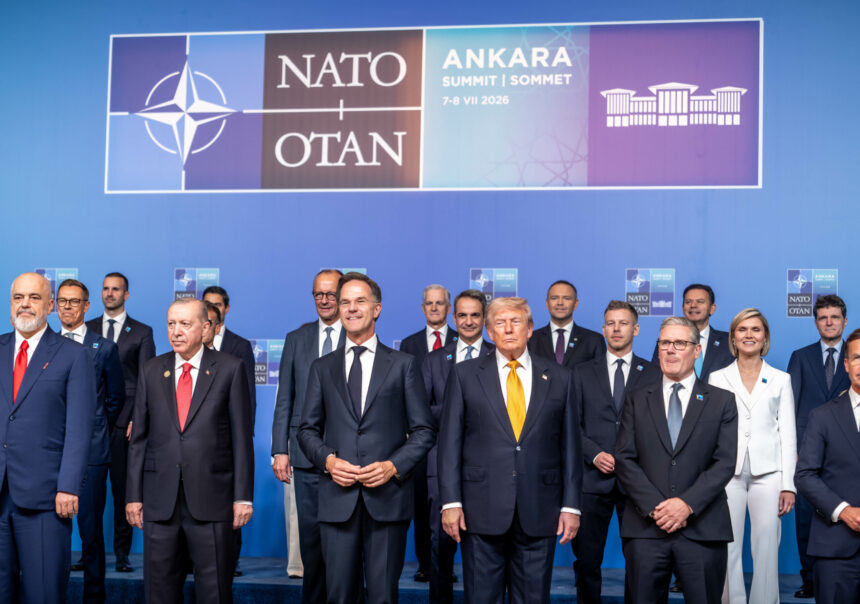
The NATO Ankara Summit was not decided by percentages of GDP, by defence contracts, or by the final wording of a solemn declaration on transatlantic unity. All of these were present, and all of them mattered. But they were the visible layer of a far deeper negotiation, conducted largely behind closed doors and never committed to any public document.
The meeting of 7–8 July 2026 unfolded at a moment of maximum tension. Donald Trump had just declared the interim understanding with Iran to be finished, the United States had resumed its strikes, and the American President was publicly voicing his dissatisfaction with the limited European contribution (Reuters). A few hours later, following consultations among allied leaders, the same Trump spoke of „a lot of unity”, of the intention of the United States to remain within the Alliance, and of a constructive atmosphere in the North Atlantic Council (Reuters).
This shift in register cannot be explained by budgets.
The most coherent hypothesis is that Mark Rutte succeeded in constructing a new political exchange: Washington reaffirms its security guarantee for Europe, while the allies implicitly accept that transatlantic solidarity does not stop at NATO’s geographical borders when the United States faces a major strategic crisis beyond them.


There is no public evidence of a secret understanding or of an explicit promise made to Donald Trump. There are, however, sufficient public elements to reconstruct the architecture of an unwritten pact.
This is the thesis of the present analysis. It can be disproved — and we shall set out, at the end, under what conditions.
A Summit Held Under the Shadow of the War with Iran
On the morning of the decisive meeting, Donald Trump announced that the memorandum with Iran was, as far as he was concerned, over. The interim ceasefire, negotiated through Pakistani mediation in order to open a sixty-day window for talks, had not produced a permanent agreement. The United States had already launched a fresh series of strikes against Iranian targets (Reuters).
NATO leaders were therefore not debating a hypothetical crisis. They met while the Alliance’s most powerful member was re-entering an open conflict, and while the risk of regional escalation was once again immediate.
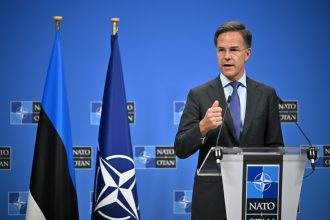
Trump publicly criticised the European states for their limited contribution to operations against Iran. The subject became sufficiently sensitive that the Secretary General was asked directly, at the closing press conference, whether he would support an American request addressed to European allies in the event that the war resumed (NATO).
Mark Rutte’s answer was revealing — not for what he promised, but for the argument he chose to make.
Rutte did not claim that NATO would automatically enter a conflict. He explained that such contributions fall within bilateral arrangements between the United States and European allies, including on the use of bases. He added, however, that approximately 5,000 American air sorties in Operation Epic Fury had been supported from European bases, and that the intervention would have been extremely difficult without Europe as a „power projection platform” for the United States (NATO).
This is one of the most significant passages of the entire summit.
Rutte framed NATO’s utility in a language Donald Trump understands directly. The United States does not defend Europe out of an impulse of strategic generosity. The American presence on the continent affords Washington bases, infrastructure, air access, logistical capabilities and forward positions for operations in the Middle East, Africa, the Arctic, and against Russia.
Europe is not merely the beneficiary of the American umbrella. It is one of the principal global infrastructures of American power. And at Ankara, the Secretary General said so explicitly, with figures, before the press.
The Anatomy of the Unseen Pact
Article 5 was reaffirmed in the very first paragraph of the Ankara Declaration. Leaders described the commitment to collective defence and the transatlantic bond as „unshakeable” and repeated the formula that an attack against one ally is an attack against all (NATO — The Ankara Summit Declaration).
For the Europeans, this was Washington’s fundamental concession.
The issue was never the legal existence of Article 5 — that had never been formally contested. The issue was the political credibility of American willingness to invoke it. In an Alliance in which the American President had repeatedly challenged burden-sharing and hinted at reducing the American commitment, an explicit reaffirmation of collective defence carried disproportionately greater weight than a routine diplomatic formula.
Following the closed-door session, a source familiar with the discussions stated that Trump did not repeat his criticisms in the room and told the allies that the United States wished to stand alongside them (Reuters).
The central question remains: what did Washington receive in return?
The most plausible interpretation is that the allies signalled their readiness to support the United States in the event of an escalation of the conflict with Iran, without NATO becoming formally party to the war. Such support could include access to bases and airspace, intelligence, aerial refuelling, logistics, the defence of American installations, the protection of maritime routes, or the participation of individual states in coalitions formed outside the allied framework.
The hypothesis cannot be presented as confirmed fact. It is, however, supported by three public elements, independently verifiable.
First: Donald Trump openly expressed his dissatisfaction with the European contribution to operations against Iran. Second: Mark Rutte explicitly defended the American strikes and described Europe as infrastructure indispensable to the projection of American power. Third, and hardest to explain otherwise: the final declaration introduced Iran and freedom of navigation through the Strait of Hormuz into a NATO document, even though the Alliance had not formally taken part in American operations (NATO — The Ankara Summit Declaration).
A NATO document does not come to speak of Hormuz by accident.
The political exchange may be summarised as follows: Washington maintains its commitment to European security, while the Europeans accept that they will not leave the United States isolated when major American interests are threatened beyond the Alliance’s territory.
This was not a legal extension of Article 5. It was a political extension of transatlantic solidarity — and that is precisely why it appears nowhere in writing.
Why Article 5 Does Not Cover a War with Iran
The legal distinction is essential to understanding why the Ankara pact had to remain informal.
Article 5 obliges allies to consider an armed attack against one of them as an attack against all, but leaves each state to decide what measures it deems necessary. Article 6 limits the guarantee geographically: the European and North American territories of the allies, the territory of Türkiye, the Mediterranean Sea, and the area of the North Atlantic north of the Tropic of Cancer (NATO — The North Atlantic Treaty).
An attack on an American base in the Persian Gulf, or on American forces operating inside Iran, would not automatically trigger Article 5. Washington could request support, but the allies’ contribution would be decided bilaterally or through a separate coalition.
This delimitation makes the political dimension of the summit considerably more important than the legal one.
Donald Trump did not need NATO to declare war on Iran. He needed to know that the allies would not obstruct his operations, would not deny him critical infrastructure, and would not distance themselves politically from Washington at the moment of escalation. A European refusal to permit take-offs from allied bases would have been, for the American administration, more costly than the absence of any direct military assistance.
The Ankara Declaration delivered the first part of this support. NATO affirmed that Iran must not acquire a nuclear weapon and called for freedom of navigation through the Strait of Hormuz to be respected (NATO — The Ankara Summit Declaration).
The Alliance did not enter the war. But it validated two of the central strategic premises of the American position. And in diplomacy, the validation of premises is the first step towards acceptance of the conclusion.
Mark Rutte and the Translation of NATO into Donald Trump’s Language
The Secretary General’s performance must be assessed beyond the appearance of a personally favourable relationship with the American President.
Rutte did not attempt to persuade Trump by invoking the history of the Alliance, the community of values, or the moral obligations of the United States. All these arguments had already failed, repeatedly, between 2017 and 2020. Rutte did something different: he translated NATO into terms of concrete utility for Washington.
His strategy had three components.
The first was the attribution of political credit. Rutte presented the increase in European budgets as the direct result of the pressure exerted by Trump. At Ankara, he stated that the American President had resolved a grievance Washington had been voicing since the Eisenhower administration: the imbalance between the American and European contributions (NATO).
The second was the delivery of material benefits. Europe and Canada had increased their investment in core defence requirements by more than 139 billion dollars in 2025, and new military acquisitions worth over 50 billion dollars were announced at Ankara (NATO — The Ankara Summit Declaration). The White House emphasised the economic dimension of this transformation: in 2025 the allies had purchased American equipment worth more than 54 billion dollars, while the support mechanisms for Ukraine allow European states to acquire weapons manufactured in the United States (The White House).
The third was the demonstration of operational utility. Europe does not offer only money and contracts. It had provided the bases from which thousands of American missions had been flown in the conflict with Iran.
Rutte thus constructed for Donald Trump a narrative he can present to the American electorate: NATO not as a burden, but as a multiplier of American power.
It is an incontestable tactical victory. It is, at the same time, a victory with a hidden cost. An Alliance that justifies its existence through utility will be permanently obliged to demonstrate that utility anew.
„NATO 3.0”: Europe Pays More, America Remains Indispensable
The formula used by Rutte describes an Alliance in which the Europeans and Canada assume greater responsibility for conventional defence, without the transatlantic bond being replaced.
At Ankara, NATO moved from setting objectives to implementing them. Announcements included investments of 40 billion dollars in unmanned systems through the Drone Edge initiative, a 27-billion-euro programme for the modernisation of depots, pipelines and fuel distribution infrastructure, and the development of an interoperable „transatlantic combat cloud”, built in part on advanced artificial intelligence models (NATO).
Taken together, these three projects say more than any budgetary figure.
The drones respond to the Ukrainian lesson: mass production, rapid adaptation and low cost have become decisive. The fuel infrastructure addresses a less spectacular but fundamental problem — no allied army can be moved and sustained on the eastern flank without depots, pipelines, transport routes and protected logistical systems. The combat cloud opens the most important competition of the decade: who will control the data, the standards, the platforms and the algorithms through which NATO operations will be coordinated.
Europe will invest more. This does not automatically mean it will become strategically autonomous.
The United States will continue to hold a disproportionate share of nuclear capabilities, strategic intelligence, long-range transport, secure communications, advanced technologies and command infrastructure. Moreover, if a significant portion of the new European budgets is directed towards American systems, Europe’s rearmament may consolidate technological dependence on Washington at the very moment it reduces financial dependence.
The new balance is fairer in the distribution of costs. It is not necessarily more symmetrical in the distribution of power. And this is, in all likelihood, the most important paradox of the summit.
Ukraine and the Transfer of the Strategic Burden
The Ankara Declaration confirms a major shift in the financing of the war.
European allies and Canada now cover the greater part of security assistance, and for 2026 they have pledged 70 billion euros in equipment, training and military support. States have committed, on a sovereign basis, to maintaining at least an equivalent level in 2027 (NATO — The Ankara Summit Declaration).
For Kyiv, the decision offers financial and military predictability — a scarce resource in recent years. For Washington, it eases pressure on the federal budget and allows the administration to argue that Europe is assuming primary responsibility for the security of its own continent.
The mechanism has a second face, however. Part of the European money returns to the American economy through the purchase of equipment manufactured in the United States. The White House has explicitly described this circuit as an advantage for American manufacturers, workers and communities (The White House).
Washington is not, therefore, abandoning support for Ukraine. It is changing its financial model. Europe pays more, American industry continues to supply a substantial share of the equipment, and the United States retains its influence over the pace and type of capabilities reaching Kyiv.
At the same time, the declaration offered Ukraine no new accession timetable. Kyiv received money, production, training and political support. It received neither an accession timetable nor a new allied security guarantee.
Ankara and the Confirmation of Türkiye as a Pivotal Power
Türkiye was not merely the host of the summit. The choice of Ankara placed at the centre of the Alliance the state that connects, geographically and strategically, the Black Sea, the Caucasus, the Middle East, the Eastern Mediterranean and the southern flank.
Coincidence became significance: a summit dominated simultaneously by Russia, Ukraine and Iran was held in the one allied capital situated at the intersection of all three files.
Türkiye controls naval access to the Black Sea, possesses one of NATO’s largest armies, hosts allied strategic infrastructure, maintains functioning channels with actors in conflict, and is developing a military industry capable of producing drones, vessels, armoured vehicles, munitions and air systems.
In the old NATO, this autonomy was treated as a problem. In the NATO taking shape after Ankara, the same autonomy becomes a resource.
President Recep Tayyip Erdoğan supported the strengthening of the Alliance’s European pillar, while cautioning that it cannot replace the transatlantic bond. He simultaneously called for the inclusion of non-EU NATO allies in European defence initiatives (Directorate of Communications of the Republic of Türkiye).
Türkiye’s message was coherent: Ankara is prepared to contribute to Europe’s rearmament, but does not accept that its status as a non-member of the European Union should become a permanent industrial barrier.
Hosting as an Instrument of Power
The organisational effort must be assessed separately from the political outcomes — and it should not be treated as a matter of protocol detail.
Mark Rutte publicly praised the hospitality of the Turkish authorities, the Presidential Complex and the involvement of the citizens of Ankara in the logistics of a summit of such magnitude (NATO). The final declaration likewise included an express expression of appreciation for the hosts.
Türkiye treated the meeting as an act of strategic diplomacy, not as a technical operation. The ceremonial, the traditional military music, the gastronomy, the protocol, the reception of the leaders and the use of the Presidential Complex projected the image of a state capable of managing simultaneously security, cultural representation, and negotiation among the most important Western powers (Directorate of Communications of the Republic of Türkiye).
At a moment when Ankara is seeking recognition of a broader role in European security, this dimension was not ornamental. It was part of the argument.
The summit functioned, in addition, as an intensive bilateral platform. Erdoğan held discussions with Donald Trump, Emmanuel Macron, Friedrich Merz, Giorgia Meloni and Mark Carney, while Türkiye and the United Kingdom signed a partnership document in the field of security and defence (Directorate of Communications of the Republic of Türkiye).
Ankara did not merely provide the stage. It used the stage.
What Türkiye Obtained
The first gain is a change of perception.
Türkiye no longer appears solely as the ally that blocks consensus and negotiates exemptions. The summit projected it as a security provider, a regional power, a military manufacturer and a diplomatic intermediary between different strategic spaces.
The second gain is the revival of the military relationship with the United States. Ahead of the summit, Washington moved forward with a sale of engines for Turkish aircraft (Reuters), and at Ankara Donald Trump stated that he intends to lift the sanctions imposed on Türkiye and to consider its return to the F-35 programme. Implementation remains conditional on legal questions and on Congress.
The third gain is the legitimisation of Turkish industry as part of the solution to Europe’s production deficit. Erdoğan called for the removal of restrictions among allies and for Turkish access to European mechanisms, including SAFE, while announcing an additional 24 billion dollars of investment in the Turkish Steel Dome air defence system (Reuters).
Türkiye did not obtain definitive reintegration into the F-35 programme, guaranteed access to SAFE, or the removal of industrial restrictions. It did, however, obtain something more valuable for future negotiations: recognition that Europe cannot rapidly expand its military production while ignoring Turkish industrial capacity.
Romania: Technical Gains with Strategic Potential
For Romania, the summit produced no spectacular political victory. It produced access — and in the new architecture, access counts for more than wording.
Romania, Bulgaria and Türkiye decided to expand the missions of the MCM Black Sea task group to include the protection of critical infrastructure. The initiative, created to counter sea mines, thereby assumes a broader role in securing submarine cables, maritime routes and vulnerable installations in the Black Sea (Romanian Ministry of National Defence).
Romania also joined the Alliance Future Surveillance and Control programme, built on the GlobalEye platform, intended to replace the current AWACS fleet and to develop a modern early-warning architecture (Romanian Ministry of National Defence). Its participation is significant in a region where drones, cruise missiles and low-altitude threats have become a daily reality.
The Romanian delegation signed the framework declaration on procurement coalitions and joined the coalition for the Naval Strike Missile and the Joint Strike Missile, alongside the United States, the United Kingdom and Norway (Romanian Ministry of National Defence).
Bucharest raised in the North Atlantic Council the strategic importance of the Black Sea and support for the Republic of Moldova, while dialogue with Turkish industry led to the scheduling of a meeting between officials and companies from the two countries in September (Romanian Ministry of National Defence).
There is, however, one dimension of Romania’s position that connects Bucharest directly to the unseen pact described in this analysis.
At the Washington meeting between Mark Rutte and Donald Trump, Romania was cited as an example of an ally that had facilitated logistical support and defensive capabilities for American operations relating to Iran. This is precisely the type of contribution the Secretary General invoked publicly at Ankara when he described Europe as an indispensable platform for the projection of American power. In this instance, Romania appears not as a beneficiary of the security umbrella, but as a provider of the infrastructure that makes American action possible.
Atlas News România put this question directly to President Nicușor Dan, at his press conference during the NATO Ankara Summit, asking him how Romania intends to capitalise on having been cited in Washington by Mark Rutte as a positive example of an ally that granted the United States logistical access for operations in Iran.
The question was not a matter of protocol. It goes to the heart of the problem: in an Alliance that has become transactional, a contribution acknowledged at the highest level constitutes political capital. And political capital, if it is not rapidly converted into capabilities, industrial investment, or a presence within decision-making structures, depreciates.
Here lies the real stake for Bucharest. Romania demonstrated, at the most visible moment of the recent transatlantic relationship, that it is useful to Washington beyond its own territory. It remains to be seen whether it will transform that usefulness into a negotiating position — or whether it will expend it as mere reputational validation.
These outcomes create access. They do not guarantee capabilities.
Joining a multinational programme does not mean Romania will receive aircraft, factories or technology transfers. Participation in NATO’s fuel infrastructure does not guarantee that any determined share of the 27-billion-euro investment will be allocated to Romanian territory. Cooperation with Turkish industry produces nothing without projects, financing and contracts. And the recognition received in Washington produces nothing without a request formulated clearly, at the right moment, to the right interlocutor.
Romania’s real gain is its positioning at the outset of programmes that will define the Alliance’s next decade. Translating that positioning into concrete benefits depends entirely on the Romanian state’s capacity to negotiate, to design and to execute — three verbs at which Bucharest’s historical performance has been uneven.
What Romania Did Not Obtain
The final declaration contains no distinct chapter on the Black Sea. Romania received no new bilateral American guarantee, no additional permanent troop deployment, and no explicitly announced major industrial allocation.
This observation does not diminish the outcomes. It imposes realism.
Bucharest obtained access to capability architectures, not a singular political trophy. It obtained the possibility of consolidating its role, not the confirmation of it.
In the NATO being built after Ankara, influence will be measured less and less by the wording extracted in a communiqué, and more and more by participation in production, infrastructure, joint procurement, command and technology. This is good news for states that know how to execute. It is bad news for those accustomed to negotiating paragraphs.
The Defence, Security and Resilience Bank
Romania is among the nine states that have announced their joint intention to found the Defence, Security and Resilience Bank, alongside Canada, Albania, Belgium, Greece, Latvia, Luxembourg, Türkiye and Ukraine. The founding documents were negotiated in Montréal, and the institution is intended to mobilise public and private capital, reduce the cost of financing, and support the expansion of defence industrial capacity (Prime Minister of Canada). Its initiators estimate a mobilisation capacity of up to 100 billion pounds sterling in low-cost financing (Reuters).
The stakes extend well beyond the financing of procurement.
A multilateral bank determines which companies receive loans, where factories are built, which technologies are treated as priorities, and which states enter the production chains. Over time, it can redraw the industrial geography of Western security.
For economies with more expensive access to capital, such as Romania, such an institution can narrow the distance separating them from the major industrial powers.
The opportunity comes, however, with a symmetrical risk. Without bankable projects, eligible companies and mature programmes, Romania risks remaining a formal founder while the financing is absorbed by better-organised industries. In a bank, shareholder status does not compensate for the absence of files.
Why Washington Might View the Bank with Reservation
There is no public evidence that the United States opposes the DSRB. Washington’s absence from among the founders does not demonstrate hostility — and this distinction must be preserved.
There are, nevertheless, grounds for discussing a possible American ambivalence.
The Trump administration has presented the increase in European budgets first and foremost through the benefits accruing to American industry: orders, production, jobs, and the transfer of Ukraine’s costs to the allies (The White House). A multilateral bank with its own governance could finance European, Canadian, Turkish or Ukrainian factories, technologies and suppliers that compete directly with American manufacturers. It could also allow smaller states to finance their industrial development without depending exclusively on bilateral procurement from the United States.
The DSRB is not an anti-American initiative. But if it becomes sufficiently powerful, it creates a margin of financial and industrial autonomy within the Western world.
Washington may consider this development useful if it increases the Alliance’s overall production. It may view it with greater reserve if the financing begins to substitute for American procurement, or to generate technological centres over which American influence is limited.
In the absence of direct evidence, this remains an analytical hypothesis, not an official position attributable to the American administration.
Türkiye’s Caution as a Signal
Ankara’s position merits attention.
Türkiye took part in the Montréal negotiations and signed the declaration of intent at Ankara. Subsequently, sources within the Turkish Ministry of Defence indicated that the state continues to evaluate its participation and cannot yet enter into a definitive commitment (Reuters).
The possible explanations are several. Türkiye may seek clarification regarding the capital to be contributed, voting rights, the seat of the institution, the financing criteria, and access for Turkish companies. It may be seeking to avoid a mechanism that would reproduce the restrictions encountered in European Union programmes. It may also wish to preserve negotiating room with Washington at a moment when the F-35 file, the sanctions and the aircraft engines are once again open.
What can be affirmed is that Ankara does not commit definitively to a new institution until it sees clearly the relationship between the costs assumed, the access afforded to Turkish industry, and the effects on its relationship with the United States.
This is the conduct of a power that no longer participates for the sake of political validation. Türkiye seeks industrial benefits and influence proportionate to its strategic contribution. Other states — Romania among them — might study the method.
Who Won at Ankara
Donald Trump obtained public recognition of his role in increasing European budgets, additional contracts for American industry, the transfer of a greater share of Ukraine’s costs to Europe, and confirmation that European allies remain operationally useful beyond the continent.
Mark Rutte averted a rupture that had appeared possible in the opening hours of the summit. He obtained Trump’s signature on the reaffirmation of Article 5 and converted the American President’s grievances into an argument for strengthening European industry and capabilities.
Türkiye obtained recognition of its status as a pivotal power. It demonstrated organisational capacity, military relevance and diplomatic utility, while simultaneously reviving its defence relationship with the United States and pressing for the integration of Turkish industry into European mechanisms.
Romania obtained access to surveillance programmes, joint procurement, naval cooperation and strategic financing. Its gain is potential, but real: Bucharest is seated at the table at which the instruments of the future Alliance are being built.
The American, European and Turkish defence industries number among the principal beneficiaries. The summit confirmed that defence is no longer merely a budgetary policy, but one of the foremost industrial projects of the decade.
Who Did Not Obtain Everything
Europe received the reaffirmation of the American guarantee, but not the certainty that it will not be politically contested once again. It gained time in which to build its defence, not strategic autonomy.
Ukraine received a major, multi-year financial commitment, but no new accession perspective.
Türkiye consolidated its position within the Alliance and secured the reopening of a number of files.
Romania entered important projects, without the guarantee that the investments will be made on its territory.
The United States obtained greater support and a more favourable distribution of costs, but did not transform NATO into a coalition that automatically follows Washington into any external conflict.
The Limits of This Analysis
The thesis of the unseen pact is a reconstruction, not a certainty. It must be tested honestly.
It would be disproved if the Europeans were openly to refuse access to bases in a new round of American strikes against Iran; if Trump were to resume public attacks on Article 5 in the coming weeks; or if it were to emerge that the change of tone at Ankara had strictly domestic American causes, unconnected to the allied negotiation.
It would be confirmed if, in the coming months, European states were to provide operational support to the United States outside the NATO framework, without significant public debate and without disputes within the North Atlantic Council.
That is the test that matters. The rest are communiqués.
What the Ankara Summit Was Truly About
Ankara was about the mutual renegotiation of strategic utility.
Europe had to demonstrate that the Alliance is not a system through which the United States bears the costs of European security. It demonstrated that it can spend more, purchase more, finance Ukraine, and provide the infrastructure required for American operations.
The United States had to demonstrate that redistributing the burden does not mean abandoning the continent. Donald Trump accepted the reaffirmation of Article 5 and signalled that Washington is remaining within NATO.
Between these two needs stood Mark Rutte. His merit lay not in tempering a personality. It lay in formulating a transatlantic contract compatible with the American President’s vision: an Alliance that produces measurable results, purchases armaments, sustains industry, assumes costs, and affords the United States a capacity for global action.
Iran was the immediate test of that contract.
NATO did not enter the American-Iranian conflict. But the allies had already provided bases and infrastructure for American operations, and the summit added to that contribution a form of political backing and strategic legitimacy. In return, Washington reaffirmed the pillar on which European security rests.
This is the unseen pact of Ankara. Not a formal agreement, nor a legal extension of Article 5, but an understanding as to the meaning of solidarity within an increasingly transactional Alliance: America continues to defend Europe, and Europe must be available when America needs allies.
What Bucharest Should Do
Three operational conclusions follow from this analysis for Romanian decision-makers.
First: influence will be negotiated in programmes, not in paragraphs. The priority is no longer to secure a mention of the Black Sea in the final declaration, but to be present within the decision-making structures of Drone Edge, AFSC, and the fuel infrastructure.
Second: the DSRB must be treated as a financial institution, not as a diplomatic gesture. Without a portfolio of bankable projects prepared by the time it becomes operational, founding-state status will remain symbolic.
Third: the Turkish model merits study. Ankara does not ask for solidarity. It asks for reciprocity — and it obtains it.
The summit did not restore the old NATO. It sketched a new Alliance: better financed, more industrialised, more technological, and far more conscious of its own interests. A NATO militarily stronger, but also more dependent on permanent negotiation between the two shores of the Atlantic.
Ankara did not close the transatlantic crisis of confidence. It built the formula through which that crisis can be managed.
Sources: NATO — The Ankara Summit Declaration; NATO — Press conference by Secretary General Mark Rutte, 8 July 2026; NATO — Doorstep statement by the Secretary General; NATO — The North Atlantic Treaty; Reuters — Trump says interim accord with Iran is over; Reuters — Trump says „a lot of unity” at NATO summit; Reuters — Erdoğan urges NATO allies to lift defence industry restrictions; Reuters — US to move forward with Türkiye jet engine sales; Reuters — Canada aims to announce countries backing global defence bank; Reuters — Türkiye still evaluating participation in global defence bank; The White House — Fact Sheet on NATO defence investment; Directorate of Communications of the Republic of Türkiye; Romanian Ministry of National Defence — Ankara NATO Summit; Romanian Ministry of National Defence — NSDIF; Prime Minister of Canada — Declaration on the Defence, Security and Resilience Bank.