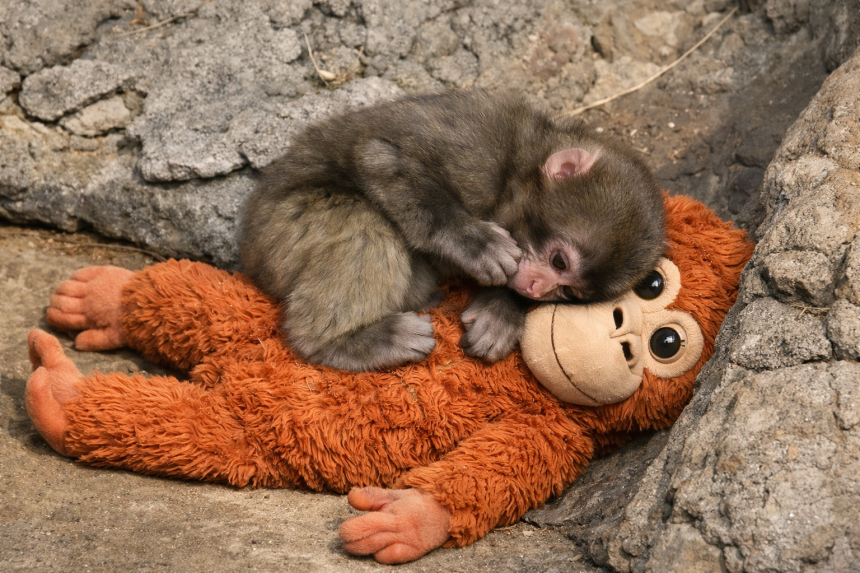
There are images that need no explanation. You look at them and something tightens in your chest. That is how Punch’s story begins: a tiny Japanese macaque, so small that the world feels as though it should instinctively protect her, clinging desperately to a large plush toy as if it were the last solid thing in a collapsing universe.
Punch was born at Ichikawa City Zoo in Japan. She is a baby Japanese macaque (Macaca fuscata), a species known for its resilience and its complex, hierarchical social structure. In the wild, a macaque infant does not leave its mother’s body during the first months of life. It clings to her fur, sleeps pressed against her warmth, regulates fear and stress through the rhythm of her breathing.
Punch did not have that chance.
Shortly after birth, she was abandoned. Zoo staff intervened and saved her physically. But biological survival is not the same as emotional security. She was bottle-fed, cared for, kept safe. What she did not receive was the primordial bond nature designed for those first fragile weeks — the steady reassurance of a heartbeat close to her own.

When the time came to introduce her to the troop, reality proved harsh. Japanese macaques live within strict hierarchies. Contact can be firm. Corrections are swift. Social rules are clear and uncompromising. For a baby raised without maternal guidance, each interaction can feel overwhelming.
And then there is the plush toy.
A large, soft orangutan doll — oversized against her small body. Punch wraps her arms around it, presses her face into it, drags it behind her across the enclosure floor. In the now-viral videos, when an adult macaque disciplines or intimidates her, she retreats and immediately clutches the plush. She grips it tightly, almost urgently.
It is not a “cute” gesture. It is emotional survival.
The Embrace That Was Missing
Behavioral specialists note that early maternal separation can affect stress regulation and social development in primates. Infants learn through touch, gaze, proximity, and the physical rhythm of their mother’s body. Without that foundation, the world can feel sharper, louder, less predictable.
Punch is learning in real time. Some footage shows rough interactions — part of natural troop dynamics. Other clips capture a brief but striking moment: an adult macaque embracing her. For a second, her tiny body appears to soften, to settle. As though, for a fleeting instant, she no longer needs to brace herself.
Yet time and again, she returns to the plush.
Because the plush does not reject her.
The plush does not dominate her.
The plush does not test her place in the hierarchy.
The plush simply remains.
Why the World Is Crying Over a Monkey
The reason is not novelty. It is recognition.
In Punch’s story, people do not see merely an animal. They see a universal need — the need to be held. The need to know that, however harsh the world may be, there exists a safe place.
Punch does not know that millions are watching her. She does not know she has become a symbol of early loneliness. She knows only that when fear rises, she must hold on to something.
And that image — a motherless infant clutching an inanimate object for comfort — strikes a deeply human chord.
Beyond species.
Beyond viral clips.
Beyond the enclosure walls.
It is the story of a child who should have been held — and who is learning, quietly and bravely, to soothe herself instead.
In Punch’s eyes, as she buries her face into the plush, we do not see a meme.
We see longing.
Read also
Gold at $5,000 per Ounce: The Classic Signal That the World Is Entering a Risk Phase