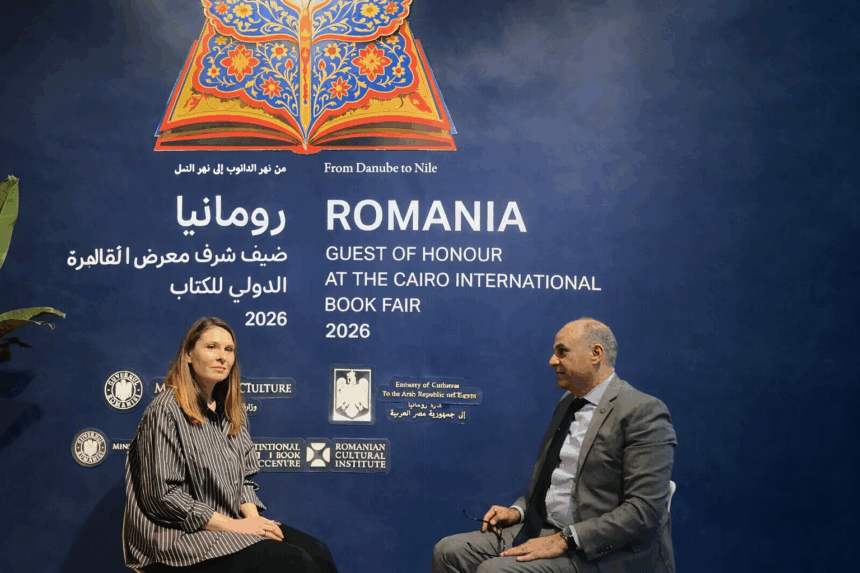
Her works are testament to the power of literature in bridging cultures. With three novels translated into over 20 languages, the writer Tatiana Tibuleac from Moldova is participating at the Cairo International Book Fair (CIBF).
In an interview with Atlas News, Tibuleac shared her experiences and insights at the CIBF, highlighting the cultural connections between Romania and Egypt. Her novels explore themes of family, history, and identity, resonating with readers across borders.
She emphasizes the importance of cultural exchange and the role of writers in shaping our understanding of the world.
Atlas News: Can you describe your experience at the Cairo International Book Fair? What are the highlights for you so far?
Tatiana Tibuleac: Of course, we came because of a fascination with the country. We grew up with Egypt being a sort of very mystic land, and of course this fascination only grew in time. I grew up and I started reading more about this place, but this is my first time, so obviously for me everything is new and it’s amazing.

I must say that even if I travelled half of the world, that moment when I came from the plane to Cairo, the idea of having this mesmerizing city built in the desert, for me it was fantastic. For me, it’s exploring the country, and of course I read one book by your Nobel Prize writer, Naguib Mahfuz, but now it’s even more interesting to discover this country through literature.
What I like here at the fair, I think everything is very cosmopolitan. It seems that people are very open-minded, they come to the meetings, they want to see, they want to learn about Romania and Romanian literature, and I think this is the main objective of this book fair.
Atlas News: Would you highlight some of your publications to Egyptian readers?
(TT): I write prose. My first novel, The Summer When My Mother Had Green Eyes, is a novel about a family drama between the mother and the son. It’s been translated now into more than 20 languages, so I hope that in Egypt it will arrive as well.
My second novel is called The Glass Garden. It’s about the years when Moldova became an independent republic after the Soviet Union collapsed. My third novel, When You’re Happy, Strike First, which was only recently published in September, is again about the transition years in Moldova — Perestroika, the new independence. I hope it’s of a certain interest for the Egyptian public.
Atlas News: What themes or messages do you strive to convey in your writing, and how do you think they resonate with Egyptian audiences?
(TT): I would say that because I think we are quite unknown to the Egyptian public, but I have hope. I think that culturally we have some things in common. I think the idea about family and hospitality is very close to how we like to see people who come to our place, to our home.
In my literature, I explore the past quite a lot, because I think that we cannot avoid the past. Even if we are very modern today, the past haunts us and catches up with us. I have three novels until now, and in a way they all search for answers from the past.
I explore the communist past of my country, but I also explore my grandparents’ generation, because I think a lot of bad things happened to them, but they never spoke about it. So for me it’s a matter of memory, I think, to tell the stories of those who didn’t have a say in it, who didn’t have a chance to speak about it.
I’m from the Republic of Moldova, which used to be part of Romania in time, so I do speak Romanian and I write in Romanian. I write about the relationship between parents and children, which I suppose is a theme that goes in every country, because everywhere there are parents and children — the struggle.
I really hope that after this participation, the public will be more interested in Romania, translators will be more interested in Romanian literature, and who knows, maybe we will be having our books translated and they will find their readers.
Atlas News: How do you see the role of literature in promoting dialogue between Romanian and Egyptian cultures?
(TT): I think literature is a language in itself, because I’m sure that Egypt and Romania haven’t explored enough of each other.
As I said before, I have only read one author from Egypt, which is obviously very little, and I’m sure that most Egyptians haven’t read anything from Romania.
I think that a language of culture should be the safest language, because it should bring only the true parts of our country. In writing, we can sometimes say things which we cannot say as people, but writing should be a safe place for a writer. When people from two cultures are put in one room, they end up talking and communicating, so this book fair, at a certain scale, is exactly this — hoping to interact with some Egyptian writers and media.
Atlas News: What aspects of Egyptian culture have influenced your work or thinking as a writer?
(TT): I didn’t write about Egypt in my books, but as Matej Visnek said on stage today, I think that there is no person from Eastern Europe who didn’t learn about Egypt. For me, Egypt is a land of mystery, first of all. I only have one huge regret linked to Egypt. My father adored Egypt, he was a fan of everything and he read a lot, a lot of history. He wanted to see the pyramids. I wished to bring him to Egypt, but he died. So this visit for me is also an act of memory for him.
It’s such a rich culture, Egyptian culture, that from that point of view it’s an honor to be here and to be on this land where so much culture was born and influenced the whole world. Egypt influences every person in the world. It’s a part of a civilization, it’s not just for Egyptians. We always say this: Egypt is not just for Egyptians. It’s an international heritage.
Atlas News: Looking ahead, what opportunities do you see for future literary collaborations between Romania and Egypt? How can they be realized?
(TT): Of course, the fastest and easiest way is to facilitate exchanges between writers, poets, and cultural people, because culture travels faster than everything else.
When a person comes on holiday, they will see beautiful food, beautiful weather, beautiful monuments, but when a poet or a writer comes, they will see much more, because they are being fed by the things they see and breathe.
I do believe that there is a lot to explore from both sides, and hopefully we will be the first ones to do so, to talk about it in a different way. Because you see how a poet works: if you are inspired by a moment, and this moment comes upon you when you are visiting the pyramid, that word will be in your poetry and it will stay there forever.
Atlas News: What is your message to Egyptian intellectuals, authors, and readers?
(TT): Personally, I’m fascinated by authors who can write about the past and the cultural heritage of a country in their modern books, because this is the easiest way for younger generations to become interested.
Of course, there are people who study the history of a place, but sometimes we want to live in modern literature. Then, if a young person takes a book, they want to learn about that country through literature. My message is to continue writing, to continue talking about stories from this land, because these are the ones that come easier, and they are the easiest way to make the country known.
Read also
Cultural diplomacy brings Romania and Egypt closer at Cairo Book Fair