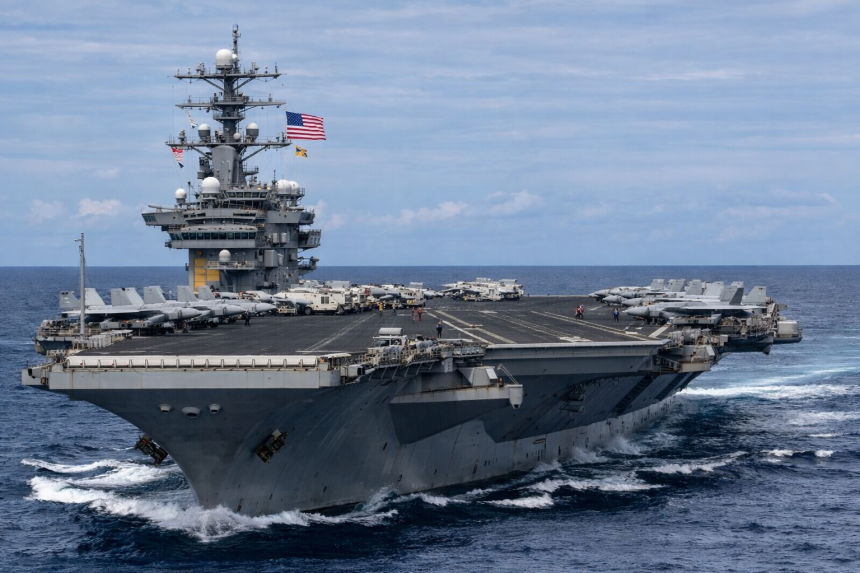
The recent repositioning of U.S. military assets in the Middle East has been interpreted in some circles as a sign of imminent escalation. A closer examination of the strategic context, official messaging from Washington, and the broader regional dynamics suggests a different reality: the United States is not preparing for a new conflict, but rather reasserting its role as a guarantor of regional balance at a time of heightened volatility.
This move should be understood primarily through the lens of active deterrence—a longstanding pillar of U.S. strategic doctrine—rather than as a prelude to direct military intervention.
A region under strain, but not out of control
The Middle East is currently experiencing a phase of structural tension. The Israel–Hamas conflict, Iran’s indirect pressure through proxy actors, maritime insecurity, and energy competition have combined to create an environment where the risk of miscalculation is significantly elevated.
In such a context, strategic ambiguity or perceived U.S. disengagement would be more destabilizing than a clear and credible presence. Recent history shows that periods marked by signals of withdrawal have often encouraged attempts to test boundaries rather than fostering regional calm.

The repositioning of U.S. naval and air capabilities is therefore intended to reduce the incentive for escalation, not to provoke it.
Washington’s message: clarity over ambiguity
From the perspective of the Pentagon and the U.S. administration, the message is carefully calibrated and dual in nature.
First, it is directed toward hostile or opportunistic actors: the United States remains capable of rapid response and willing to act should red lines be crossed. This is not an offensive posture, but a reaffirmation of credibility.
Second, the message is addressed to regional allies: the U.S. is not abandoning the Middle East, nor is it outsourcing regional security entirely. Continued American presence provides predictability in a geopolitical environment already saturated with uncertainty.
This balance is essential. Allies left uncertain may behave unpredictably, while adversaries who perceive weakness may become increasingly adventurous.
Why this is not about preparing a new war
A critical element often overlooked in alarmist interpretations is the broader global strategic burden carried by the United States. Washington is simultaneously managing major dossiers: systemic competition with China, the war in Ukraine, Indo-Pacific security, and domestic economic pressures.
Within this strategic landscape, a large-scale military confrontation in the Middle East would not serve U.S. interests. The costs would be high, while the strategic returns would be limited. Precisely for this reason, U.S. policy is oriented toward prevention rather than intervention.
Deterrence, at this stage, is the most effective tool for managing risk.
Iran, Israel, and the logic of limits
Iran remains a central actor in the regional equation, yet its behavior is largely strategically rational. Tehran tests boundaries but avoids direct confrontation with the United States. A reinforced American military presence narrows the space for uncontrolled indirect actions by proxy forces.
For Israel, the signal is equally significant. The United States supports Israel’s security while also maintaining a framework of restraint designed to limit unintended regional escalation.
In this sense, U.S. repositioning functions as a stabilizing mechanism, not as a catalyst for radicalization.
Energy security and maritime stability
Another key dimension is the protection of energy flows and commercial maritime routes. Any major disruption in the Middle East would have global economic repercussions, directly affecting Western economies.
U.S. naval presence serves to guarantee freedom of navigation and to signal clearly that critical infrastructure and strategic routes are not grey zones open to coercion or disruption.
In a fragmented international system, control over logistical and energy options is increasingly as important as traditional military power.
Conclusion: deterrence as strategic maturity
The U.S. military repositioning in the Middle East should not be read as a sign of weakness or aggression. It reflects a mature, tested strategic approach that recognizes a fundamental reality: credible presence prevents conflict, while ambiguous retreat invites it.
At a time of global fragmentation, the United States is acting as an architect of balance, not a generator of instability. The objective is not war, but control of escalation. And this move is designed precisely to achieve that.
Read also