Donald Trump’s announcement of a two-week pause in the war with Iran was immediately received as a sign of de-escalation: oil prices fell, stock markets rallied, and the risk of a global energy shock appeared, at least temporarily, to have receded. A superficial reading stops there. A serious geopolitical reading begins precisely where public optimism ends. For the current truce does not necessarily signal the approach of peace; it may instead mark the transition of the conflict into a higher phase, from the exchange of strikes to the negotiation of a new order of power in the Gulf.
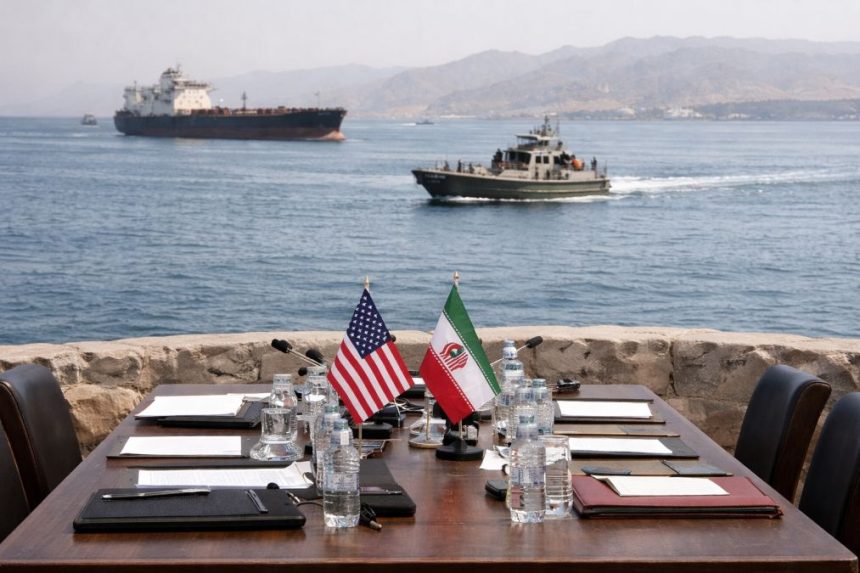
If Washington sought to project the image of de-escalation achieved from a position of strength, Tehran is trying to convey something quite different: that any return to normality will henceforth require acceptance of an Iranian role in the management of maritime security in the world’s most sensitive energy corridor. Hormuz is not merely a maritime passage. It is the route through which a vital share of global oil exports flows, and any disruption there has immediate consequences for markets, supply chains, transport costs, and energy prices. When a state succeeds in turning such a chokepoint into a negotiating instrument, it is no longer discussing a ceasefire alone. It is negotiating status, recognition, and the ability to impose systemic costs on its adversary.
Tehran Is Negotiating More Than Peace: It Is Negotiating Its Place in the Regional Order
The real issue at this stage is not whether Trump has secured two weeks without bombardment, but what Iran is trying to obtain in exchange for that window. The messages emerging from the Iranian side point to a far broader logic than the mere suspension of hostilities. The issue is not simply the halting of American strikes, but guarantees that they will not resume, compensation for the damage inflicted, relief from economic pressure, and, above all, recognition of an Iranian role in the new security framework of the Gulf.
This is where the decisive angle appears — the one least visible in the news cycle, yet probably the most important in understanding the logic of the negotiation. Iran’s ten-point list should not be read exclusively as a literal collection of final, fixed, and indivisible demands. In hard negotiations, especially those conducted under military pressure, states deliberately place on the record demands that appear impossible to accept. They do so not because they expect them to be approved in full, but because such demands create room for manoeuvre and prepare the ground for controlled concessions later on.

In other words, not every point is intended to be won. Some are placed on the table precisely to make others achievable. A maximalist demand raises the ceiling of the discussion, shifts the centre of gravity of the negotiation, and allows its author later to retreat from it without appearing to have yielded strategically. On the contrary, stepping back from an untenable position can be presented as a major concession, precisely in order to secure other gains that may be less visible in media terms, but far more consequential geopolitically.
In Iran’s case, that logic is essential. If some of the ten points were framed in maximalist terms precisely so that they could later be withdrawn, then the real question is not what Tehran officially demands, but what it truly intends to preserve until the end. The likely answer lies not in the public rhetoric, but in a handful of key objectives: legitimising an Iranian role in the administration of maritime security in the Strait of Hormuz, obtaining guarantees against renewed military action, gaining access to blocked financial resources, and securing tacit recognition that no durable regional arrangement can be built without Iran.
That is the difference between a ceasefire and a negotiation over status. The former temporarily halts violence. The latter redistributes legitimacy and influence. And Iran is, in all likelihood, attempting precisely such a conversion: to turn the vulnerability produced by the military campaign into a new form of political capital. If it succeeds in establishing the idea that safe passage through Hormuz is no longer an automatic feature of the international order, but rather an arrangement managed, conditioned, and in part arbitrated by Tehran, then it will have obtained something far more valuable than a mere military pause. It will have secured a precedent.
Trump’s Truce Is, Above All, a Test of Strategic Credibility
From the perspective of the White House, the truce can be presented as a pragmatic success. Trump is conveying the message that American objectives have largely been achieved and that the present pause may create the necessary space for a broader solution. Politically, that formula is convenient: the administration avoids the image of unlimited escalation, calms the markets, and sends the American public the signal that Washington can impose de-escalation without entering a total war.
Strategically, however, matters are far less linear. The fact that the truce was tied directly to the reopening of the Strait of Hormuz shows that the central issue was never purely military. What matters most is not the number of strikes, but who sets the rules of access, control, and security in a space vital to the global economy. If the United States announces a pause, but Iran succeeds in imposing a new form of conditionality on maritime transit, then the image of an American victory becomes, at the very least, open to question.
Moreover, the fact that the process has required indirect channels, mediation, and last-minute negotiations shows that brute force was not sufficient to close the equation. This is not necessarily proof of weakness. It is, however, proof that the balance of power cannot be read solely through the prism of American military superiority. Iran has demonstrated that it can generate costs substantial enough to force a recalibration of the adversary’s position. And in a regional crisis, the capacity to impose costs matters almost as much as the capacity to deliver strikes.
The Real Test Is Not the Political Statement, but the Behaviour of the Maritime Market
In geopolitics, the truth of a crisis is not always visible in leaders’ statements, but in the behaviour of the actors who carry real cargoes, real capital, and real risk. From that perspective, the reaction of maritime operators may be the most important indicator of the moment. Financial markets can instantly welcome a political announcement. The shipping industry reacts far more cautiously, because it does not operate on the basis of diplomatic optimism, but on the basis of the probability of an incident, seizure, renewed blockade, or rapid escalation.
That is why the phrase “safe transit” must be examined with the utmost rigor. If it means freedom of navigation guaranteed through clear mechanisms and without additional political cost, then it would indeed represent a first step toward stabilisation. If, however, it means transit permitted under Iranian supervision, possibly accompanied by conditions, filters, or politically imposed costs, then the world is not witnessing the restoration of the previous order, but the emergence of a new one, in which Iran is forcibly inserting its power into the rules governing the global circulation of energy.
This is where the real significance of Iran’s ten-point list becomes visible. It lies not in the fact that some demands appear excessive or impossible to accept, but in the fact that they may serve as a negotiating screen for far more sophisticated objectives. Some of those points may be sacrificed precisely in order to make other gains acceptable: a new regime of coordination in Hormuz, political security guarantees, selective economic relief, and implicit recognition of Tehran’s regional role. If that is indeed the real architecture of the negotiation, then Iran is not playing defensively. It is playing to convert crisis into strategic advantage.
For Atlas Geopolitic, the serious conclusion is this: the truce announced by Trump should not be read as the end of the crisis, but as its transfer into a more sophisticated and, in certain respects, more dangerous framework. The war is no longer being waged only with missiles and bombardment, but with lists of demands, legal formulas, maritime corridors, and systemic costs. If Iran conceived the ten-point list as an architecture of negotiation rather than a simple inventory of wishes, then Tehran is seeking not merely to obtain a pause, but to turn military shock into a durable strategic advantage.
And if Washington accepts, even implicitly, the idea that Hormuz may operate under a new regime of Iranian political conditionality, then the current pause in fighting will not be remembered as the beginning of peace, but as the moment when the order in the Gulf began to be rewritten.
Sources: Reuters, Associated Press, The Guardian.
Read also