Atlas News Editorial Analysis
The European Union is, without question, one of the most ambitious and successful political projects of the twentieth century. For Romania, EU membership has meant stability, access to markets, development funding, infrastructure upgrades, economic growth, and a firm anchoring within a broader space of prosperity. This reality cannot—and should not—be disputed. The challenge begins when Europe’s economic achievements of the past are mistaken for strategic relevance in the present.
The world in which the European Union prospered no longer exists.
A diplomacy shaped for another era, confronting instant decision-making
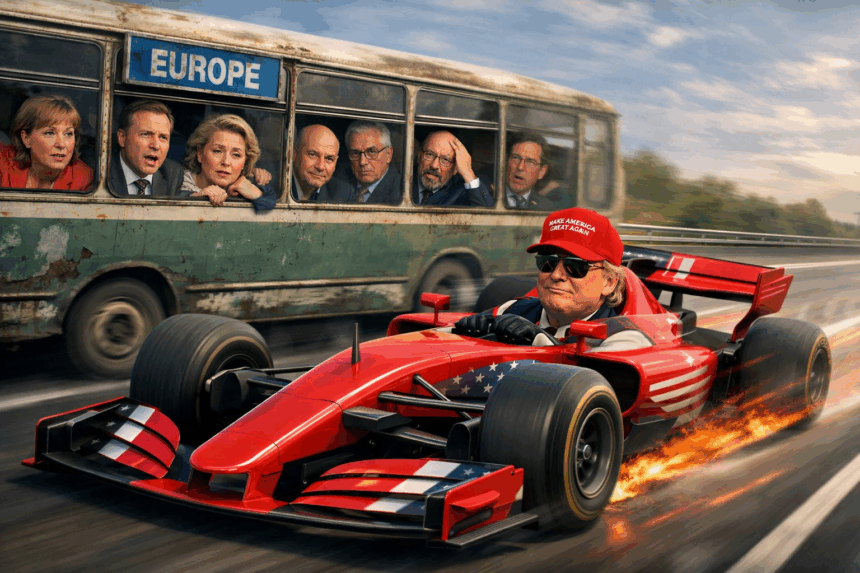
European diplomacy still operates according to refined, slow-moving patterns—designed for an age of prolonged negotiations, carefully balanced formulas, and incremental compromise. Today, however, global foreign policy is increasingly driven by speed, executive decisiveness, and the capacity to translate intent into immediate geopolitical facts.
In this environment, U.S. President Donald Trump operates in a register fundamentally different from that of Europe: rapid decisions, direct public messaging, economic pressure, and swift strategic repositioning—often without extended consultations. This pace places the European Union in a near-permanent state of delayed response, struggling to produce a coherent, unified, and credible reaction.
Europe is not losing because its principles are inherently flawed, but because it reacts too slowly in a world that no longer waits for consensus.
Greenland and sanctions: signals of a changing order
The Greenland issue has been more than a passing diplomatic dispute; it has functioned as a reality test. Strategic interests in the Arctic—maritime routes, resources, and security—have made clear that Washington is increasingly unwilling to accept ambiguity or prolonged bureaucratic paralysis on matters it deems essential.
In parallel, the prospect of U.S. sanctions targeting European states that did not support American proposals has exposed the fragility of the transatlantic relationship. European reactions have ranged from public indignation to familiar moral language, yet too often they have avoided the core issue: the underlying balance of power.
NATO and the illusion of parity
Within NATO, the rhetoric of unity masks a structural imbalance. The United States accounts for roughly 70% of total Allied defense spending, while many European states continue to treat security as a service effectively outsourced across the Atlantic.
Under such conditions, calls for an “equal partnership” become increasingly difficult to sustain. The logic is straightforward: those who bear the greater share of the burden wield greater influence. This reality, long minimized or postponed in political discourse, is now returning through direct pressure and harder bargaining.
A “Coalition for Peace” and Europe’s strategic sidelining
The U.S. initiative to build a pragmatic alternative to the United Nations—described as a “Coalition for Peace,” and reportedly including an invitation to Russia—signals that major global decisions may increasingly be negotiated outside traditional multilateral frameworks.
Europe, deeply invested in normative and procedural language, risks being bypassed in key security dossiers. Not because it lacks values, but because it is increasingly perceived as unable to deliver outcomes at the speed and scale required by today’s geopolitical competition.
The European Union: a valuable project, but institutionally outpaced
To argue that the European Union must be reformed is not to reject it. On the contrary: the EU remains a valuable project. Yet it is a project built for a world that has changed dramatically. Without profound reform—institutional, decision-making, and, above all, leadership—Europe risks becoming a prosperous space that is strategically irrelevant.
Europe needs leaders who understand the new dimension of foreign policy: hard competition, flexible alignments, power-based deterrence, and rapid decision cycles. A “salon diplomacy” mindset is no longer sufficient.
Romania and the risk of placing all options in one basket
For Romania, placing all strategic options exclusively in the “European basket” risks becoming a serious diplomatic vulnerability. A Europe that is slow, divided, and weakly coordinated cannot, on its own, guarantee Romania’s security and relevance in an increasingly unforgiving international environment.
Bucharest needs a flexible, realistic, and modern foreign policy—one adapted to shifting power realities rather than anchored primarily in declarative reflexes.
Domestic instability as a window for strategic correction
At home, a potential withdrawal of the PSD from government would, inevitably, produce political instability. That correction matters: the issue is not a simple “overthrow” scenario, but the possibility of a reset moment.
Paradoxically, for the first time in a long while, an internal political movement could create the conditions for correcting an external strategic misalignment. The government led by Ilie Bolojan stands before a difficult choice: manage instability as a vulnerability—or treat it as an opportunity for recalibration in a world undergoing rapid strategic reordering.
Conclusion
The European Union delivered prosperity to Romania, but prosperity alone is no longer sufficient. The world is entering an era in which speed of decision, strategic capability, and political realism matter more than the elegance of declarations.
Europe must reform deeply—or risk being overtaken. Romania, in turn, can no longer afford to wait while others decide. It must determine whether it remains trapped in an inert European reflex, or adapts its positioning to endure in a world where history no longer pauses for consensus.