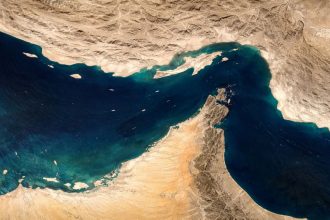
In any serious analysis of the Strait of Hormuz, the first trap must be avoided: reducing it to a mere route through which oil passes. Hormuz is not simply an energy corridor. It is, in reality, one of the central pieces of the global system of power — a space where geography, energy, maritime trade, military credibility, and market psychology converge.
The fact that roughly one-fifth of global trade in oil and liquefied natural gas passes through this passage explains only part of its importance. The deeper reality is this: Hormuz is one of the very few places in the world where a localized military crisis can produce almost immediate global effects on inflation, transport, monetary policy, and the cohesion of Western alliances.
What is unfolding now confirms precisely that. The de facto blockage of the strait has not merely triggered a nervous market reaction; it has caused a real disruption of energy and logistical flows. Energy prices have risen, Gulf-producing states have been compelled to temporarily recalibrate their volumes, and markets have begun to internalize not only the theoretical risk of disruption, but the prospect of a prolonged supply crisis. At the same time, warnings from the international maritime community indicate that a mere military presence does not automatically guarantee safe navigation, confirming that the problem has moved beyond the stage at which it could be treated as a simple episode of volatility.
Hormuz Is Not Just About Oil. It Is About the Control of Uncertainty
The true power of the Strait of Hormuz lies not only in the volume that passes through it, but in the fact that it concentrates, within a narrow geographical space, a disproportionate amount of strategic uncertainty. Markets can absorb supply losses, up to a point. The immediate response of major consumers — the release of 400 million barrels from global strategic reserves — illustrates precisely this logic.
Measured against global consumption of 105 million barrels per day, that quantity theoretically covers fewer than four days. Measured against the normal flow through Hormuz — approximately 20 million barrels per day — it is equivalent to roughly 20 days of ordinary transit. Sufficient to calm panic in the short term. Insufficient to resolve the structural problem.
What markets find much harder to absorb is uncertainty regarding the duration of the blockage, the capacity of military actors to restore safe navigation, and the willingness of shipowners, insurers, and traders to operate in a corridor perceived as an active theatre of risk.
That is precisely why the Hormuz crisis does not function merely as a supply shock, but also as a multiplier of systemic risk. A more expensive barrel is only the first effect; far more important are transport costs, insurance premiums, the rerouting of commercial flows, and the erosion of confidence in the predictability of maritime order.
In an interdependent global economy, control over — or disruption of — such a chokepoint no longer generates only energy advantages, but also macroeconomic and diplomatic advantages. Whoever can keep the corridor open influences global inflation. Whoever can disrupt it influences the pace of monetary policy, industrial costs, and the degree of strategic autonomy available to other powers.
In this sense, Hormuz is not a secondary piece on the world’s chessboard, but a true queen: mobile, disproportionately powerful, and capable of changing the entire game through the mere threat of movement.
The Crisis Exposes an Uncomfortable Reality: Naval Superiority No Longer Means Automatic Control
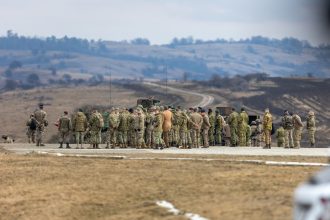
The instinctive reaction of major maritime powers in the face of such a crisis is to send ships. Washington followed precisely that logic, asking its allies to contribute to reopening Hormuz and suggesting that the future of certain security relationships may depend on their willingness to participate. Yet the techno-military reality of the moment is far less reassuring than the political reflex.
In the age of drones, naval mines, missiles, hybrid attacks, and intimidation directed at critical infrastructure, traditional naval power can reduce risk, but it cannot by itself restore commercial normality. A frigate may escort an oil tanker. It cannot compel the insurance market to ignore risk, nor can it automatically persuade a private operator that the route has returned to normal.
The distinction between military security and economic functionality thus becomes central to any serious analysis of Hormuz.
This is one of the most important strategic changes of the past decade. For a long time, the global maritime order functioned on the assumption that Western naval dominance was sufficient to protect the essential arteries of trade. The current crisis suggests, however, that military dominance no longer automatically produces commercial confidence. It may buy time, limit risk, and deter certain forms of escalation, but it cannot by itself restore the economic functionality of the corridor.
Hormuz Has Also Become a Political Test for Alliances
Donald Trump’s appeal to allies has moved the crisis into an even more sensitive register: that of Western cohesion. If until now Hormuz had been treated primarily as an energy and maritime security issue, his statements have transformed it into a political test of who is willing to share the costs of maintaining global order.
Responses from Europe and Asia have been cautious, nuanced, and, in many cases, marked by reservations. This does not mean that Western allies regard Hormuz as irrelevant. On the contrary. It shows that there is consensus on the importance of the corridor, but not on the political legitimacy of the method proposed to protect it.
For Washington, freedom of navigation appears to fall into the category of global strategic goods that allies ought to secure together. For many European and Asian capitals, however, there remains a crucial distinction between common interest and participation in an escalation over which they had no direct decision-making control.
From this perspective, the Hormuz crisis exposes one of the most sensitive fissures in the Western world: the capacity to recognize the same threat does not automatically entail the willingness to manage it together.
Europe Is Caught in a Profound Strategic Paradox
For Europe, the current crisis is more serious than it first appears. The continent has every interest in keeping Hormuz open, because destabilization in energy and transport prices strikes directly at inflation, competitiveness, and social stability. And yet Europe appears to have the least appetite for direct military involvement.
This is not merely an episode of diplomatic caution, but the symptom of a deeper problem: Europe understands the economic cost of maritime insecurity, but has not yet built the strategic will necessary to act in proportion to that cost.
Here, the difference between economic power and geopolitical power becomes unmistakably clear. Europe can measure with precision what it stands to lose if Hormuz remains blocked: more expensive energy, more expensive transport, renewed inflationary pressure, and even less fiscal space. But it has far fewer political and psychological instruments with which to transform that vulnerability into coherent strategic action.
For that reason, in the current crisis, Europe risks playing the role of the actor that pays disproportionately for a maritime order it can no longer decisively shape.
Asia May Understand the Raw Stakes of the Chokepoint More Directly
If Europe sees Hormuz primarily through the lens of inflation and energy, many Asian states see it through the lens of structural dependence. For economies that live by the stability of trade and energy flows, any disruption of the strait is more than a price issue; it is a question of strategic continuity.
Here lies one of the great asymmetries of the moment. Actors possessing reserves, internal political space, and the capacity to absorb temporarily higher costs have time. Actors dependent on continuous flow, predictable prices, and immediate economic legitimacy have less time.
Put simply, the Hormuz crisis rewards strategic patience and penalizes dependence on normality.
That is why its geopolitical effect may prove deeper than its energy effect: it redistributes advantage among powers not only according to fleets and bases, but also according to reserves, political cohesion, and tolerance for instability.
The Gulf States: Between Regional Responsibility and the Imperative of Stability
A superficial interpretation might suggest that the Gulf states would view such a crisis exclusively through the prism of opportunities generated by higher energy prices. A serious strategic analysis points in a different direction. For the Gulf states, the fundamental stake is not short-term volatility, but the preservation of the region’s credibility as an essential pillar of global energy stability.
In the short term, price fluctuations may generate certain conjunctural advantages. In strategic terms, however, any prolonged disruption in Hormuz affects precisely the element that has consolidated these states’ international role: their reputation as relevant, predictable, and indispensable suppliers to the world economy.
A strong energy infrastructure loses part of its value if markets begin to perceive exports from the region as exposed to permanent uncertainty.
From this perspective, the Gulf states occupy a complex position. They have a legitimate interest in protecting their infrastructure, preventing escalation, and preserving the stability of export routes, without turning the region into a space of open and prolonged confrontation.
This helps explain why their strategic messages and reflexes tend to combine firmness in the defense of national interests with a preference for predictability, regional stability, and the protection of the relationship between energy and prosperity.
For these states, victory cannot be defined solely in military terms. It is equally bound to the restoration of confidence, the preservation of commercial functionality, and the protection of the region’s status as a global energy pivot.
Why This Crisis May Redraw Strategic Order More Than Energy Order
The most important effect of the current crisis may not be the price of oil, but the change in perception regarding the true cost of global order. For decades, the world treated freedom of navigation through major chokepoints as an almost natural strategic given. The Hormuz crisis shows that it is neither natural nor free. It depends on military will, political legitimacy, allied coordination, and the capacity to manage hybrid threats in a space saturated with risk.
At the moment when all of these elements begin to fracture simultaneously, the world discovers that what appeared to be economic infrastructure is, in fact, power infrastructure.
From this point of view, Hormuz is indeed the queen on the board. Not because it is the only important piece, but because its movement forces every other piece to reposition: Washington tests its alliances, Europe confronts its strategic limits, Asia recalculates its dependencies, China leverages its patience, and the Gulf states seek to protect regional security and market stability simultaneously.
When a single strait produces such realignments, we are no longer dealing with a regional crisis, but with a global examination of how power is distributed.
Hormuz Does Not Put Only Oil at Risk. It Puts the Credibility of Global Order at Risk
A sober analysis of the Strait of Hormuz leads to an uncomfortable conclusion for nearly all those involved: the world is facing not only an energy crisis, but a crisis in the strategic governance of interdependence. The real issue is not merely whether oil and LNG can once again move through the corridor, but who can restore enough confidence for markets, shipowners, insurers, and states to believe that order has, at least temporarily, been repaired.
That is why the true stake in Hormuz is not merely the reopening of a route, but the answer to a larger question: in 2026, does there still exist a power — or a coalition — capable not only of commanding the seas, but of credibly guaranteeing the economic order that depends upon them?
Until that question receives a convincing answer, the Hormuz crisis will remain more than an episode of regional war. It will remain a signal that the center of gravity of world power is shifting from the control of territory to the control of systemic vulnerability.