Writer and President of the Romanian Writers’ Union, Varujan Vosganian, affirmed to Atlas News the strong cultural ties between Romania and Egypt, citing the upcoming anthology of Romanian and Egyptian poets as a testament to this relationship.
As a former finance minister and current president of the Union of Writers, he emphasizes literature’s power in fostering cultural understanding and national identity.
He added that the Union of Writers in Romania, established in 1908, is a prominent organization with 2,500 members, including writers, poets, novelists, and critics, spread across 20 branches nationwide. The union publishes nine literary magazines in Romanian, financially supported by the state. He discussed the organization’s activities, cultural exchange initiatives, and literature’s role in shaping national identity.
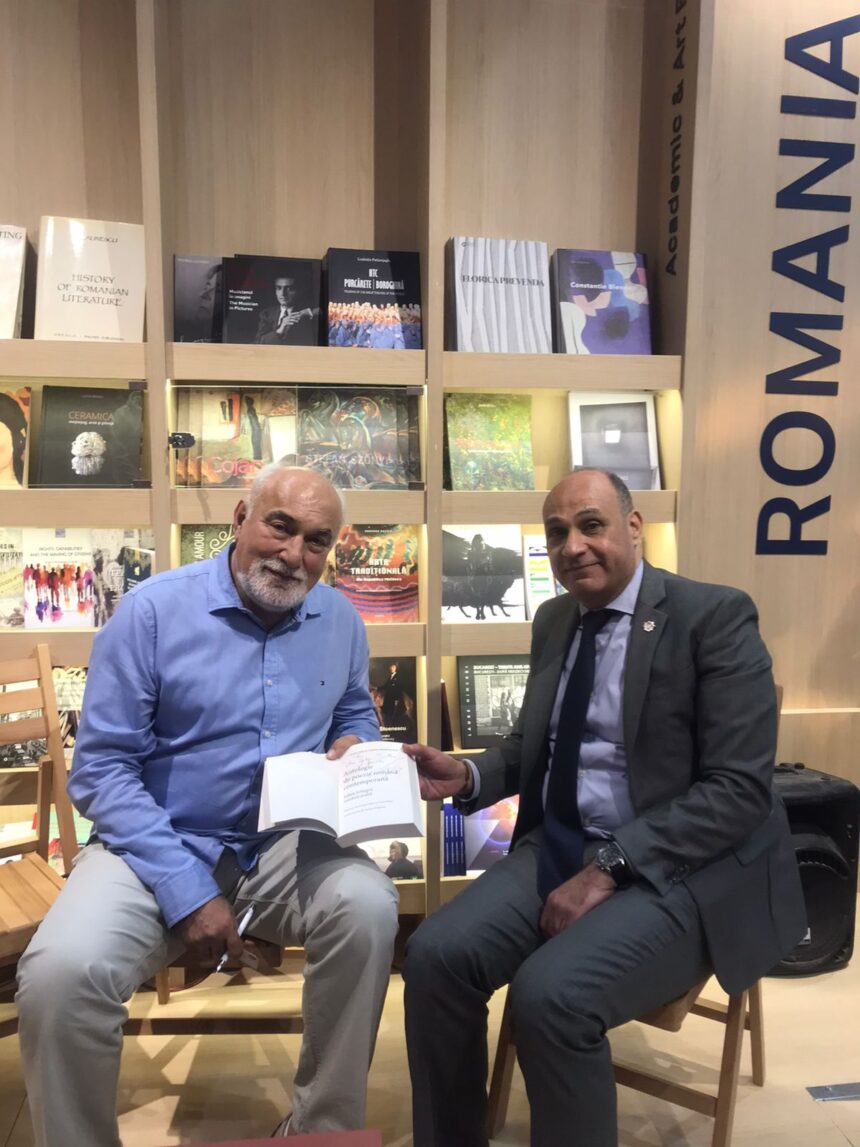
Atlas News interviewed Vosganian on the sidelines of the event “Anthologies or Distinct Titles: How Does Poetry Pierce Through a New Market?”, hosted by the Romanian Pavilion, with the participation of Alaa Abdel Hady, President of the Egyptian Writers’ Association. The event, moderated by the ambassador of Romania to Egypt, Olivia Toderean, was followed by the launch and book signing of a landmark bilingual poetry volume made possible by the joint efforts of the Romanian Writers’ Union, the Center for Arabic Studies of the University of Bucharest, and the publisher Cartea Romaneasca.

This extraordinary project was celebrated at CIBF: 16 contemporary poets from the two countries were translated in a double anthology, with each volume keeping the original and the translation side by side. Egyptian and Romanian poets were presented, and the ambassador of Romania read poems in the Romanian language, enjoying the diversity of languages and poetic musicality.
Atlas News: Could you please introduce yourself and your work for Egyptian readers?
Varujan Vosganian: I represent the Union of Writers in Romania, an organization founded in 1908 with roughly 2,500 members—including poets, novelists, and critics—across 20 branches. We publish nine state-supported literary magazines.
Personally, I am an Armenian-born Romanian poet and novelist. My most recognized work, The Book of Whispers, has been translated into 20 languages. Although my mother tongue is Armenian, I write primarily in Romanian. I have a long-standing connection with the region, having lectured in Beirut and Cairo in 2015.
(Atlas News): What motivates your participation in the Cairo International Book Fair, and what are your expectations?
(VV): Egypt plays a prominent role in the Arabic world, and its literary language is universally understood across the region. The Cairo International Book Fair is the most significant literary event in the Arabic world, and it is an honor for Romania to be the guest of honor this year.
We are currently celebrating 120 years of diplomatic relations with Egypt. As part of this, we collaborated with Dr. Alaa Abdel Hadi and the Union of Egyptian Writers to launch an anthology featuring 16 Romanian poets alongside Egyptian poets. We intend to make this a tradition, with future plans for anthologies focusing on novels, short stories, and criticism.
(Atlas News): How can literature foster cultural exchange between Romania and Egypt?
(VV): Our cooperation spans decades—from engineering projects like the Aswan Dam to modern economic partnerships. However, cultural diplomacy is just as vital. By bringing Romanian poets and novelists to Cairo and inviting Egyptian writers to our international festivals in Romania, we ensure that our relationship is as strong intellectually as it is economically.
(Atlas News): Which aspects of Egyptian heritage excite you most, and do they influence your writing?
(VV): It has been said that we all “come from Egypt.” For us, Egyptian culture is one of our most brilliant roots; its legends, alphabets, and art belong to the collective treasure of humankind.
In my own work, there is certainly an influence. For instance, I recently read a poem called The Bird, which describes the creature like an ideogram or a letter from the Egyptian hieroglyphic alphabet.
(Atlas News): How does literature contribute to shaping national identity?
(VV): Culture is the ultimate expression of identity. While political unions are possible, they must remain a union of distinct nations. Unity is a gift that sparks creativity. In times of occupation, the poet becomes the most important figure because they represent the soul of the nation. Culture is like the North Star—it shows the path to rescue the soul.
(Atlas News): How does Romanian participation strengthen the dialogue between the Arab world and Europe?
(VV): Romania has always maintained close relations with the Middle East. Within the European Union, we view ourselves as an open door. For Egypt and the Middle East, that door to Europe is always open in Romania—you don’t even need to knock.
(Atlas News): What is your final message to Egyptian authors, readers, and intellectuals?
(VV): When you hold a book, nationality disappears. I feel a deep compassion for books that are never opened; a book waits with great patience to be touched. Empires and armies dissipate, but the book—from papyrus to e-books—survives. Readers are a global family, a brotherhood where there should be no weapons and no hatred. I have a deep compassion for the “suffering” of an unread book. A book is a patient entity; it waits for years to be touched and opened. While empires crumble and armies vanish, the book survives—from the papyrus of Egypt to the digital screens of today.
Read also