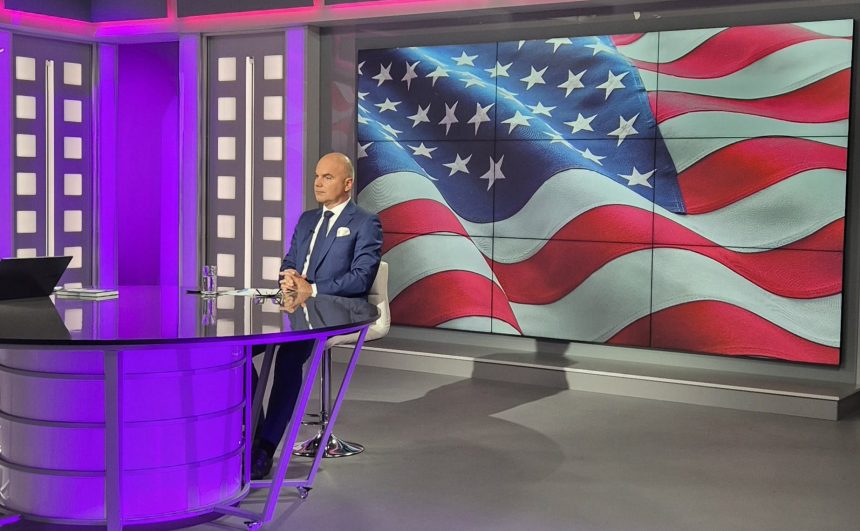
European Parliament Member Rareș Bogdan publicly responded to the decision of the United States Supreme Court that blocked the commercial tariffs imposed by former U.S. President Donald J. Trump under the International Emergency Economic Powers Act (IEEPA). Bogdan argued that the verdict weakens America’s ability to defend itself amid global economic competition.
He stated that the Supreme Court interpreted the law rigidly and ignored present-day strategic realities. “They sentenced Donald J. Trump with the liver, not with the brain,” Bogdan said, implying that the ruling was driven more by political considerations than a substantive evaluation of national interest.
Commercial Deficit: Accounting Issue or Strategic Vulnerability?
The Supreme Court held that the statute cited by Trump allows the president to regulate imports in a national emergency but does not explicitly authorize the imposition of tariffs. The Court reasoned that the authority to levy taxes belongs to Congress, and a commercial deficit does not qualify as a “national emergency” under the strict definition of IEEPA.
Bogdan challenged this interpretation, arguing that a multi-hundred-billion-dollar trade deficit — which has recently reached record levels — is not a mere accounting anomaly but constitutes a systemic vulnerability.
According to his argument, the effects of the deficit include factory closures, loss of industrial jobs, and the erosion of a significant portion of the middle class. “When you buy massively from others, you import their labor and close your own factories,” he said, highlighting the negative multiplier effect on local economic ecosystems.
Bogdan also emphasized that a crisis can unfold in “slow motion,” and the fact that an imbalance has persisted for decades does not make it less dangerous.
China and Critical Dependencies
A central point of Bogdan’s critique focused on U.S. trade relations with China. He warned that dependence on imports in strategic sectors — including steel, microchips, aluminum, and pharmaceuticals — creates vulnerabilities in the event of conflict or diplomatic tensions.
He additionally noted how the trade deficit is financed: dollars accumulated by trading partners are reinvested in U.S. Treasury securities, turning certain states into significant creditors of the U.S. government. According to Bogdan, this dynamic raises concerns about economic sovereignty and security.
Letter of the Law vs. Founding Spirit
Supporting his position, Bogdan referenced the political philosopher John Locke, whose ideas significantly influenced America’s Founding Fathers, including Thomas Jefferson.
Locke’s concept of “prerogative” refers to the executive’s right to act for the public good, even beyond the strict letter of the law in exceptional circumstances. In this light, Bogdan argued that the Court’s interpretation disregards the constitutional spirit and reduces the president to a strictly administrative role.
He contested the notion that the term “to regulate” in IEEPA does not include tariff authority. In his view, regulation is a broader concept that can encompass taxation, even if not explicitly stated.
Separation of Powers or Strategic Paralysis?
The Supreme Court held that adopting a broad definition of “national emergency” could allow a president to usurp the constitutional role of Congress. While Bogdan acknowledged that the risk of executive overreach is a legitimate concern, he argued that eliminating executive tools in the face of a global economic war can lead to strategic paralysis.
“If aggression does not come in the form of a missile but through dumping, currency manipulation, or intellectual property theft, that does not mean it is not a threat,” the MEP said.
In closing, Bogdan said the balance between the rule of law and executive responsiveness must be calibrated according to contemporary realities, not solely on interpretations formulated in a different historical context. His message ended with a call for transatlantic solidarity and strengthening the partnership between the European Union and the United States, which he considers pillars of global equilibrium.
The debate over the limits of presidential prerogatives in economic security remains open, and the Supreme Court’s decision adds a new chapter to a controversy that transcends the legal sphere and enters the strategic domain.