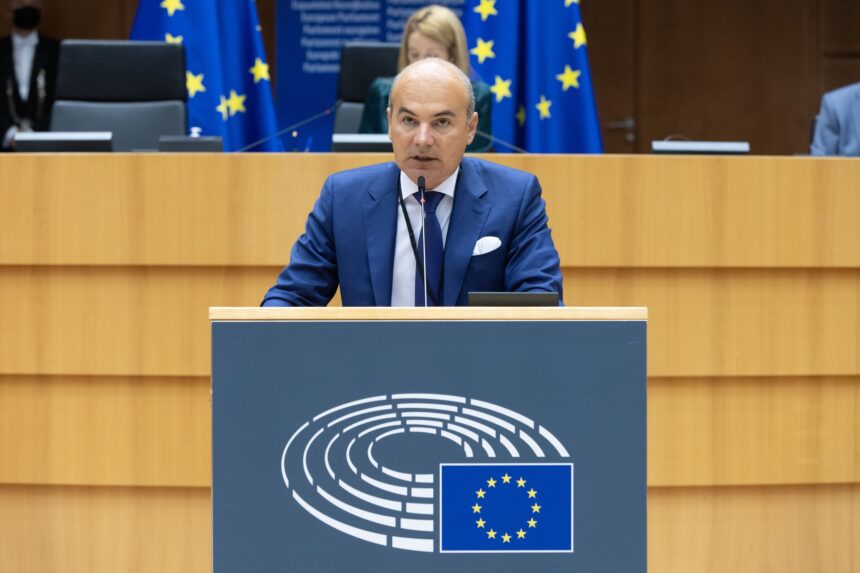
Rareș Bogdan has publicly endorsed the tightening of immigration policy at the level of the European Union, in a strongly worded Facebook post published after the vote in the European Parliament on the regulation concerning persons unlawfully present on EU territory and return procedures.
The Romanian MEP argues that the measures adopted move in the direction desired by European citizens and rejects the criticism voiced by the European left.
“The truth about the vote on migration, not shameless lies that are destroying Europe! Yes, I voted for the Regulation on undesirable persons in the EU. I would do it again!”
His message comes amid an increasingly tense European debate on border control, asylum procedures, the return of migrants unlawfully present on Union territory, and the balance between the protection of fundamental rights and the internal security of the Member States. In the political reading advanced by the MEP, Thursday’s vote in the European Parliament represents a direct response to the concerns of a significant part of European society.

Rareș Bogdan maintains that the measures adopted are in line with what EU citizens want, referring to citizens “increasingly exposed to the severing of their Christian roots and the abandonment of the traditional values on which their home was built. For centuries!”
How Rareș Bogdan Explains the Stakes of the Vote in the European Parliament
The MEP says that the political group to which he belongs supported the new regulation without hesitation and presents this choice as one rooted in principle rather than electoral calculation:
“The European People’s Party has assumed without hesitation the protection of the EU’s interest, and the EPP Romania Delegation would vote exactly as it did on Thursday any time, because the stakes are not electoral, but existential!” Rareș Bogdan wrote.
In the same message, he criticizes the position of his political opponents in the European Parliament and argues that the vote exposed a clear difference in vision between the EPP and the parties of the left and centre-left. According to the Romanian MEP, “S&D voted almost as a bloc against it, alongside the radical left (The Left), the Greens and Macron’s Renew.”
The post also includes a direct reference to the political position of French President Emmanuel Macron, whom Rareș Bogdan portrays as caught in a logic of domestic political competition:
“Of course, his stake is to remain the progressive alternative to the right, so as not to lose his centrist identity. Perhaps, deep down, he agrees with the new Regulation, but fears that validating these measures would offer an ideological boost to Jordan Bardella just before the elections.”
At the heart of his argument, Rareș Bogdan says he wanted to explain “briefly” what the “compass of this vote” is and why he considers the protection of European interests in matters of migration and asylum to be essential.
He explicitly lists the categories of persons targeted by the regulation:
“persons who never entered the EU legally (that is, they did not pass through border crossing points or do not hold visas), persons whose asylum application has been definitively rejected (meaning that their stay becomes illegal), those considered dangerous to public order, and those who entered with a tourist or work visa, but whose visa has expired.”
Another central idea in his message is the direct linkage between the asylum procedure and the return mechanism. Rareș Bogdan argues that the new European framework reduces delays and removes the separate stages that have so far allowed for procrastination:
“The Regulation on asylum procedures works in tandem with the return Regulation. When an asylum application is rejected at the border, the return decision is issued automatically. And there is no further pause or separate procedure.”
The MEP also states that the new regulation aims to standardize the enforcement of return decisions at European level. He says that “a return decision taken by one Member State will be recognized and enforced immediately by the rest of the EU countries.” In his interpretation, this change would eliminate situations in which a person declared undesirable in one Member State could move to another and restart procedures in order to avoid expulsion.
Costs, Security, and the Difference Between Economic Migration and Illegal Stay
Rareș Bogdan also raises the issue of the efficiency of the current system. He states that “Until now, the return rate was 20%, precisely because the law allowed delays.” At the same time, he says that the new rules also concern persons who have just crossed the Union’s external border but who, under certain legal conditions, could still be treated as not having formally entered EU territory.
In this context, the Romanian MEP refers to the possibility of transferring such persons to external return centres located outside the European Union:
“Although they are physically on the territory, legally they will be considered as not having entered yet. And that makes it possible to send them to a return hub outside the EU. What exactly is the problem? I do not understand!” Rareș Bogdan states.
He adds that this change “facilitates the swifter expulsion of those considered dangerous to public order.”
Another major line of the message is his criticism of the European left, which he says denounces the erosion of fundamental rights and the transformation of the Union into a fortress, while overlooking the real costs and the pressure that illegal stay can place on public systems and the labour market.
On the economic front, Rareș Bogdan argues that maintaining persons whose asylum applications have been rejected, but who are not deported because of bureaucratic obstacles, entails substantial costs:
“The accommodation, food and medical assistance of persons whose asylum applications have been rejected, but who cannot be returned because of bureaucratic reasons, cost a great deal.”
He argues that, “By accelerating returns and using external hubs, the financial burden is removed. It is far cheaper to fund an external centre for a few months than to support thousands of undesirable persons in the national system for many years.”
The MEP also draws a sharp distinction between economic migration and illegal stay, arguing that this distinction is essential for an honest debate:
“Let us make a distinction between economic migration and illegal stay! Migrants with illegal stay fuel the underground economy. The result is tax evasion, but also pressure on the wages of legal workers.”
In addition, he links the issue of returns with the investments already made by the European Union in securing its external borders. “We are investing enormously in securing the EU’s borders. But if we do not have a functional return system, we are throwing money out the window,” Rareș Bogdan states.
In the final part of his post, the Romanian MEP returns to the strategic and political dimension of the decision, insisting that the EPP supports a migration policy that is “fair” yet firm, explicitly oriented toward defending the interests of European citizens:
“The EPP has committed itself to building a migration policy that is fair, but also very firm in protecting the interests of Europeans.”
He also invokes figures regarding the gap between return orders and their actual enforcement: “Each year, around 500,000 people were ordered to leave the EU, but 400,000 did not do so. Ridiculous. Unacceptable.”
The message concludes with a renewed criticism of the “political games” which, in his view, end up placing interests other than those of the European Union above the Union’s own interests.
Rareș Bogdan is conveying this position in the wake of the European Parliament vote, at a time when migration remains one of the most sensitive and polarizing issues on the political agenda of the European Union.
Read also