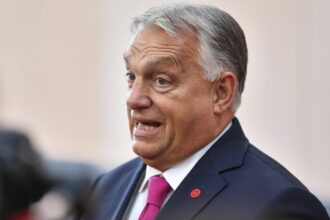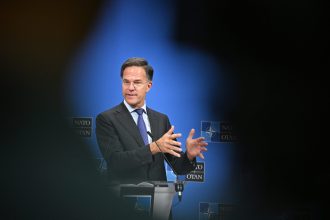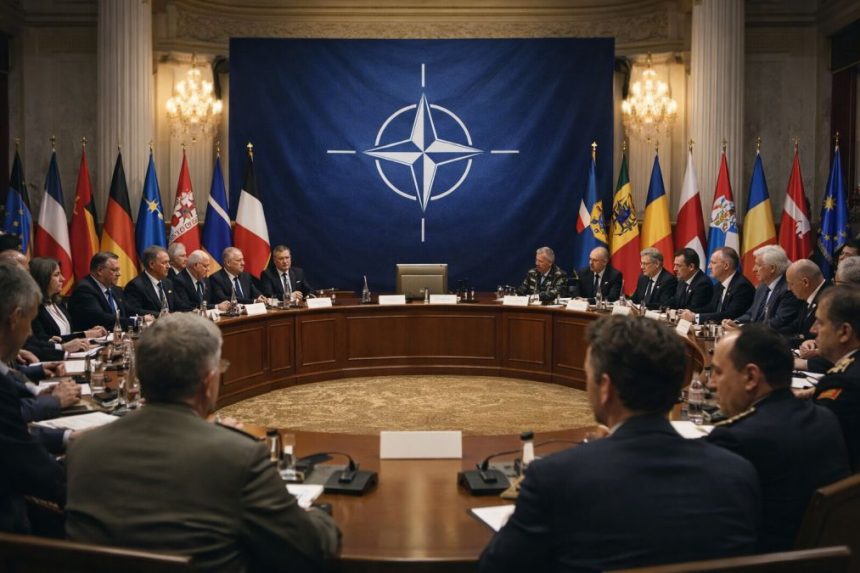
Poland Opens NATO’s Forbidden File at a moment when Europe is beginning to understand that the issue is no longer merely Donald Trump’s explosive rhetoric, but the erosion of a strategic certainty that the continent treated for decades as nearly immutable. The threat of a possible United States withdrawal from NATO is generating more than political unease; it is compelling European states to enter a new phase, one in which they are increasingly forced to ask what the continent’s security architecture would look like if the American guarantee became conditional, limited, or unpredictable.
From a legal standpoint, such a step would face significant obstacles in the United States. From a strategic standpoint, however, the effects of an American administration openly hostile to NATO could begin to materialize well before any formal withdrawal. A military alliance does not begin to fracture only when a member state signs its exit from a treaty, but also when the other members begin to suspect that the alliance’s central promise can no longer be taken as absolute.
This is where the true significance of the moment lies. For years, many European capitals viewed Trump’s criticism of NATO as a form of blunt political bargaining designed to pressure allies into increasing defence spending. This time, however, tensions within the Alliance—intensified by the refusal of several European governments to join US operations related to Iran and the Strait of Hormuz—have pushed the dispute into far more dangerous territory. For the first time in a long while, the debate is no longer confined to transatlantic irritation; it is now moving into the realm of strategic continuity planning in the event of a sharp reduction in the American role.
Poland Is the First to State Openly What the Rest of Europe Is Calculating in Silence
What makes Poland pivotal in this equation is not only its geographic position, but the clarity with which it is articulating the problem. Warsaw is, at this stage, the first allied capital to say publicly that Trump’s threats must be treated as a real possibility and that alternative scenarios must be taken seriously. This is the moment when a subject that, until recently, was regarded as almost unspeakable in Western strategic language formally enters political debate.

The weight of such a position also stems from the fact that Poland is not speaking from the comfort of a power located far from Russia’s strategic frontier. It is speaking as a frontline state—one that has invested heavily in defence, that sees the war in Ukraine as a structural turning point, and that understands that any weakening of the American commitment would be felt first in Eastern Europe. For Warsaw, this is not a matter of ideological speculation, but of security calculation.
Still, analytical discipline must be maintained. There is, at least for now, no public evidence of a complete and formal Polish document laying out a fully developed contingency plan for a NATO without the United States. What does exist, however, is perhaps more important than that: the explicit acceptance that such a scenario must be thought through. In major geopolitical shifts, the first decisive step is not always the adoption of a written strategy, but the moment when the subject ceases to be taboo. Poland appears to have crossed precisely that threshold.
Europe Is Not Responding Uniformly, and That Difference Reveals the Alliance’s True Condition
Europe’s response to this crisis is far from uniform. France has been among the clearest in doctrinal terms, insisting that NATO must remain an alliance for the security of the Euro-Atlantic area rather than an instrument that automatically follows Washington into every theatre of operations. At the same time, Paris is pressing more forcefully than before for greater European responsibility in the field of defence. This is not a discourse about breaking away from NATO, but about limiting exclusive strategic dependence on the United States.
The United Kingdom is taking a different approach. London is not calling the Alliance into question, yet it is reinforcing its strategic relationship with Europe in a way that betrays the same underlying anxiety. It does not frame the issue in the French language of strategic autonomy, but it is nonetheless seeking to build a stronger continental safety net. This is a form of strategic hedging—more discreet, but no less significant.
Germany, for the moment, remains in the register of institutional continuity. Berlin is avoiding public dramatization and prefers to reiterate that NATO must remain the central pillar of European security. This caution reflects the German tradition of stabilizing Western discourse in moments of strain. At the same time, it also illustrates a difference in perception between Western Europe and the eastern flank. Where Poland already sees the need for alternatives, Berlin is still trying to preserve the existing order.
In northeastern Europe, the Baltic states are arguably operating in the most realistic register of all. For them, the issue is no longer confined to military doctrine; it is also one of societal resilience. Evacuation plans, protection of critical infrastructure, cyber defence, and responses to hybrid threats show that these states are no longer thinking about security exclusively in terms of collective defence guarantees, but also in terms of functional survival in the event of a major strategic shock.
Romania Is Not Yet Speaking of a Plan B, but It Is Quietly Broadening Its Options
Romania occupies a different and more delicate position. Bucharest remains deeply anchored in its strategic partnership with the United States and has neither the interest nor the political instinct to turn this debate into a frontal public confrontation. Unlike Poland, Romania has not publicly formulated the idea of a Plan B in the event that the United States were to leave NATO. That does not mean, however, that it is not beginning to adapt.
In reality, Romania appears to be following a logic of strategic prudence. On the one hand, it is preserving its unequivocally pro-American orientation and its role as a key ally in the Black Sea region. On the other hand, it is discreetly expanding its margin of safety through participation in European defence projects, through the strengthening of industrial capabilities, and through growing attention to internal resilience.
This nuance is essential. Romania is unlikely to build a Plan B against America. It is, however, likely to develop—gradually—a Plan B against uncertainty. The distinction is fundamental. For Bucharest, the objective is not to replace its strategic relationship with Washington, but to reduce the risk of being left without options at a time when US policy could become more transactional, more selective, and less predictable.
In this context, Romania’s role in the Black Sea becomes even more significant. If, in the coming years, Europe attempts to build a greater capacity for self-defence within NATO or around it, Romania will not be a peripheral actor. Its geographic position, strategic infrastructure, proximity to the war in Ukraine, and the importance of the Black Sea to the security of the eastern flank make Bucharest one of the critical nodes of any future European security realignment.
A Crisis of Alliance, or the Beginning of a New Strategic Era?
The central issue in this development is not whether NATO will disappear tomorrow, nor whether the United States will soon sign a formal act of withdrawal. The real issue is that Europe has begun to enter a new era in which American certainty can no longer be treated as an absolute given. This changes everything: military planning, industrial architecture, defence doctrines, relations among European states, and even the continent’s strategic culture.
Poland is the first country to have said openly what many others still prefer to formulate cautiously: the future of NATO can no longer be built exclusively on the assumption that the American umbrella will remain unchanged, regardless of who occupies the White House. France is trying to redefine Europe’s role. The United Kingdom is strengthening its continental strategic anchorage. The Baltic states are already thinking in terms of worst-case scenarios. Romania is not yet verbalizing the same rupture, but it is quietly broadening its options.
The real transformation, therefore, is mental before it is legal. Europe is not yet in a post-American era. But it has visibly entered a post-certainty American era. And when an alliance begins to be conceived in terms of that uncertainty, what we are witnessing is no longer merely a passing political crisis, but the beginning of a historic realignment. Poland has opened the file. The rest of Europe, Romania included, must now decide not whether to read it, but how quickly it will begin drafting its own response.
Sources: Reuters, PAP, NATO.
Read also