In major international crises, public attention instinctively focuses on the same centers of power — Washington, Tel Aviv, Tehran. It is there that decisions, escalation, or signals of withdrawal are expected. Yet the way out of a deadlock is not always constructed in those capitals.
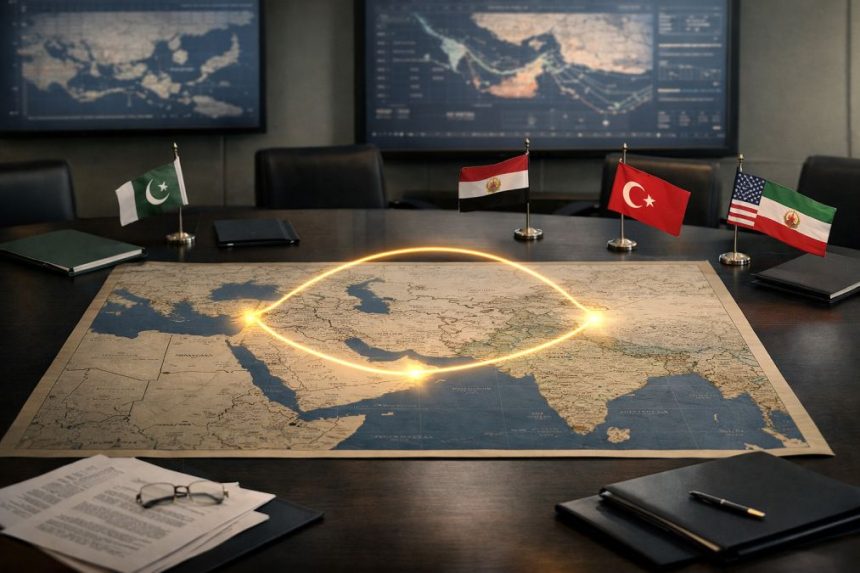
In the current configuration, the mechanism through which escalation is being contained is visibly passing through other capitals as well. Islamabad, Cairo, and Ankara are not formally leading negotiations and have not been granted any official mandate. Yet, in practice, they have become indispensable channels for indirect contacts between parties that, publicly, continue to deny any space for compromise.
This reality confirms a structural shift that Atlas News anticipated in its analysis of the “era of pivot states.” The thesis was that, in a fragmented international order, real influence no longer belongs exclusively to overstretched great powers, but rather to states capable of providing access, connectivity, and mediation between rival blocs.
In other words, power is shifting toward those actors who cannot be bypassed when direct lines break down. The current crisis compresses this logic into reality.
Pakistan: The Channel That Remains Open
Among the actors involved, Pakistan has gained the highest visibility in recent days. The conversations between Donald Trump and General Asim Munir, as well as the contacts between Prime Minister Muhammad Shehbaz Sharif and Iranian President Masoud Pezeshkian, have placed Islamabad at the center of a diplomatic dynamic that goes beyond the level of public statements.
This signal should not be overinterpreted. Pakistan is not, at this stage, the primary mediator of the crisis. Yet it is increasingly clear that it represents one of the few channels through which political contact can be explored without the public cost of direct negotiations.
In a context where Iran officially denies direct talks with the United States, while acknowledging the existence of messages transmitted through third states, this positioning becomes essential. Islamabad is not perceived as a decisive military actor in the theater, but it is sufficiently connected to be heard by both sides.
It cannot impose a solution, but it can prevent the complete breakdown of contact.
This is the logic of the pivot state: it does not dominate the system, but becomes indispensable to its functioning in moments of crisis.
Egypt: The Balance Between Firmness and Dialogue
Egypt’s role cannot be understood without the direct involvement of President Abdel Fattah el-Sisi. Unlike other states that operate exclusively through diplomatic channels, Cairo has elevated its intervention to the presidential level, signaling that the stakes go beyond the routine management of a regional crisis.
Abdel Fattah el-Sisi’s conversations with regional leaders, including Iranian President Masoud Pezeshkian, as well as the sustained activity of Foreign Minister Badr Abdelatty, indicate a coordinated effort to preserve a space for dialogue at a moment when it risks disappearing.
“Egypt is making sincere efforts to end the war, as it knows all too well that wars bring nothing but destruction and harm to the interests of peoples,” declared Abdel Fattah el-Sisi — a message that functions simultaneously as political positioning and diplomatic signaling.
Egypt’s position is, at the same time, carefully calibrated. The condemnation of Iranian attacks against Arab states has been clear, yet it has not led to the closure of channels with Tehran. On the contrary, it has kept them operational.
This combination of firmness and openness defines Egypt’s role. Egypt does not mediate from outside the conflict, but from within a network of interests it understands and influences.
It is not a neutral arbiter, but a balancing actor — and this distinction gives it real relevance.
Turkey: The Actor Operating Across All Registers
Turkey’s role is distinct and derives from its ability to operate simultaneously across multiple geopolitical spaces. Foreign Minister Hakan Fidan has maintained contacts both with Iranian officials and with Western and regional partners, in an effort to keep open the option of a negotiated solution.
“Military actions against Iran generate serious regional and global risks, and a negotiated exit remains necessary,” Hakan Fidan conveyed, encapsulating Ankara’s position.
For Washington, Turkey remains a NATO ally that cannot be ignored. For Tehran, it is a relevant neighbor that has not fully closed its diplomatic channels.
This dual positioning is not an anomaly, but a strategic resource.
Turkey does not formally mediate the conflict, yet it functions as an interface between parties that no longer trust one another. In a fragmented regional order, this capacity for simultaneous access becomes a direct form of influence.
Confirmation of the Atlas News Thesis: The Power of the Indispensable
The current crisis does not demonstrate that great powers have lost control. It shows that they can no longer manage the way out of a deadlock on their own.
The United States, Iran, and Israel remain the central actors of the confrontation. Yet between these centers of power, an intermediate space has opened without which political contact becomes impossible.
It is within this space that Pakistan, Egypt, and Turkey operate.
Here, the pivot state thesis is confirmed in its purest form. Influence does not shift toward the most vocal actors, but toward those capable of maintaining connections when others can no longer communicate directly.
The Limits of Indispensability
None of these states holds, on its own, the key to a ceasefire. Neither Pakistan, nor Egypt, nor Turkey can impose the strategic decisions of Washington, Tehran, or Tel Aviv.
Therefore, the correct formulation is not that these states lead negotiations, but that they sustain the diplomatic infrastructure without which indirect negotiations could not function.
This distinction is essential. It reduces the spectacular, but increases precision.
The “pivot powers” thesis is no longer a hypothesis. The Hormuz crisis has transformed it into an operational reality.
In the international order of 2026, power no longer belongs solely to those who can trigger conflicts, but also to those without whom they cannot be brought to an end.
Pakistan, Egypt, and Turkey are not the most visible actors in this crisis. But they are, increasingly clearly, the actors that cannot be bypassed.
Read also