A ground military intervention by the United States in Iran is not a quantitative extension of the month-long aerial campaign now underway. It is a fundamentally different kind of action. Airstrikes produce destruction at a distance; troops on the ground produce physical control of territory, direct exposure and, inevitably, a political dynamic of an entirely different order. This analysis examines what would concretely change — immediately, over the medium term and over the long term — if such a decision were taken.
What Changes Immediately: Three Fronts Activated at Once
The first consequence of a ground invasion order would be the simultaneous activation of several fronts, including some that have so far remained at the edge of direct engagement.
On the Iranian front, armed resistance is a certainty. Mohammad Bagher Ghalibaf, Speaker of the Iranian Parliament, declared on 29 March 2026 — the thirtieth day of the conflict — that „the enemy sends public messages of negotiation and dialogue, while secretly planning a ground attack. Unaware that our men are waiting for American soldiers to enter on the ground, ready to set them ablaze and punish their regional allies once and for all.” The statement was carried by the official IRNA state news agency. Kharg Island, the primary target under discussion, has been reinforced in recent weeks with additional military personnel, air defence systems and improvised explosive devices, according to US intelligence sources cited by CNN. Even following the air strikes of 13 March — which targeted 90 sites, including naval mine storage facilities and missile bunkers — Iran retains residual drone and missile capabilities launched from its mainland coast, situated a short distance from the island.
On the proxy front, a recent precedent speaks for itself. The Houthi movement in Yemen — which had refrained from any direct engagement for a full month — launched its first ballistic missiles against Israel on 28 March 2026, since the outbreak of the conflict. A second strike followed, targeting the city of Eilat. Military spokesman Brigadier General Yahya Saree announced that attacks would continue „until the aggression on all fronts of the resistance ceases.” The Houthis’ entry into the conflict is significant not so much for its immediate military impact as for the signal it carries: each American escalation tends to lower the threshold for engagement among Iran’s proxy network. Shia militia groups in Iraq are already striking US bases across the region, while Hezbollah continues to engage Israel on a separate ground front in Lebanon.
On the energy front, the effects would be nearly instantaneous. Kharg Island handles approximately 90 percent of Iran’s crude oil exports. Any ground military operation in the area — regardless of outcome — would generate maximum uncertainty on energy markets already under severe strain: the price of Brent crude has oscillated between 102 and 166 dollars per barrel in the course of the conflict. Houthi Deputy Minister of Information Mohammed Mansour stated that „closing the Bab el-Mandeb Strait is among our options.” Two strategic chokepoints blocked simultaneously — Hormuz and Bab el-Mandeb — would represent a scenario without precedent in the modern history of maritime trade.
What Changes Over Months: The Nature of the Conflict Transforms
While the first hours would be dominated by immediate military reaction, the months that follow would structurally alter the nature of the war itself.
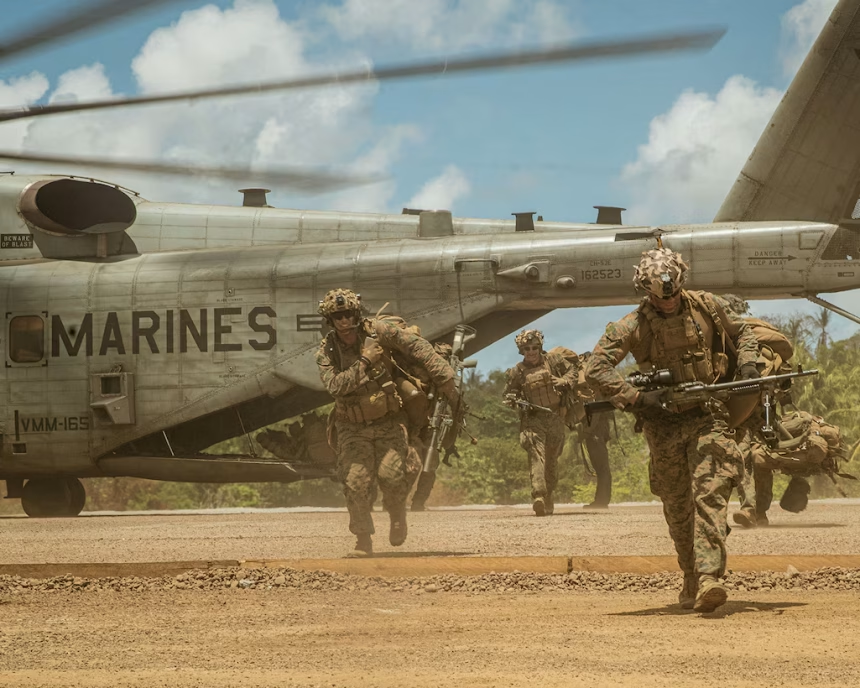
The first effect is the dispersion of American forces across multiple simultaneous theatres. Secretary of State Marco Rubio stated on 27 March 2026, following the G7 Foreign Ministers’ meeting in Paris, that the United States could achieve its established military objectives „without any ground troops” and that operations would last „weeks, not months.” The deployments currently underway partially contradict this public position: 3,500 soldiers and Marines from the 31st Marine Expeditionary Unit arrived in the region aboard USS Tripoli on 27 March, while approximately 3,000 troops from the 82nd Airborne Division remain in transit. The contradiction between Rubio’s public statements and Pentagon planning reflects, in itself, an unresolved internal debate within the Trump administration regarding the operation’s actual objectives.
The second structural effect concerns Iran’s internal situation. The new Supreme Leader, Mojtaba Khamenei — elected on 8 March 2026, ten days after his father’s death in the strikes of 28 February — does not possess the institutional legitimacy built over four decades by Ali Khamenei. The presence of foreign troops on Iranian soil could produce two opposing reactions: a national rallying effect around the regime, through the classic mechanism of external threat, or an acceleration of institutional fragmentation. Both outcomes generate medium-term instability that would prove difficult to manage from the outside.
The third structural effect is economic. The Organisation for Economic Co-operation and Development revised its inflation forecasts for G20 economies in March 2026 to an average of 4 percent and lowered its global growth estimate from 3.3 to 2.9 percent. These figures reflect the cost of the aerial campaign and the Hormuz blockade alone — before any ground component. A prolonged war, combined with Houthi activation in the Bab el-Mandeb, would further disrupt supply chains transiting the Suez Canal and the Red Sea, with direct consequences for trade between Europe and Asia.
What Remains in the Long Term: Questions Without Clear Answers
Long-term consequences depend on a factor that no military power controls directly: what kind of political entity emerges in Iran after the conflict concludes.
The experience of Iraq in 2003 demonstrated that dismantling a centralised authority without a functioning succession structure produces a period of disorder whose human and political costs exceed any initial calculation. Iran is a nation of 90 million people, with real ethnic and regional tensions — Kurds, Arabs, Azeris, Baluchis — and with parallel institutions built over decades around the Islamic Revolutionary Guard Corps. A fragile or fragmented Iran generates risks of nuclear material proliferation, refugee flows and regional instability of indefinite duration.
At the global level, a US ground war in Iran would redistribute Washington’s strategic attention at a moment when Russia continues its war in Ukraine and China monitors developments in the Pacific. European allies — who declined to contribute militarily to the reopening of the Strait of Hormuz, drawing sharp criticism from President Trump — would face even more difficult decisions should ground operations be prolonged. This tension compounds already existing disagreements over defence contributions and policy toward Ukraine.
For Europe and for Romania in particular, the consequences are concrete: energy prices directly affect economic competitiveness, while a United States engaged on a third major front would have diminished capacity for credible deterrence on NATO’s eastern flank.
The question is not whether a ground intervention in Iran can produce immediate military results. It can, at a cost. The question is how long it lasts, what it leaves behind, and who bears the unanticipated consequences — that category of effects which, in every major conflict of recent decades, has exceeded every initial projection.
Analysis based on verified sources: IRNA, The Washington Post, CNN, Al Jazeera, NBC News, CNBC, France 24, The Times of Israel, The Associated Press, OECD — 27–29 March 2026.
Read also
The Houthis Enter the War: The New Front That Could Reshape the Conflict and Hit Global Trade