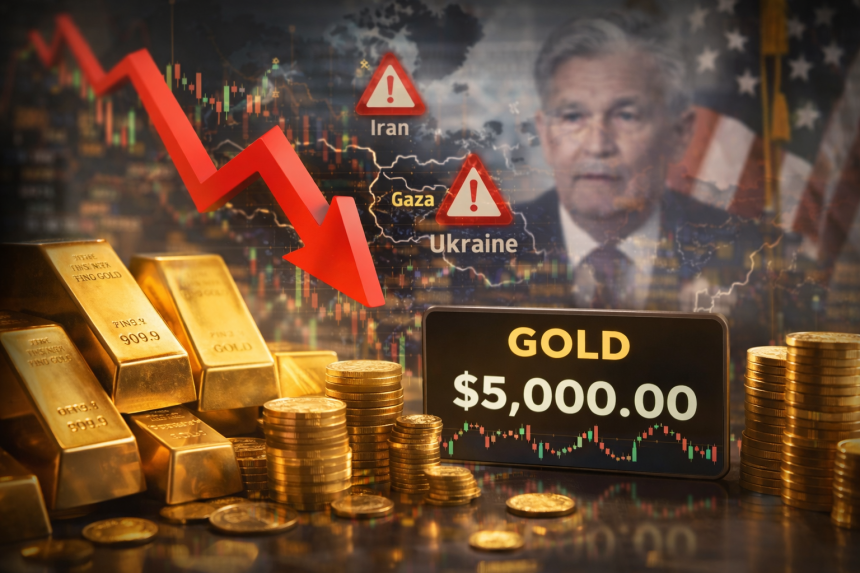
Gold at $5,000 per ounce represents one of the most powerful financial and geopolitical signals of the present moment, confirming that the global system has entered a phase defined by strategic uncertainty, monetary repositioning, and elevated geopolitical risk. Crossing this threshold is not merely a market milestone—it is a historic indicator of collective perceptions regarding global economic and political stability.
Traditionally, gold has functioned as a safe-haven asset during periods of tension. The accelerated rise observed in 2026 comes amid escalating tensions in the Middle East, fragile negotiations surrounding the war in Ukraine, and increasingly visible economic competition among major global powers. Investors respond to these risks by reallocating capital toward assets perceived as secure, and gold remains the definitive reference in such periods.
The breach of the $5,000 per ounce level also reflects a profound shift in how currencies and the global financial system are perceived. Gold is not merely a speculative asset; it is a strategic reserve. Unlike fiat currencies, it does not depend on the monetary policy of any single state and cannot be devalued by administrative decision. This independence makes it an essential asset during periods when investors seek protection from volatility.
A major factor supporting this surge is unprecedented demand from central banks. In recent years, numerous states have accelerated gold purchases as part of broader strategies to diversify their reserves. This trend reflects a structural transformation: gold is returning to the center of the global financial system—not as a relic of the past, but as a stabilizing instrument in an increasingly multipolar world.
At the same time, U.S. monetary policy plays a critical role in gold’s trajectory. Federal Reserve decisions regarding interest rates directly influence the attractiveness of the precious metal. When investors anticipate monetary easing or perceive economic risks, gold becomes more attractive as an alternative to traditional financial assets. Currently, mixed signals regarding inflation and economic growth continue to sustain elevated demand.
Gold’s rise is also closely linked to global geopolitical dynamics. Historically, every major period of instability has been accompanied by significant increases in gold prices. The global financial crisis, geopolitical tensions over the past decade, and structural shifts in the international system have reinforced gold’s role as a strategic asset.
Surpassing the $5,000 per ounce level sends a clear message: financial markets are anticipating a period in which stability can no longer be taken for granted. In such environments, global capital reorients toward fundamental assets, and gold remains the most important among them.
For the United States and its allies, gold’s trajectory reflects both the challenges of the current era and the enduring role of American economic leadership in maintaining global equilibrium. The U.S. dollar remains the central pillar of the international financial system, and decisions made in Washington continue to shape global market direction. At the same time, gold’s rise demonstrates that investors are closely monitoring geopolitical and economic developments, preparing for a more complex and uncertain environment.
Looking ahead, most analysts anticipate a period of elevated volatility in which gold will remain a key indicator of global risk perception. While short-term corrections may occur, the structural trend reflects a deeper transformation: gold is consolidating its position as a strategic asset in a world where global equilibrium is being fundamentally redefined.
Thus, the $5,000 per ounce threshold represents not merely a numerical value, but the symbol of a new phase in the international system—one in which economic and geopolitical stability becomes a strategic resource, and gold remains the clearest barometer of that reality.
Read also
Board of Peace: The Beginning of a New U.S.-Led Architecture of Global Stability