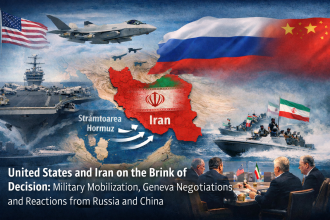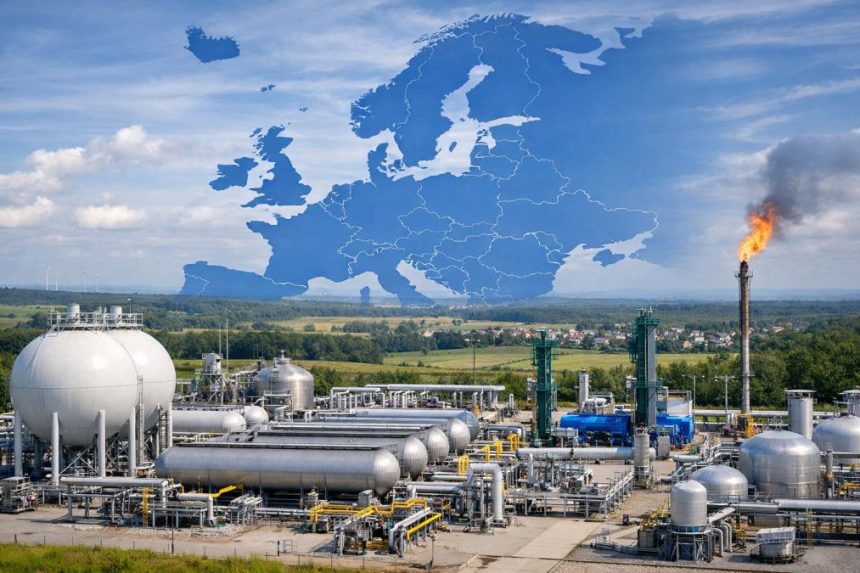
Europe’s natural gas refill season — the critical window between April and November during which member states must rebuild their strategic reserves ahead of the following winter — opens in 2026 under the worst conditions in four years. The Strait of Hormuz crisis, triggered on February 28 by the American-Israeli strikes on Iran, has transformed a well-known structural vulnerability into an emergency with a countdown attached.
The numbers speak for themselves. Europe entered 2026 with natural gas inventories of 46 billion cubic metres at the end of February — down from 60 billion cubic metres in 2025 and 77 billion cubic metres in 2024. A harsh winter eroded reserves at an unprecedented pace: by the end of the heating season, European underground storage levels had fallen to between 22 and 27 percent of capacity, against a five-year average of approximately 41 percent. That is the starting point. And precisely when Europe needed to begin refilling its reservoirs, the Persian Gulf went up in flames.
Qatar Declares Force Majeure. The Calendar Is Working Against Europe
Iranian strikes on March 2 against QatarEnergy’s Ras Laffan facilities forced the immediate shutdown of the world’s largest LNG production complex. Two days later, the company declared force majeure, suspending its contractual delivery obligations. Even if hostilities were to cease today, the full restoration of Qatari output could take weeks or even months.
The calendar is unforgiving. Losing two months of the refill season means forfeiting approximately 25 percent of the injection window before a single additional cargo reaches Europe. In other words, even a ceasefire signed tomorrow can no longer fully salvage the 2026 refill cycle.
Under EU regulations, storage levels must reach at least 90 percent of capacity by December. Given current conditions, Europe will need to inject nearly 60 billion cubic metres of gas during the refill season just to meet that target. Kpler estimates indicate a requirement for LNG deliveries equivalent to 67 billion cubic metres — approximately 700 cargoes, some 180 more than last year’s requirement. The total refill bill could reach 40 billion dollars should the crisis persist.
The Cascade Effect: From Gas Prices to Inflation and Industry
European natural gas benchmark prices have risen by approximately 70 percent compared to pre-conflict levels, breaching the 60 euros per megawatt-hour threshold by mid-March. The increases are cascading through energy-intensive industrial sectors — chemicals, steel, fertiliser production — compressing margins and forcing the suspension of long-term contracts.
A specific risk flagged by agricultural sector analysts concerns nitrogen-based fertiliser producers, for whom natural gas is the primary feedstock. A prolongation of the energy crisis beyond the summer of 2026 could disrupt fertiliser supply ahead of the autumn agricultural season, with potential knock-on effects on food prices in the winter of 2026–2027.
The European Central Bank postponed its planned interest rate cuts on March 19, revising its 2026 inflation forecast upward and cutting GDP growth projections. Economists warn that energy-intensive economies face a real risk of technical recession should the maritime blockade persist through the refill season.
Brussels’ Response: A Lowering of Targets That Conceals a Structural Problem
The European institutional response confirms the scale of the problem. Energy Commissioner Dan Jørgensen instructed member states to reduce their gas storage refill target from 90 to 80 percent of capacity — ten percentage points below the EU’s statutory objectives — with the stated aim of preventing market panic and offering flexibility to operators.
This decision is, in itself, a distress signal dressed up as pragmatism. Lowering the legal refill threshold does not resolve the structural problem — it defers it and transfers the risk to the winter of 2026–2027. Scenarios developed by ICIS indicate that even a relatively brief supply disruption — of around four weeks — keeps TTF prices elevated for several months after the strait reopens. A prolonged disruption would create sustained market tightening and make the refill process significantly more difficult.
Dependence on Washington: From One Crisis to Another
The 2022 energy crisis prompted Europe to migrate strategically away from Russian pipeline gas toward American and Qatari LNG. The 2026 Hormuz crisis has eliminated the Qatari half of that equation at a stroke. What remains? Dependence on Washington.
The EU has committed to purchasing 250 billion dollars’ worth of American LNG and oil annually through 2028, as part of the trade agreement signed between Ursula von der Leyen and the Trump administration. This arrangement is not equivalent to the former dependence on Russian gas — the political and legal context differs fundamentally — but the structural vulnerability is real. Europe finds itself more reliant on American energy supply at the very moment it is seeking to strengthen its strategic autonomy from Washington.
The situation underscores a fundamental point: Europe’s exposure to geopolitical shocks remains rooted in its continued dependence on imported fossil fuels traded on volatile global markets — even as that dependence has migrated from Russia to other suppliers. Rather than slowing the energy transition, the current tensions demonstrate that accelerating the deployment of clean, domestically produced energy is the only path to durably reducing this structural vulnerability.
Three Scenarios for the Winter of 2026–2027
The trajectory of the coming winter depends on a single variable: the duration of the Gulf conflict and the pace at which the Strait of Hormuz is reopened.
Scenario 1 — Rapid de-escalation (ceasefire before May 2026): Prices remain elevated, but Europe can rebuild reserves to between 75 and 80 percent of capacity by October. The winter would be difficult and costly for consumers and industry, but manageable from a supply security standpoint. Current probability: moderate, contingent on the negotiations under way between Washington and Tehran.
Scenario 2 — Prolonged conflict (Hormuz blockade persisting into summer): Europe would enter winter with storage at 50 to 60 percent of capacity, necessitating mandatory rationing for industrial users and emergency support packages for households. Stagflation in the eurozone becomes the likely baseline. This is the scenario in which the ECB no longer has meaningful room to manoeuvre.
Scenario 3 — Extended escalation (strikes on major regional infrastructure): The most severe scenario, with low probability but systemic consequences. Should alternative export infrastructure in the Persian Gulf come under sustained attack, the International Energy Agency would no longer have sufficient instruments at its disposal — the 400 million barrels released from strategic petroleum reserves in March 2026 cover, by IEA estimates, at most 20 to 45 days of disruption at the Hormuz level.
Not a Price Crisis, but a Crisis of Architecture
The 2026 energy crisis is not a replay of 2022. It is structurally different — and in certain respects more dangerous. Europe enters the refill season with lower inventories, less fiscal space after years of post-Ukraine energy subsidies, and with its principal alternative supplier — Qatar — removed from the equation by force majeure.
What is at stake is not next month’s gas bill. It is the stability of the European energy architecture painstakingly built over the past four years and, by extension, the ability of European industry to remain competitive in a geopolitical environment where chokepoint crises are no longer exceptional — but structural.
Sources: Bruegel · Atlantic Council · EUI Florence School of Regulation · Reuters / Kpler · OilPrice.com · Euronews · ICIS / LNG Industry · Modern Diplomacy · S&P Global Market Intelligence
Read also