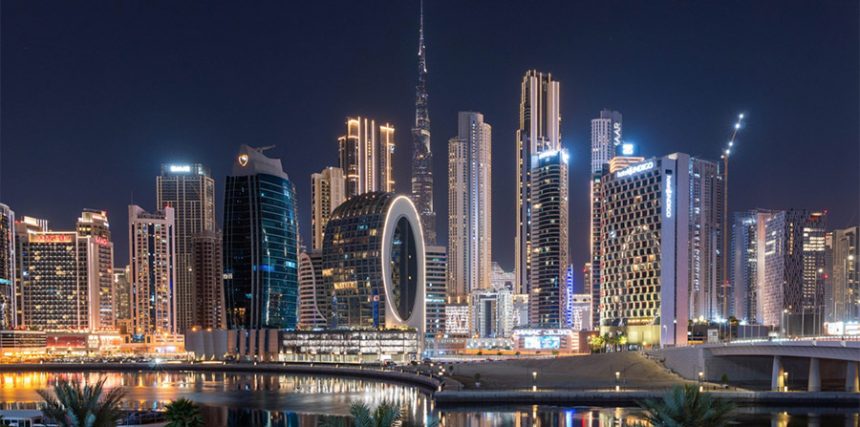
Dubai’s waning glory must be understood in the appropriate analytical context: not as an emotional episode or a momentary reaction to military escalation, but rather as a potential structural rupture in the geopolitical and financial architecture of the Gulf. For the first time since its transformation into a global hub, Dubai can no longer claim the status of a “regional exception.” The direct targeting of critical infrastructure and the association of the city’s symbolic assets with military events fundamentally alter its risk paradigm. A city that built its legitimacy on uninterrupted operational continuity — a permanently open airport, unbroken air traffic, functional ports, and luxury tourism without disruptions — now faces a different reality: demonstrable vulnerability.
The End of Separation Between Economics and Security
Dubai’s model operated through a strategic separation: the economy was portrayed as autonomous from regional tensions. Investors were offered a simple equation: instability exists around here, but not here. Today, that separation has been invalidated by reality. When the world’s busiest airport — a critical infrastructure for the mobility of capital and global elites — is impacted by conflict, that separation becomes untenable. When architectural symbols of the city are referenced in a military context, the perception of the city as an inherently secure enclave fractures. The issue is not simply physical damage but the integration of Dubai into the regional risk map.
Global Capital Does Not Tolerate Systemic Geopolitical Risk
In the previous Atlas News analysis about the migration of financial flows from Europe to the UAE, we showed that Dubai’s attraction was a result of a combination of fiscal competitiveness, robust legal infrastructure, and a perception of superior stability. DIFC and ADGM became destinations for mobile, sophisticated capital seeking efficiency and protection.
This mobility, however, is bidirectional. Global capital is not identifiably anchored to Dubai; it is anchored in systemic stability. When geopolitical risk ceases to be episodic and becomes structural, the response is not incremental adjustment, but a radical reassessment. It is crucial to state without ambiguity: if the Gulf region enters a prolonged and open cycle of conflict, capital will not relocate within the Gulf Cooperation Council — from Dubai to Doha or Riyadh — but will reposition itself outside the region entirely. Natural alternatives include Singapore, select North American jurisdictions, and stable European enclaves. Capital does not seek “the safest city in an unstable region”; it seeks stable regions. Under such circumstances, financial flows do not redistribute internally; they exit the system.

The Real Estate Market: Vulnerability Amplified by Overheating
Dubai’s real estate market — already characterized by rapid price increases and stretched valuations — is exposed to dual pressures: the withdrawal of investment capital and the departure of temporary residents. The majority of Dubai’s population is expatriate, and a significant proportion of recent property acquisitions were made by non-resident investors or strategic relocators. If the perception of safety declines, both investment demand and residential demand will suffer. In overheated markets, changes in sentiment produce disproportionate corrections. A physical collapse is not necessary to trigger a collapse in prices; the disappearance of marginal demand is sufficient. In a city where real estate is a central pillar of economic growth, such a scenario has systemic implications.
The Inverse Network Effect
Dubai benefited from a positive network effect: the more companies and funds that established a presence, the more attractive the ecosystem became. In a systemic risk scenario, this effect can function inversely. Once significant actors begin to diversify or reduce exposure, the perception of collective withdrawal accelerates the process. Global financial centers are ecosystems of confidence. Confidence is not simply a set of regulations; it is a psychological and geopolitical construct. When it is impacted, reconfiguration can be rapid and extensive.
From Regional Hub to Strategic Frontier
What is emerging is not merely a problem for Dubai, but for the entire Gulf region. If the region begins to be perceived as an active frontier of extended conflict, the entire financial and logistical hub architecture built over the past two decades comes into question. Institutional investors, sovereign funds, major private equity structures, and wealth management firms operate on aggregate risk bases. A structural increase in regional risk triggers portfolio recalibration at the macro level, not just isolated adjustments. Dubai’s waning glory is, in this regard, emblematic of a broader transformation: the end of an era in which the Gulf could be perceived simultaneously as geographic proximity to conflict and operational distance from it.
An Existential Test, Not a Volatile Episode
Dubai is not on the brink of disappearance. Its infrastructure remains impressive, and its administrative capacity solid. However, the city is undergoing an existential moment for its economic model. If regional risk stabilizes rapidly, the system may absorb the shock. But if conflict becomes persistent, capital and investment will not migrate within the Gulf; they will depart the region altogether. For a city built on the idea of absolute stability in a volatile region, integration into the risk map represents a paradigm shift. And in the global economy, paradigm shifts are not noisy at the outset. They are cold, technical, and decisive.