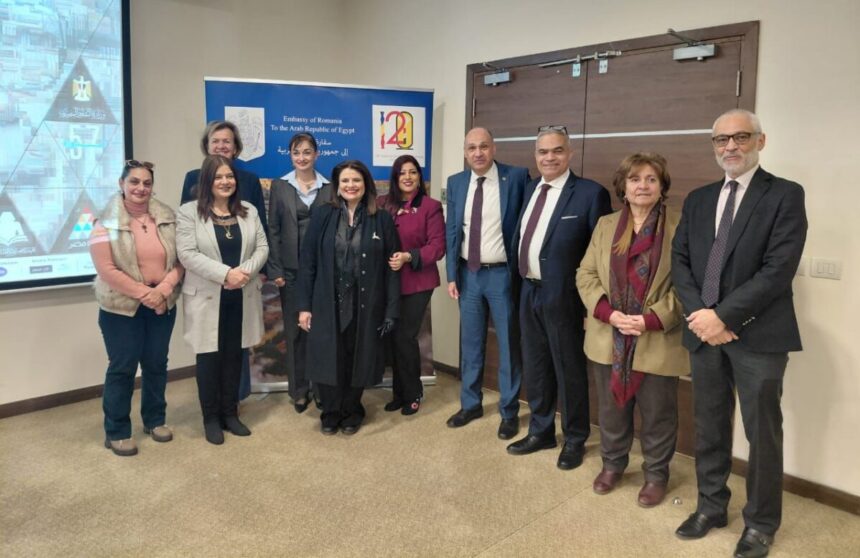
Alongside the 57th Cairo International Book Fair (CIBF), a prestigious group of Egyptian diplomats gathered to celebrate the enduring ties between Cairo and Bucharest at a seminar titled, “When the Past Meets the Future: Taking Renewed Inspiration from Cultural Diplomacy.” Jointly organized by the Romanian Embassy—the fair’s Guest of Honor—and the General Egyptian Book Organization, the event highlighted how culture has served as a vital bridge for rapprochement over the decades.
Moderated by TV host Taghreed Hussein, the panel featured former Egyptian Ambassadors to Romania, including Wafaa Bassim, Salah Abdel Sadek, Lila Bahaa Eldin, Moayed El Dalie, and Soha Gendi. The discussion was attended by Romanian Ambassador Olivia Toderean and EU Head of Delegation Angelina Eichhorst, along with members of the diplomatic corps, the Romanian community in Egypt, and media and journalist figures.
The seminar underscored that the 120-year relationship between the two nations is defined by profound historical, religious, and artistic parallels. From the shared traditions of Orthodox Christianity and the preservation of heritage along the Nile and the Danube to the modern exchange of literature and scholarship.
The speakers illustrated a partnership that has only grown more “youthful and lively” with time. Notable revelations included the significant role of Romanian seafarers in supporting the Suez Canal and the introduction of marionette art to Egypt by Romanian masters. By focusing on everything from the universal appeal of Naguib Mahfouz’s translated works to the common culinary staples shared across the Mediterranean, the panel reaffirmed that cultural diplomacy remains the most effective tool for building a stable, shared vision for the future.

To open the seminar, moderator and Egyptian TV host Taghreed Hussein expressed her gratitude to the distinguished ambassadors for their career-long efforts in serving Egypt. She voiced her hope that the discussion would solidify a shared vision, illustrating how cultural diplomacy serves as a fundamental pillar for building stable and enduring relations between Bucharest and Cairo.
Ambassador Wafaa Bassim, a cornerstone of Egyptian diplomacy, highlighted the transformative impact of the past three decades on Egyptian-Romanian relations, describing the period as a bridge for mutual understanding and rapprochement. She praised the pivotal role diplomats have played in fostering cultural dialogue and elevating Egypt’s image in Bucharest.
“It is an honor to be here with you today in this beautiful, inspiring, and important discussion on the history of cultural and artistic relations between Egypt and Romania,” Bassim stated.
She added, “I worked there from 2001 until 2005. Our final task then was celebrating the 100th anniversary of the Egyptian-Romanian relationship. I am deeply moved to now celebrate the 120th anniversary with you. The longer this relationship lasts, the more youthful and lively it becomes. Over the past 20 years, I witnessed difficult and shocking periods, yet they remain historical milestones that cannot be forgotten.”
Bassim further noted, “Romania was the first place to offer a dream of peace in the Middle East, playing a significant role that many may not realize. The first message calling for peace in the region originated from Romania, specifically from the beautiful area of Sinaia, located near the capital.”
Reflecting on her tenure, she said, “A highlight of my cultural diplomacy experience was discovering Romanian translations of three novels by Nobel laureate Naguib Mahfouz at the embassy. Finding these in Romanian, alongside the usual French or English versions, filled me with immense pride.” She noted that cultural diplomacy is also driven by early tourism waves, with Romanians seeking high-level cultural experiences in Egypt, and mentioned the influence of Romanian pan-flute master Gheorghe Zamfir.
“I am very pleased with the theme ‘From the Danube to the Nile.’ Rivers are divine, enchanting creations that bring people together. Those who live along these great rivers develop special characteristics; the rivers plant unique qualities in them,” Bassim remarked.
She concluded by emphasizing the necessity for youth exchange, noting that young people—whose “pages are still blank”—convey ideas of friendship and solidarity. She also paid tribute to the Romanian woman as the “pillar of the house.”
Ambassador Salah Abdel Sadek highlighted the major cultural and artistic similarities that drive the bond between the two nations. “I felt a beautiful similarity in the relations and between the two peoples that created a real bond,” he said, noting historical ties dating back 1,500 years.
Abdel Sadek praised the Romanian government’s historical support for the Suez Canal, specifically the efforts of Romanian seafarers who worked 16-hour shifts to ensure navigation. He recalled that when other European countries refused to accept Egyptian scholars during the Nasser era, Romania opened its doors. Furthermore, he noted that the art of the marionette first entered Egypt via Romania through the late Egyptian artist Salah Al-Saqqa. “We were the first in Africa and the Middle East to embrace this art; these are vital historical points,” he stated.
An avid photographer, Abdel Sadek added, “The diverse landscape—from the mountains to the Danube, the Black Sea, and the traditional fashion—captivates the eye. There is a saying that a person without a hobby is a person without an identity. Many diplomats share a passion for painting or photography. During my time as ambassador, I captured numerous images reflecting Romanian culture, which I have included in a photography exhibition at this year’s book fair.”
Ambassador Lila Bahaa Eldin focused on the shared historical and cultural trajectories of the two peoples. She noted that beyond economic interests, both nations fought Ottoman occupation and looked toward France in the 19th and 20th centuries, leading to strong contemporary ties within the International Organization of La Francophonie. “There are also religious similarities; in Romania, the church is Orthodox and the language is Latin, creating a bridge between our respective churches and an interest in popular arts,” she explained.
Ambassador Moayed El Dalie described the bilateral relations as “very special” and broad in scope. “We are building on the foundations of the past. During my tenure in Bucharest, we introduced new series of cultural and technological events,” he said. He credited the ongoing coordination with Romanian Ambassador to Egypt Olivia Toderean for successful collaborations like the current book fair.
“We have held several art exhibitions and worked with artists from Egypt and the Arab world to showcase our culture to the Romanian public, who have shown great acceptance,” El Dalie noted. He highlighted an exhibition in Bucharest that photographed faces from various municipalities in both countries to showcase the striking similarities in traditional clothing and customs.
Ambassador Soha Gendi reflected on her time as First Secretary in charge of cultural affairs in Romania, describing those days as some of her “most beautiful moments.” She emphasized that the large Egyptian community in Romania played a significant role in bringing the two countries closer.
Gendi highlighted the deep religious ties, stating, “The principles of the Orthodox Christian faith created a strange and close relationship. In Romania, Egyptian saints are honored; for instance, St. Catherine has a major presence, and Romanians actively contribute to its heritage.” She also noted that Mar Gergis (Saint George), a Roman saint who settled in Alexandria, is one of the most important figures in the Egyptian church.
Regarding education, Gendi noted that cultural files often involved scholarships for Romanians to study at Al-Azhar and other Egyptian institutions. Conversely, she explained that Romania provided a vital alternative for Egyptian students to study at Romanian universities. She concluded by noting artistic parallels, specifically in music. “The use of the flute in traditional songs is a shared tradition. This musical influence is identical, creating a 100% resonance between the two countries—much like our shared culinary traditions, such as stuffed grape leaves, which are common across this region.”
Read also