Pete Hegseth’s remarks in Normandy should not be read in isolation, nor reduced to a passing formula about migration. They belong to a broader line of argument within the Trump administration, in which the messages conveyed by Donald Trump, JD Vance, Marco Rubio and the current U.S. Secretary of Defense converge around the same strategic reproach directed at Europe: the transatlantic alliance can no longer function on historical memory, American protection and European promises deferred indefinitely.
The American tone is sharp, and at times uncomfortable for European capitals. But it does not yet sound like an irreversible decision. It sounds rather like the reproach of an ally that has paid, for decades, the cost of European security and is now trying to wake Europe up to a reality postponed for too long: the continent’s peace is not a natural given, and American protection can no longer be treated as permanent and free infrastructure.
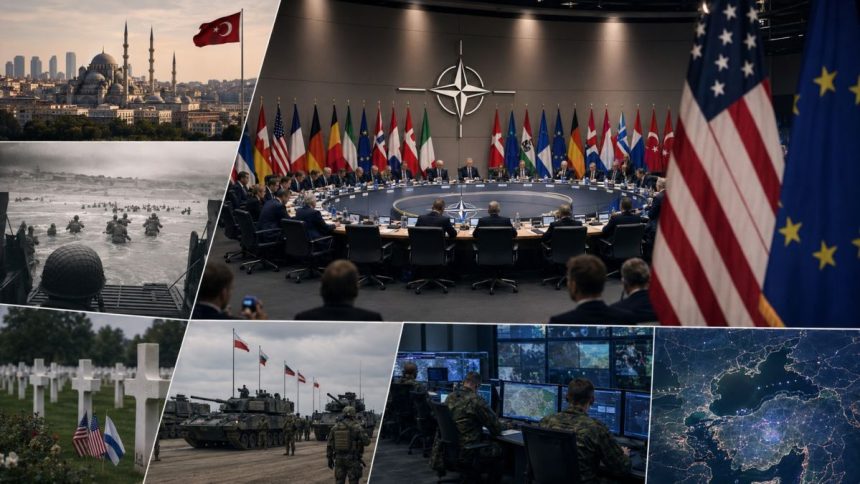
Ahead of the NATO summit in Ankara, where Trump has announced his participation, this line becomes essential. Washington does not appear to be telling Europe that the alliance is over, but that it can no longer operate on the same terms. America no longer wants to be the automatic guarantor of a Europe that hesitates to decide what it defends, how much it pays and when it acts.
Normandy: Two Speeches, the Same Cemetery, Two Doctrines
On June 6, 2026, at the commemoration of the 82nd anniversary of the Normandy landings, Pete Hegseth used one of the most symbolically charged sites of the transatlantic alliance to deliver a message that went far beyond the ceremonial setting. Reuters reported that Hegseth warned that Europe today faces an “invasion” of dangerous ideologies arriving by sea, pointing to beaches in Spain, Italy, Greece and Bulgaria.


Associated Press noted that Hegseth did not explicitly use the word “immigration”, but suggested that contemporary maritime arrivals represented a new form of ideological threat to Europe. The formulation was, evidently, controversial. Beyond the controversy, however, the choice of setting says more than the sentence itself.
Normandy is not just another place. It is one of the founding sites of the postwar Western order, the place where thousands of young Americans died to liberate Europe from Nazi occupation and to help build a world in which European freedom was ultimately guaranteed by American power. To speak there about Europe’s present vulnerabilities is to place the present under the weight of a historical debt.
The European response came on the same day, in the same place, but in a different register. France 24 reported that, at the international ceremony in the afternoon, which Hegseth did not attend, French Prime Minister Sébastien Lecornu paid tribute to the “3,000 men barely past the age of 20” who died on D-Day. In an apparent allusion to American calls for Europe to provide for its own defense, Lecornu said the continent must face “the challenge of our generation” in order to build “our autonomy, our capacity to defend ourselves” against threats that are “approaching, intensifying and multiplying.”
The two men use the same phrase — greater European defense — but fill it with meanings that do not fully coincide. For the Trump administration, a more heavily armed Europe is a Europe that assumes more of the burden while remaining strategically aligned with the United States. For Lecornu and the current he represents, the same rearmament means autonomy, including the freedom to decide independently when and where to act. The fact that the U.S. Secretary of Defense delivered an accusatory speech in the morning and then missed the alliance’s common ritual in the afternoon is not a mere protocol detail, but an image of how the two shores of the Atlantic now relate to ceremonies they once shared without reservation.
The Reproach of the Ally That Paid for the Security of the Common House
From Washington’s perspective, this discussion does not begin from zero. It comes after eight decades in which European security was built under an American guarantee — from Normandy and the nuclear umbrella to military bases, the U.S. presence on the eastern flank and NATO infrastructure sustained by vast American budgets.
This does not erase Europe’s contributions. Europe has supported sanctions, NATO enlargement, Ukraine and the consolidation of the eastern flank. But the basic reality remains: the continent was able to build prosperity, industry and social systems under a security umbrella in which the United States remained the ultimate guarantor.
This is where the American reproach begins. Not that Europe prospered, but that when the same architecture now demands reciprocity, many capitals appear suddenly to rediscover legal limits, political prudence and geographic distance. The reading may be uncomfortable in Brussels, Paris or Berlin, but it explains why the messages from Washington sound more like the reproach of a tired ally than a cold calculation of withdrawal.
From JD Vance to Hegseth: Europe Is No Longer Seen Only as a Weak Ally, but as a Confused One
The Normandy speech is directly connected to the line opened by JD Vance at the Munich Security Conference in 2025. There, Vance argued that the main threat to Europe does not come only from Russia or China, but “from within”: restrictions on free speech, the distance between leaders and voters, migration and the crisis of democratic legitimacy. Reuters reported the reaction of EU foreign policy chief Kaja Kallas, who said the speech sounded as if the United States was trying “to pick a fight” with Europe.
That reaction mattered precisely because it confirmed the nature of the perceptual divide. For many European capitals, JD Vance appeared to be attacking European democracy. For the Trump administration, it was a warning: an ally that cannot defend its internal freedom, borders and political will cannot be a fully strategic partner.
In the same logic, Hegseth moved the message from the political register of Munich to the military-symbolic register of Normandy. Vance had spoken of an internal problem of freedom and representation; Hegseth adds a problem of borders and strategic identity. Trump translates everything into the language of contribution, while Rubio tries to turn the tension into an institutional discussion in Ankara. This is where the coherence of the American line lies: it is not only about money, nor only about migration or Iran. Washington is saying that Europe can no longer demand unlimited guarantees while preserving ambiguity over its own responsibility.
The Doctrine of Conditionality, Stated Openly
If Normandy was the symbolic register, Singapore was the explicit one. One week before the speech in the Normandy cemetery, at the Shangri-La Dialogue on May 31, 2026, Hegseth formulated the American doctrine without diplomatic wrapping. Reuters reported that the U.S. Secretary of Defense praised Asian partners for increasing military spending and aligning with Washington, before delivering a direct message: “When our interests align, we act together with focused determination. When our interests diverge, we adjust pragmatically, without drama or moralizing. I think Western Europe might take note.”
This is the doctrine of conditional reciprocity in condensed form: cooperation when interests converge, cold adjustment when they do not. Also in Singapore, Reuters reported that the Trump administration had asked both Europe and Asian allies to raise defense spending toward 3.5% of GDP, while Washington announced in May the withdrawal of 5,000 troops from Germany. Read against this background, the Normandy speech no longer looks like a ceremonial outburst, but the symbolic application of a doctrine already stated without ambiguity.
Trump and Rubio: Pressure, Not Abandonment
Trump’s participation in the Ankara summit is itself a signal. If the American message were one of pure withdrawal, the summit would become marginal. The fact that Trump is going to Ankara shows that Washington has not closed the NATO file — on the contrary, it is reopening it on harsher terms.
Reuters reported that Marco Rubio confirmed Trump’s participation in the summit in Turkey, scheduled for July 7–8, and said the United States remains committed to the alliance despite the president’s disappointment with allies. Rubio described the meeting as possibly the most important in NATO’s history, “because there are some things here that need to be clarified and fixed.”
The distinction is crucial. The American message is not, at least for now, a notice of divorce, but a demand to renegotiate European strategic behavior. America is not saying that NATO no longer matters, but that the alliance can no longer function as a system in which it guarantees Europe’s security while Europe reserves the right to decide, case by case, when reciprocity is convenient. In this sense, Ankara may become the summit of a more conditional alliance, not necessarily a weaker one. For the Trump administration, declaratory solidarity is no longer enough; it must be expressed in budgets, capabilities and operational readiness.
The Hormuz File: The Test Europe Treats Differently From Washington
One of the crises fueling American frustration is the Strait of Hormuz. For Washington, the security of this maritime route is not a distant regional issue, but one that directly affects energy, trade and Western economic stability. For many European capitals, however, NATO involvement in a Middle Eastern crisis remains legally and politically problematic.
Reuters reported that, after Iran effectively closed the strait — through which one fifth of the world’s oil and liquefied natural gas normally passes — several U.S. allies said they had no immediate plans to send ships to reopen it. Germany, Spain and Italy were among those that ruled out participation in a Gulf mission, at least for the time being, while the United Kingdom and Denmark said they would examine ways to help, while stressing the need for de-escalation. The European argument was consistent: NATO is a defensive alliance, and the war with Iran does not fall within its mandate. The spokesman for German Chancellor Friedrich Merz was categorical — “This is not NATO’s war” — arguing that the United States had not consulted allies before launching the campaign.
Trump’s reaction was harsh and public. In a Truth Social post, the U.S. president called NATO “a paper tiger” without the United States, accusing allies of refusing to help reopen the strait. The tension went even further: Reuters, cited by CNBC, reported that an internal Pentagon email floated options for sanctioning allies, including the possibility of suspending Spain from certain alliance activities, amid the rift caused by the war with Iran.
The paradox Washington is exploiting is that the same European allies that refused the naval blockade nevertheless signaled a willingness to contribute to securing the strait after the end of hostilities, while non-NATO partners — Japan, Australia and South Korea — also showed readiness to become involved. The distinction matters less than the perception: in the moment of crisis, the European core of the alliance invoked prudence. Europe can legitimately argue that NATO is a defensive alliance and that not every American crisis in the Middle East automatically becomes a NATO mission. Just as legitimately, Washington can respond that energy security and freedom of navigation are not exclusively American interests, but Western ones.
What Washington Is Really Reproaching Europe For
The American reproach, if one aggregates the messages of Trump, Vance, Rubio and Hegseth, has several layers.
The first is financial and military. Europe spent too little, for too long, on its own defense. Reuters reported that, according to NATO Secretary General Mark Rutte’s annual report of March 26, 2026, European allies and Canada increased defense spending by 20% in 2025, yet the United States still accounted for approximately 60% of the total. The increase exists, but from the American perspective it comes late, after long years of imbalance.
The second is operational. Europe promises more than it can rapidly deliver. Air defense, ammunition, industrial capacity and military mobility are not built through political declarations, but through years of investment and difficult domestic decisions.
The third is political. Europe invokes strategic autonomy, but does not yet possess the full military and industrial base required to sustain it — which, for Washington, sounds like a contradiction: more freedom of decision, but continued dependence on the American guarantee when the risk becomes existential.
The fourth is civilizational, in the language of the Trump administration. Migration, borders and internal cohesion are treated by Washington as strategic vulnerabilities, not merely as European domestic files. The Washington Times reported that in December the Trump administration’s National Security Strategy had warned that Europe faced the “prospect of civilizational erasure” and could become “unrecognizable” in 20 years. Hegseth in Normandy did not improvise: he read, in symbolic code, from a state document.
This is a structural change. America is no longer asking Europe only to buy more weapons, but to clarify what kind of order it wants to defend.
The European Counterargument Is Not a Detail, but Half the Truth
An honest analysis cannot treat the European position as a closing objection. Europe is not a stowaway of the Western order. It has provided bases, logistical support, massive financial assistance to Ukraine, sanctions against Russia and diplomatic capacity. Recent figures also partly contradict the American position: Rutte’s report shows a real 20% increase in one year and the fact that all allies have met the 2% of GDP target, with some exceeding it substantially.
Moreover, the European reading has its own coherence. For Paris and other capitals, autonomy is not a whim, but the logical conclusion of the American message itself: if Washington reserves the right to “adjust pragmatically” when interests diverge, then Europe must build its own capacity to act without the automatic U.S. guarantee. In other words, the doctrine of conditionality formulated by Hegseth justifies, in mirror image, Lecornu’s plea for autonomy. European capitals may also recall, with equal legitimacy, that the United States has taken major strategic decisions — from Iraq to Afghanistan — without always taking European sensitivities into account, and that reciprocity cannot mean automatic alignment with every American conflict.
The counterargument is strong. It does not, however, resolve the core problem: a Europe that asks for automatic protection while simultaneously claiming selective autonomy when the cost of solidarity rises risks being caught between two stools. In a mature alliance, autonomy requires capacity, and capacity requires investment and assumption of responsibility. Both shores of the Atlantic have, here, a share of truth and a share of inconsistency.
What the NATO Summit in Ankara May Bring
In Ankara, the United States may arrive with an agenda less formal than it appears and deeper than a simple summit document. Beyond diplomatic language, the likely stake is the redefinition of the transatlantic relationship in terms of reciprocity.
The first direction is accelerated European defense — not percentages of GDP, but real capabilities: ammunition, air defense, logistics and defense industry. Reuters reported that Hegseth called on allies to move toward 3.5% of GDP, in line with the Trump administration’s pressure.
The second is NATO’s utility beyond the alliance’s classic European geography: Washington may ask that issues such as Hormuz, energy security and freedom of navigation be viewed as tests of Western security, not merely American problems.
The third concerns the eastern flank. For Romania, Poland and the Baltic states, the message has a dual nature. On the one hand, the logic of reciprocity should favor allies that invest, host American forces and take the Russian threat seriously. On the other hand, if the American presence becomes increasingly transactional, even loyal allies must understand that Washington’s strategic reflex can no longer be taken for granted.
The fourth is political: Europe will be pressed to demonstrate that strategic autonomy is not merely a concept used to say “no” to the United States, but a real capacity for defense and action.
Romania Between the American Guarantee and European Maturation
For Romania, the discussion is not theoretical. Romanian security has been built, after NATO accession, on two realities: membership in the alliance and the strategic American presence. The Mihail Kogălniceanu base, the eastern flank architecture, missile defense and military cooperation with the United States are not symbols, but pillars of national security.
That is precisely why the American message must be read in Bucharest without irritation, but also without naivety. Not as a rejection of Europe, but as a change in the political price of the American guarantee. Washington is asking allies to be not only loyal, but useful.
This may be an opportunity, if properly understood. The eastern flank already has a concrete benchmark: according to Rutte’s report, Poland, Lithuania and Latvia had already exceeded, in 2025, the new 3.5% of GDP target — exactly the criterion Washington is now asking of the entire alliance. Romania may enter this category, but it is not there yet. Its current advantage is strategic positioning, not the level of spending, and the distance between the two is measured in capabilities, not declarations.
Concretely, Bucharest should come to the table in Ankara not with a plea of loyalty, but with an offer: a clear and predictable trajectory toward 3.5%, capabilities in which the American presence becomes operationally indispensable — air defense, logistics on the eastern flank, infrastructure for rapid rotations — and an explicit position on the files where the United States asks for solidarity, including maritime security. The difference between a tolerated ally and an indispensable one is no longer measured in shared memory, but in what Washington cannot do without Bucharest. This is the real currency of influence at a transactional table.
The Reproach Is Not the End of the Alliance
The American message should not be read mechanically as abandonment. The United States does not appear to be closing the door on the alliance, but it does seem determined to reopen it on new terms: contribution, reciprocity, political will and Europe’s ability to defend its own order.
Normandy gave the reproach historical weight. Munich gave it an ideological dimension, Singapore gave it explicit form, and Hormuz gave it an operational one. Ankara may give it an institutional shape.
This reading may be wrong, and it is worth saying how. If the summit ends with an unconditional reaffirmation of Article 5 and the American commitment, then Normandy will have been a rhetorical episode, not a turning point. And if the war with Iran ends before July, the Hormuz file may be defused, draining the tension of the concrete fuel that now sustains it. The thesis of this analysis — pressure and recalibration, not abandonment — remains, until Ankara, a testable hypothesis, not a certainty.
For Europe, the question is no longer whether the American message is comfortable. It is not. The question is whether it is entirely without foundation. It is not that either. From Washington, Europe appears as an ally that has benefited from a peace guaranteed by someone else. From Brussels, Paris or Berlin, America appears as an increasingly hard, increasingly unilateral ally, increasingly willing to turn security into negotiation. Both perspectives contain part of the truth.
But for NATO, the issue is not who is rhetorically right. It is whether the alliance can survive the transition from shared memory to shared responsibility. In Ankara, Trump will not come only to confirm the American presence. He will most likely come to ask Europe what it is prepared to do for an alliance it has considered guaranteed for decades.
This may be the most important transatlantic test of the moment: not whether America still wants NATO, but whether Europe is prepared to become the strategic partner America says it has waited for too long.
Read also
Europe Between Three Powers: The Anatomy of a Strategic Direction Crisis